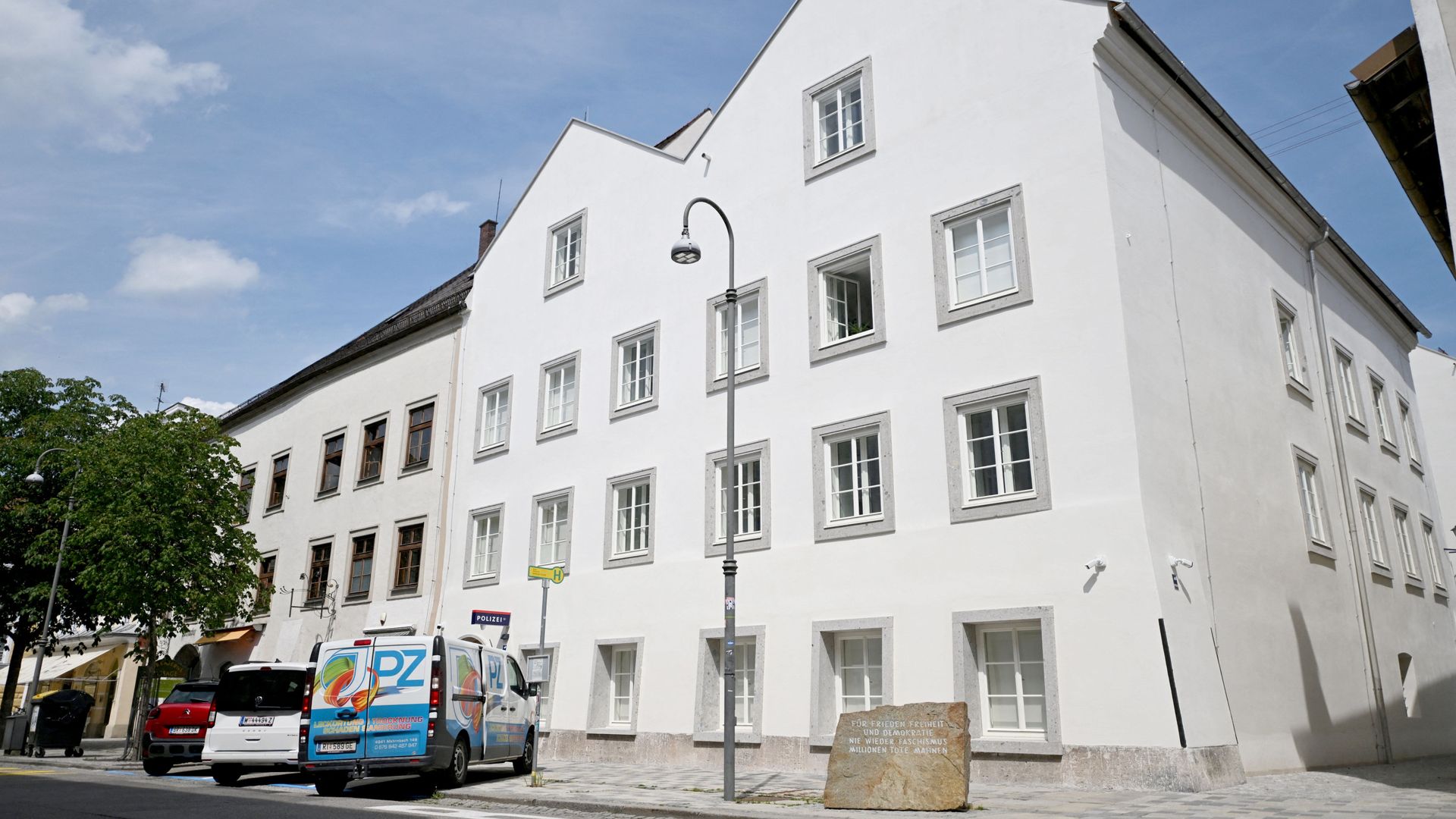
Neutralizing Adolf Hitler's Birthplace
Austria's government has finalized plans to transform the birthplace of Adolf Hitler in Braunau am Inn into a local police station. The decision aims to neutralize the ideological magnetism of the yellow, three-story Renaissance-era house at Salzburger Vorstadt 15, ending decades of legal battles, public outcry, and political hesitation. By housing the district police headquarters and a human rights training center within the structure, state officials hope to strip the site of its symbolic power for neo-Nazi pilgrimage while signaling a firm commitment to democratic law enforcement.
The transformation was not born out of swift moral clarity. It came from decades of bureaucratic gridlock.
For decades, the Austrian Ministry of the Interior leased the building from its long-time private owner, Gerlinde Pommer, paying thousands of euros a month simply to keep it empty and prevent it from becoming a far-right shrine or commercial venture. In 2016, following years of refusal by the owner to allow necessary renovations or sell the property, the Austrian parliament took the extraordinary step of passing a specific expropriation law to seize the building.
The state took ownership, paid compensation, and established an interdisciplinary commission to answer a question that had haunted post-war Austria for generations. What do you do with the physical birthplace of modern history's greatest dictator?
The commission’s mandate was clear: neutralize the site.
The Politics of Historical Amnesia
To understand why a police station became the state's chosen solution, one must look at how Austria has handled its Nazi past. For decades after 1945, the nation wrapped itself in the official doctrine of the "first victim" of National Socialism. This narrative was built on the 1943 Moscow Declaration, which stated that Austria was the first free country to fall victim to Hitlerite aggression.
The reality was far darker. Huge crowds cheered the Anschluss in March 1938 as German troops crossed the border. Austrians were disproportionately represented in the ranks of the SS and the administration of the death camps.
Yet the victim myth allowed post-war Austria to avoid the rigorous process of reckoning—what the Germans call Vergangenheitsbewältigung—that unfolded across the border in West Germany.
The house in Braunau am Inn stood as an inconvenient physical counter-narrative.
Over the years, proposals for the space varied wildly. Some argued for demolition, aiming to erase the building entirely. Architects and historians quickly pointed out that razing the house would create a void that could easily become an even more potent symbol. Demolition risks looking like an attempt to erase history rather than confront it.
Others suggested turning the building into a museum, a dedicated Holocaust memorial, or a peace center.
The government explicitly rejected those ideas. Official reasoning held that an educational memorial would continue to attract the very people Austria wanted to keep away. A memorial site remains a point of interest, a destination on a map, an invitation to visit.
The goal was not to commemorate, but to render the building completely ordinary.
Erasure Versus Recontextualization
Architectural neutralization is a delicate exercise. The winning design by the Vorarlberg-based architecture firm Marte.Marte simplifies the building’s facade, altering the roofline and reshaping its exterior to blend in with the surrounding historic town square.
The intent is clear. Make it look like any other provincial government building in Upper Austria.
Yet this approach has drawn fierce criticism from historians, political scientists, and civil society groups. By deliberately erasing the physical features associated with the site, critics argue that Austria is resorting to a modern form of architectural amnesia.
The debate centers on a fundamental tension in historic preservation:
- The State's Position: Eradicate any aesthetic or spatial elements that neo-Nazis could glorify. Convert the space into a functional apparatus of the constitutional state (police forces) to demonstrate democracy's triumph over fascism.
- The Critics' Position: Neutralization is a euphemism for sanitization. Converting the space into a police station obscures history, relieving the public of the uncomfortable duty to engage with the site's true historical weight.
There is also an uncomfortable irony that critics have been quick to point out. Placing a police force inside Hitler's birthplace raises eyebrows given the history of the Austrian police apparatus during the Third Reich, when local law enforcement was seamlessly integrated into the Nazi terror machine.
While the government plans to incorporate human rights training for police officers into the facility, scholars argue that using the police to "guard" the legacy creates an awkward juxtaposition that risks substituting historical understanding with state authority.
The Financial and Legal Reality of Expropriation
The path to the current redesign was marked by intense litigation and escalating costs. The expropriation of Gerlinde Pommer in 2016 triggered a legal struggle over the financial compensation owed to her.
Initial state valuations pegged the worth of the building at roughly 310,000 euros. Pommer challenged the sum in court, arguing that the historical uniqueness and potential commercial value of the site justified a far higher payout.
A regional court originally awarded her 1.5 million euros, though the Austrian Supreme Court later reduced the final payout to approximately 812,000 euros after factor-adjusting the state's long-term maintenance costs and real estate market conditions in Braunau am Inn.
+-------------------------------------------------------------+
|        CHRONOLOGY OF SALZBURGER VORSTADT 15                 |
+-------------------------------------------------------------+
| 1889        | Adolf Hitler is born in a rented room on the  |
|             | top floor.                                    |
| 1938        | Nazi Party purchases the building, turning it |
|             | into a cultural center.                       |
| 1952        | Property returned to original owners (Pommer  |
|             | family); leased by state shortly after.       |
| 1972-2011   | Leased by Ministry of Interior; used as a     |
|             | workshop for adults with disabilities.        |
| 2011        | Owner refuses necessary renovations; building |
|             | sits vacant.                                  |
| 2016        | Austrian Parliament passes expropriation law. |
| 2019-2020   | Design competition launched; Marte.Marte      |
|             | selected for police conversion.               |
+-------------------------------------------------------------+
Beyond the property payout, the budget for architectural conversion skyrocketed. Original estimates placed construction costs at around 5 million euros. By the time ground was broken, design modifications, security upgrades, inflation, and structural reinforcements pushed the projected cost past 20 million euros.
Taxpayers are funding a massive infrastructural project designed to make a building deliberately unremarkable.
The Local Burden of Braunau am Inn
For the citizens of Braunau am Inn, a border town of around 17,000 people, the house at Salzburger Vorstadt 15 has long been a burden.
Town residents have lived under the shadow of the birthplace for generations. Every anniversary of Hitler’s birth brings unwanted national and international media coverage, along with far-right provocateurs attempting to leave flowers, light candles, or pose for photographs across the street.
Local authorities have made attempts to counter the dark tourism. In 1989, shortly before the 100th anniversary of Hitler's birth, the mayor placed a memorial stone directly in front of the house on public property.
The granite block, sourced directly from the quarry of the former Mauthausen concentration camp, bears an inscription: Für Frieden, Freiheit und Demokratie. Nie wieder Faschismus. Millionen Tote mahnen. ("For peace, freedom, and democracy. Never again fascism. Millions of dead warn us.")
The stone was meant to prevent the space directly outside the door from becoming a site of overt adoration.
When the state announced its neutralization plan, debate raged over whether the memorial stone should remain. Initial reports suggested the stone would be removed or relocated to a museum in Vienna to complete the total aesthetic erasure of the site.
Public backlash was immediate. Local advocacy groups, backed by prominent Austrian writers and historians, argued that removing the Mauthausen stone was an unacceptable retreat from public memory.
The government eventually backtracked, confirming the stone would remain in place on municipal land outside the police station's front entrance.
The dynamic creates a strange spatial contradiction: a neutralized, modernized, functional police building sitting directly behind a crude, dark granite block warning against the horrors of fascism.
The Global Phenomenon of Dictator Heritage
The struggle over Braunau am Inn is not unique. Governments worldwide face agonizing questions regarding how to manage the physical infrastructure left behind by authoritarian regimes and dictators.
Strategies vary wildly:
- Total Destruction: In 1945, Allied forces blew up the Führerbunker complex in Berlin, eventually paving over the site and converting it into an unremarkable residential parking lot with only a small, non-descript informational sign installed decades later.
- Preservation for Education: Italy took a different path with Benito Mussolini’s birthplace in Predappio. The town remains a legal site of pilgrimage for neo-fascists, with local shops openly selling fascist memorabilia, creating a persistent ethical nightmare for regional authorities.
- Subversion: In Spain, the body of dictator Francisco Franco was exhumed from the monumental Valle de los Caídos (Valley of the Fallen) in 2019 and moved to a discreet family grave, converting the massive state-built monument into a site dedicated strictly to the memory of all Spaniards who died in the Civil War.
Austria's strategy with Salzburger Vorstadt 15 represents a pure administrative attempt at ideological erasure through functional utility.
By turning the site into an arm of state enforcement, the Austrian government is attempting to impose modern democratic authority over a site of historic fascism.
The Limits of Architectural Neutralization
A building is fundamentally wood, stone, and mortar. It possesses no inherent morality.
The meaning attached to the house in Braunau am Inn was created entirely by human ideology, and changing its physical facade does not automatically erase that meaning from the cultural consciousness.
The decision to install a police station aims to solve an immediate, practical problem: preventing neo-Nazis from gathering at a specific address.
In that narrow goal, it will likely succeed. Extreme right-wing sympathizers are unlikely to pose for photos or leave flowers in front of a fully operational police station equipped with 24-hour surveillance and active-duty officers coming and going.
However, the broader issue remains unresolved. By choosing functional utility over rigorous, uncomfortable confrontation, Austria has prioritized public order over deep historical education.
Redesigning the facade may remove the building from far-right tourist itineraries, but it cannot alter history. The house where Adolf Hitler was born will remain standing, regardless of how many coats of modern paint are applied to its walls, and regardless of who holds the keys to the front door.