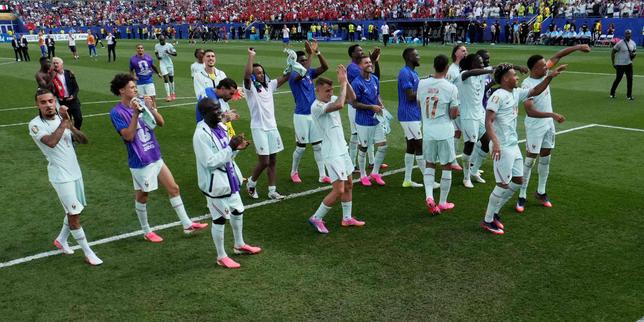
The air inside the Al Bayt Stadium did not circulate; it vibrated. It was a thick, humid soup of noise, red flares, and the collective intake of breath from nearly seventy thousand souls. On one side stood France, the clinical aristocrats of modern football, wearing the quiet confidence of reigning kings. On the other stood Morocco, an entire continent and an entire culture riding on their shoulders, carrying a burning fire that had already consumed Spain and Portugal.
But stripped of the flags, the geopolitical echoes, and the roaring seas of red and blue in the stands, the grandest spectacle of the World Cup semi-final distilled into two young men standing in the tunnel.
Kylian Mbappé and Achraf Hakimi.
They were not just opponents. They were brothers in arms at Paris Saint-Germain, two hyper-accelerated athletes who shared a flank, a locker room, and a deep mutual understanding of what it means to carry the weight of a nation before turning twenty-five. Months before this whistle blew, they had joked on camera about having to destroy each other if their paths crossed in Qatar. Now, the joke was a brutal reality. As they waited to step onto the grass, they shared a brief embrace. It was a momentary truce. Then, the masks came down.
The Early Fracture of a Dream
Morocco had built their historic run on an impenetrable wall. They had not conceded a single goal to an opposition player in the entire tournament. Their defense was not just a tactical setup; it was a religious commitment.
Then came the fifth minute.
Antoine Griezmann, moving with the elusive grace of a ghost in midfield, found space where none should exist. The ball moved to Mbappé. His shot was blocked, ricocheting through a panicked thicket of red shirts. It fell to Theo Hernandez. The French left-back adjusted his body in mid-air, striking a high-bouncing ball with a downward, acrobatic volley that beaten the outstretched arms of Yassine Bounou.
One-zero.
Silence descended on the Moroccan fans, but only for a heartbeat. Then, the whistling began again, louder, angrier, more defiant.
The early goal forced Walid Regragui’s men into a terrifying existential pivot. They could no longer sit back and absorb pressure. They had to hunt. What followed was a masterclass in human resilience. Despite losing their captain Romain Saïss to injury early in the first half, the Atlas Lions did not fracture. They grew larger.
Consider Jawad El Yamiq. Late in the first half, the Moroccan defender launched himself into the air for a bicycle kick born of pure audacity. The ball flew past the desperate dive of Hugo Lloris, only to crash violently against the base of the post. A centimeter to the left, and the stadium would have erupted into an earth-shattering roar. It was a moment that proved Morocco did not belong in the semi-finals by mere luck; they belonged because they possessed the skill to match the world's absolute best.
The Duel of the Flank
As the second half unfolded, the tactical battle melted away into a series of deeply personal wars. The fiercest of these was waged on the French left wing.
Mbappé versus Hakimi.
It was a matchup of terrifying speed. When Mbappé pushed the ball into open space, it usually meant the end for a defender. But Hakimi knew his brother’s stride. He knew the exact moment the Frenchman would drop his shoulder. On multiple occasions, Hakimi tracked back with a furious, desperate sprint, sliding in to dispossess his friend with surgical precision. When Hakimi won the ball, he did not celebrate. He looked up, initiated the counter-attack, and kept running.
Morocco dominated the second-half possession. They swarmed the French penalty box, weaving intricate passing triangles that left the French defense scrambling. Hakim Ziyech and Azzedine Ounahi moved with a furious urgency, probing, crossing, and demanding everything from the French center-backs. Ibrahima Konaté, starting in place of an ill Dayot Upamecano, played the match of his life, throwing his body in front of every low cross, a human shield protecting the French lead.
You could see the physical toll written on every face. The Moroccan players, many of them carrying heavy injuries masked by painkiller injections and sheer willpower, began to limp. Yet, they kept moving forward, fueled by the collective hope of millions watching from Casablanca to Dakar, from Doha to Paris.
The Dagger of Ice
Football is a cruel sport because it does not reward effort; it rewards moments.
With just over ten minutes left on the clock, Didier Deschamps made a substitution that felt like a roll of the dice, bringing on Randal Kolo Muani. Within forty-four seconds, the tactical choice turned into a stroke of genius, though the architecture of the goal belonged entirely to Mbappé.
Receiving the ball on the edge of the area, surrounded by three Moroccan defenders, Mbappé did not panic. He danced. With a sequence of rapid-fire stepovers and a sudden burst of acceleration, he manipulated the space around him, squeezing a deflected shot across the face of the goal.
Kolo Muani, completely unmarked at the back post, simply had to tap it in with his very first touch of the match.
Two-zero.
The goal was an icy dagger to the heart of the Moroccan dream. It was the moment the mountain became too high to climb. The energy in the stadium shifted from the frantic heat of battle to a profound, melancholic realization. The historic run was over. The crown would be defended.
Beyond the Final Whistle
When the referee blew the final whistle, the French players erupted in joy, celebrating a consecutive World Cup final appearance—a feat not seen since Brazil in 1998.
But the defining image of the night happened away from the cameras of the main broadcasters.
Mbappé did not immediately join his teammates in their wild celebrations. Instead, he walked across the pitch to find Hakimi. The Moroccan fullback was sitting on the grass, spent, exhausted, staring blankly at the turf while the weight of defeat finally broke through his defenses.
Mbappé pulled him up. They embraced tightly, exchanging words that belonged only to them. In a display of profound respect, they swapped shirts. For the rest of the evening, as France celebrated their ticket to the final against Argentina, Mbappé walked around the pitch wearing the red shirt of Morocco, with Hakimi's name proudly displayed across his back.
The history books will record a 2-0 victory for France. They will note that Mbappé guided his team to another final. But those who watched the match unfold inside the Al Bayt Stadium will remember something far deeper: a night when the relentless pursuit of glory collided with an unbreakable human bond, proving that even in the fiercest fires of competition, brotherhood endures.