The sea around Okinawa does not care about jurisdiction. It rolls inshore with the same heavy turquoise rhythm, slapping against the seawalls of Kadena and curling past the coral shelves of Yomitan, indifferent to the uniforms worn by the men who stare out at it. To stand on the seawall at dusk is to feel an acute sense of double life. On one side, the neon bustle of local life, the scent of sizzling pork and soba broth, the quiet click of bicycle spokes on damp pavement. On the other, the razor-wire perimeter of bases that have sliced through this island's geography for eight decades.
Then a siren sounds, or a curfew order drops from a flagpole five thousand miles away, and the fragile truce shatters.
Midnight curfew. It sounds administrative. It sounds like a box being ticked on a clipboard in a command tent somewhere in Hawaii or Virginia. But on the ground, in the narrow alleys of Chatan or outside the fluorescent glow of a family-run convenience store, a curfew is a physical weight. It is an admission. It is the sound of a gate slamming shut because a trust, battered and bruised by generations of friction, has fractured once again.
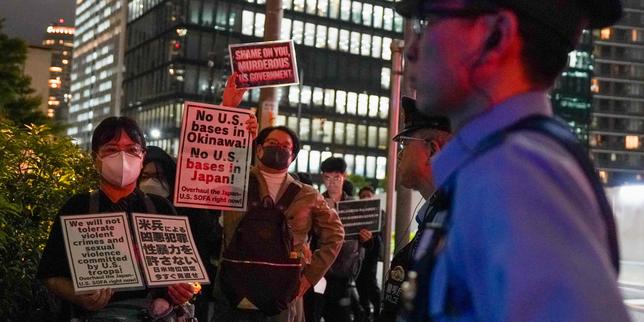
Consider what happens when a community learns that a local woman has been killed, and that the man suspected of wearing the uniform meant to protect them is an American Marine.
The grief does not arrive in neat press releases. It starts as a rumor, a tightening in the chest, a phone call passed between neighbors in hushed tones. Then it hardens into fury. Not the sudden, explosive fury of a riot, but the cold, calcified anger of a population that has lived with an occupying footprint longer than most of them have been alive. Okinawan mothers know this grief intimately. They have buried it under aircraft noise for decades. They have carried it in their bones since the end of the Second World War.
When the news broke regarding the suspected murder, the reaction from the military brass was swift, predictable, and bureaucratic. Restrictions imposed. Liberty curtailed. Bases locked down after a certain hour. A blanket punishment designed to signal control, to appease an outraged host nation, to project discipline outward while internal rot festered within the barracks.
As a resident who has walked these streets and felt the shifting tension in the air, I can tell you that curfews do not solve the underlying pathology. They simply herd the frustration indoors.
To understand why a single crime on an island of over a million people can paralyze a military alliance, you have to look past the headlines and examine the architecture of presence. Okinawa hosts the lion's share of United States military facilities in Japan. For Tokyo, these bases are the bedrock of the security umbrella, the strategic chess pieces holding the line in the East China Sea. For Washington, they are irreplaceable projection points. But for the people of Okinawa, they are an inescapable neighbor who drops trash in your yard, plays music too loud at three in the morning, and occasionally commits an atrocity that reminds you you are living under a conditional sovereignty.
The math of occupation is brutal. Tens of thousands of young service members, many of them barely out of their teens, dropped into a foreign culture thousands of miles from home, stuffed into high-stress environments, and given access to lethal training and heavy machinery. Most navigate this transition with quiet competence. They eat taco rice at local diners, learn a few phrases of the dialect, and leave without a ripple.
Yet the system leaves a wide margin for catastrophe. And when catastrophe strikes, the response from the command structure often feels less like justice and more like damage control.
The curfew announced in the wake of the murder applied to all personnel stationed on the island. Drinking off-base prohibited. Movement restricted. For the average service member who had nothing to do with the crime, it felt unfair, an arbitrary collective punishment. For the Okinawan shopkeeper whose livelihood depends on the weekend foot traffic of young Americans, it meant another economic blow. For the family of the victim, it was an empty gesture, a bureaucratic band-aid on a gushing wound.
The historical echo here is deafening. Decades ago, the rape of a schoolgirl by American servicemen triggered mass protests that nearly unhinged the bilateral security treaty. Every few years, a crime punctures the thin membrane of normalcy, forcing everyone involved to pretend that this time is an aberration rather than an inevitable structural symptom.
The military calls these incidents "isolated events." But when an isolated event happens with a grim, rhythmic regularity across generations, it ceases to be an anomaly. It is a feature of the landscape.
Walking through the entertainment district near Gate Two in Okinawa city, the ghosts are palpable. Neon signs buzz above shuttered storefronts. The tattoo parlors, the bars with faded English menus, the curry shops—they all bear witness to a decades-long symbiosis that is part romance, part hostage situation. You see a young Marine sitting on a curbside, head in hands, scrolling through his phone after the curfew announcement dropped, realizing his weekend is gone because of the actions of someone he has never met. A few blocks away, a group of local high school students walk past in silence, eyes averted, shoulders tense.
There is a profound loneliness in that distance.
The authorities in Tokyo and Washington negotiate force posture, deterrence, and geopolitical leverage in air-conditioned rooms. They speak of regional stability and deterrence frameworks. But deterrence is an abstract noun that offers cold comfort to a family grieving an empty chair at the dinner table.
When the curfew takes effect, the streets empty out. The MPs patrol in pairs, flashlights cutting through the humid Okinawan dark. The sea continues its steady, indifferent work against the seawall, washing over the coral, carrying away the debris of a day that changed everything and nothing all at once.
The restriction orders will eventually be lifted. The patrols will thin out. The politicians will issue their statements about ironclad alliances and mutual respect. But the iron gate remains where it has always been, dividing two worlds that share the same narrow island, forever waiting for the next moment the lock gives way.


