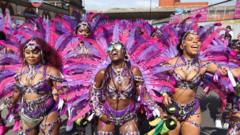
The standard history of Notting Hill Carnival has become a sanitised, corporate-sponsored bedtime story. As the event approaches its 60th milestone, the media rollout is entirely predictable: standard retrospectives tracking the line from Claudia Jones’s 1959 St Pancras Hall indoor event and Rhaune Laslett’s 1966 neighborhood festival straight to the massive street party we see today. The narrative is always wrapped in the comfortable language of multicultural triumph, community cohesion, and artistic expression.
This cozy consensus is wrong. It misses the point entirely.
By flattening the history of Carnival into a linear march toward state-sanctioned celebration, we have stripped the event of its actual power. The lazy assumption is that growth equals success—that attracting two million people to West London and generating millions for the local economy means Carnival is thriving. In reality, the festival is suffocating under the weight of its own institutionalisation. What began as a radical, disruptive act of spatial politics has been packaged, policed, and polished into a sterile tourist attraction.
We don't need another anniversary tribute. We need an autopsy of how a counter-cultural explosion got tamed.
The Myth of the Gentle Evolution
The dominant narrative suggests that Carnival evolved naturally from an integrationist community fair into a Caribbean sound system spectacular. This historical rewrite ignores the intense friction that defined its survival.
Carnival was never meant to be a polite showcase of diversity. It was a reclaiming of public space by a diaspora that was actively denied safety in their own neighborhoods. When the police clashed with Black youth in 1976 under the Westway, it wasn't an unfortunate breakdown in communication. It was the predictable flashpoint of an event that refused to be contained by the state.
Historical Realities vs. Corporate Rewrites:
1960s/70s: Spatial reclamation, political resistance, radical noise.
2020s: Gated VIP zones, hyper-policing, corporate brand activations.
By framing the event's history as a smooth journey toward mainstream acceptance, commentators erase the ideological war fought over these streets. The moment Carnival became "London's premier summer event" rather than an act of defiance, the original spirit was compromised. The state failed to suppress Carnival with batons in the 70s and 80s, so they adopted a far more effective strategy: they funded it, regulated it, and bound it in red tape.
The Economics of Gentrification and Displacement
Walk through Notting Hill today during the final weekend of August. The backdrop isn't a working-class Caribbean enclave; it is one of the most aggressively gentrified pieces of real estate on earth. Multimillion-pound townhouses are boarded up with pristine plywood, their wealthy owners fleeing the noise while simultaneously capitalizing on the "vibrant culture" that inflates their property values.
This creates an unsustainable paradox. The culture that birthed Carnival has been priced out of the very streets the festival occupies. True mas bands and sound system operators face astronomical costs just to participate.
Consider the mechanics of running a traditional sound system today:
- Licensing and Compliance: Weeks of bureaucratic back-and-forth with local councils.
- Infrastructure Costs: Skyrocketing prices for transport, heavy-duty generators, and security.
- Spatial Restrictions: Tight physical footprints dictated by crowd-control metrics rather than acoustic or cultural logic.
I have spoken with sound operators who have spent decades anchoring specific corners in Ladbroke Grove. They are systematically squeezed by local authorities using health and safety regulations as a weapon of attrition. The modern setup favors massive commercial brands that can afford the compliance fees and the sponsorship activation costs. When Red Bull or major global music streaming platforms take over stages, it isn't a victory for grassroots culture. It is an eviction dressed up as a partnership.
The Failure of the Two-Million-Person Metric
Media coverage loves to boast about crowd sizes. "Two million people hit the streets!" is used as shorthand for cultural relevance.
This is a flawed metric. Mass tourism is killing the quality of the festival. When an event becomes a bucket-list item for global travelers and casual partygoers who have zero connection to the history of Caribbean resistance, the event shifts from a participatory ritual to a passive spectacle.
The streets are overcrowded not because the culture is expanding, but because the physical footprint of the event has been frozen for decades by local authorities terrified of letting it breathe. This artificial compression creates dangerous bottlenecks and forces a security-first approach to event management.
Instead of allowing Carnival to occupy wider swathes of the city to accommodate its natural scale, the Royal Borough of Kensington and Chelsea and the Metropolitan Police keep it trapped in a network of narrow residential corridors. The result is an environment where the music is strictly curated, movement is heavily restricted, and the spontaneous joy of the road is replaced by managed crowd flow.
The Sound System Subversion
The real tragedy is the slow death of the sound system's political utility. Historically, the sound system was a mobile broadcasting station for the disenfranchised. It played the music the BBC banned; it delivered the political commentary the newspapers ignored.
Today, the decibel limits imposed by local councils mean that many systems can barely project past the immediate crowd surrounding them. The bass—the physical, visceral frequency that defined the dub and reggae roots of the festival—is systematically turned down to appease the wealthy residents who chose to buy property next to a historic event site.
If you want to know who really controls an event, look at who holds the volume dial. It isn't the community. It is the local authority noise pollution officers armed with digital meters.
Stop Demanding a Corporate Makeover
Every year, center-right think tanks and risk-management consultants publish op-eds demanding that Carnival be moved to Hyde Park or converted into a ticketed event like Glastonbury. They argue this would solve the security issues, streamline the cleanup, and generate predictable corporate revenue.
This proposal is culturally illiterate. Moving Carnival to a park turns it into a festival. Carnival is not a festival. A festival is a closed loop where you buy a ticket to consume culture. Carnival is an intervention into the geography of the city. The moment you put a fence around it and scan a barcode at the gate, it ceases to exist.
The solution to Carnival's stagnation isn't to make it more like a corporate music festival. The solution is to remove the institutional shackles that prevent it from being dangerous, radical, and raw.
We must reject the pressure to make Carnival respectable for the sake of its 60th anniversary. It shouldn't be a palatable advertising campaign for multicultural London. It should remain loud, inconvenient, politically charged, and structurally uncompromising. If it leaves the local authorities comfortable and the corporate sponsors happy, it isn't Notting Hill Carnival anymore—it's just a street party with a history it no longer deserves.