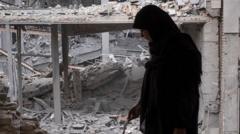
The spring equinox usually hits Tehran like a burst of color. Street vendors normally scream over each other, selling goldfish and bundles of hyacinth, while families scramble to finish their khaneh-tekani—literally "shaking the house" to clean out the old year's dust. But this year, the dust isn't moving. It’s settling on ruins and empty bazaar stalls.
If you’re looking for the usual "renewal and rebirth" narrative for the Persian New Year, you won't find it here. Iranians just entered the year 1405, and the mood isn't festive. It’s heavy. The air is thick with the scent of cordite from recent airstrikes and the crushing weight of an economy that has finally, truly snapped. For the first time since the 1980s, Iranians are observing their most sacred secular holiday in the middle of a hot war, while a domestic crackdown makes the streets feel more like a cage than a carnival.
The death of the Iranian middle class
You can't celebrate when you can't eat. It’s that simple. While official state media tries to paint a picture of resilience, the numbers tell a story of absolute collapse. By February 2026, food inflation in Iran officially crossed the 110% mark. Meat is a memory for most families. Even the basics—bread, eggs, and cooking oil—have seen prices triple in a matter of months.
The Haft-Seen table, the centerpiece of Nowruz, is a perfect barometer for this misery. Each item on the table represents a hope for the new year: Seeb (apple) for health, Sabzeh (sprouts) for rebirth, and Sekkeh (coins) for prosperity. This year, the "coins" are worthless rials, and the "health" is a prayer that the local pharmacy hasn't run out of basic antibiotics due to sanctions and war-time supply chain breaks.
A worker’s average monthly salary now hovers around $120. In a city like Tehran or Karaj, that doesn't even cover ten days of survival. People are selling household furniture just to buy the traditional New Year's dinner of Sabzi Polo Mahi (herbed rice with fish). When a tradition becomes a financial impossibility, it stops being a joy and starts being a source of resentment.
War above and war below
The dual pressure of foreign strikes and internal repression has created a surreal atmosphere. In late February and early March, US and Israeli strikes targeted Iranian infrastructure, including the South Pars gas facilities. For the average person, this doesn't just mean a headline on the news; it means the internet goes dark for weeks, making it impossible to call relatives abroad or run an online business.
The regime’s response to these external threats has been to turn its guns inward. Following the massive protests of January 2026—which some estimates suggest saw the deadliest two-day crackdown in the country’s history—the security apparatus is everywhere.
- The Internet Blackout: Access to global platforms isn't just restricted; it’s effectively severed. This isn't about stopping "foreign influence." It’s about stopping people from seeing the videos of the 20,000+ people reportedly killed or arrested since December.
- The Death Penalty as Policy: The judiciary has openly expanded the use of the death penalty for "online offenses" and "psychological insecurity." Essentially, if you tweet that you're scared or angry, you're a target.
- The Bazaar Strike: In a rare move, the merchants of the Tehran Grand Bazaar—the traditional heart of the Iranian economy—have joined social activists in strikes. They aren't just protesting politics; they're protesting the fact that they can't even price their goods because the currency drops too fast to print labels.
Defiance through ritual
Despite the "anger and fear," there is a reason Iranians haven't just stayed in bed. Nowruz is pre-Islamic. It’s older than the current regime, older than the previous monarchy, and older than the borders of the modern state. For many, celebrating it is an act of pure rebellion.
During Chaharshanbeh Suri—the festival of fire on the last Tuesday of the year—the tradition is to jump over bonfires to "give your yellow (sickness) to the fire and take its red (warmth)." This year, those fires were built in the middle of streets as barricades. The chants weren't just about spring; they were about the end of the "darkness."
When the regime sends text messages warning that "unconventional behavior" during the holidays will lead to flogging or imprisonment, and people go out anyway to dance in the streets, that’s not "marking a holiday." That’s a frontline.
The psychological toll of the 12 day war
The trauma of the June 2025 "12-Day War" with Israel still haunts the collective psyche. It provided the regime with the perfect "state of siege" excuse to consolidate power and crush the "Woman, Life, Freedom" movement that had been simmering since 2022. But that tactic is wearing thin.
The narrative that "the enemy is at the gates" doesn't work when the people feel the gates were left open by their own leaders' mismanagement. There’s a palpable sense that the social contract is completely shredded. The government can no longer provide security, food, or a future. All it has left is the gallows.
What happens next
We’re past the point of "reform." The current unrest is leaderless, which makes it harder for the state to decapitate the movement, but also harder for the movement to negotiate. If you're watching this from the outside, don't look for a single "revolution" moment. Look at the erosion.
- Watch the Bazaar: If the merchants stay closed after the 13-day holiday period (Sizdah Bedar), the regime’s last link to the traditional middle class is gone.
- Monitor the Currency: If the Rial continues its freefall past the current historic lows, the barter economy will become the only way to survive.
- The Succession Question: With senior leaders targeted in recent strikes, the internal power struggle between the IRGC and the traditional clergy is reaching a breaking point.
The arrival of spring is supposed to be a time of hope. But for Iranians in 1405, hope is a dangerous thing. They aren't looking for "new beginnings" anymore; they're looking for an end to the current nightmare.
If you want to support those on the ground, focus on tools that bypass the National Information Network (Iran's "halal" internet) and provide secure, decentralized communication. The fight for the Iranian New Year isn't happening on a Haft-Seen table; it’s happening in the encrypted chats and the darkened alleys of a country that has simply had enough.