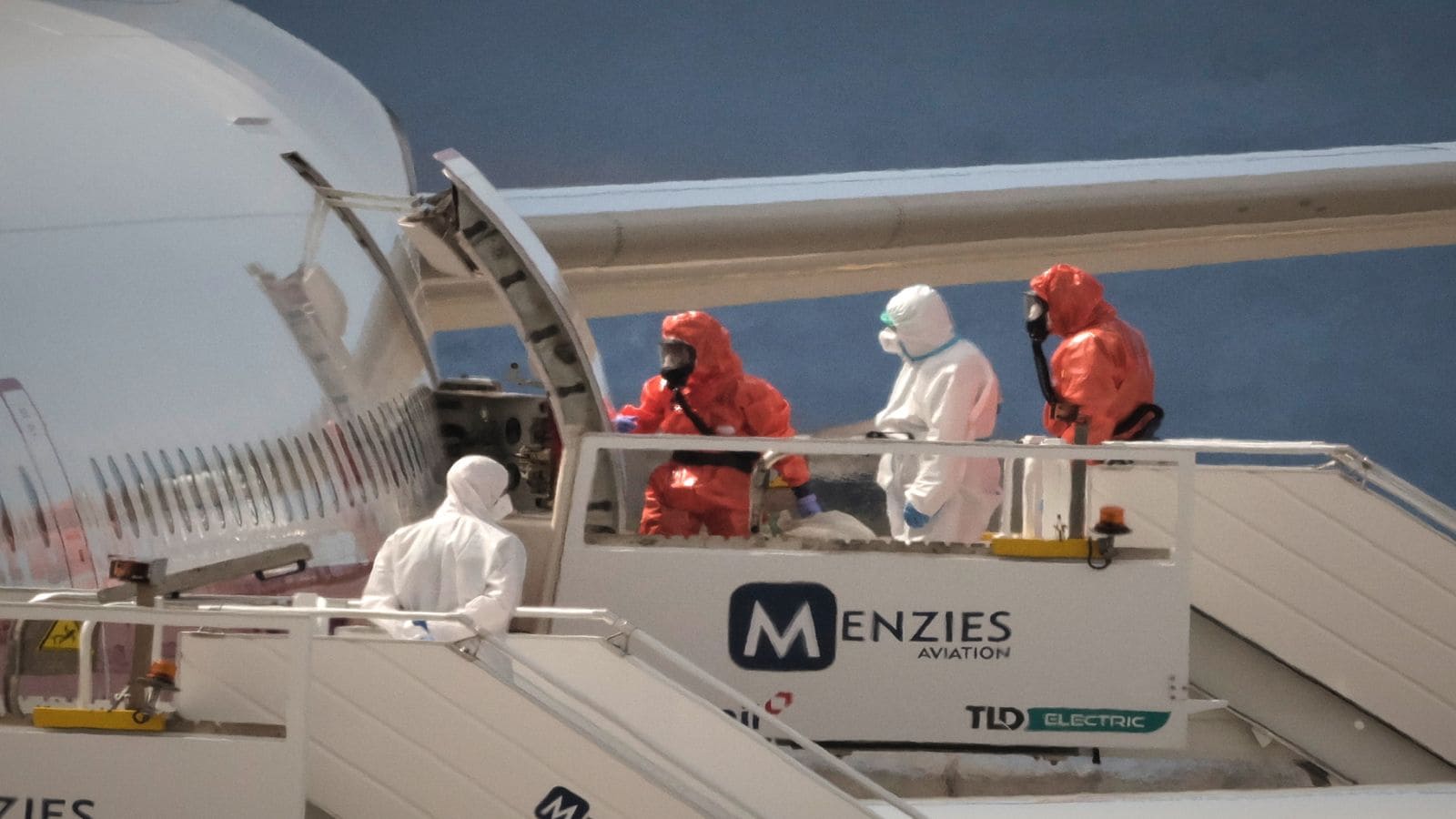
The disembarkation of passengers from a cruise vessel in Spain’s Canary Islands following a confirmed Hantavirus outbreak represents a critical breakdown in maritime biosafety and vector control. While standard reporting focuses on the logistics of the landing, the true failure lies in the intersection of high-density human habitation and the failure of physical barriers against zoonotic spillover. Hantavirus is not typically associated with maritime environments, as its primary reservoirs are terrestrial rodents (Muridae and Cricetidae families). The presence of this pathogen on a luxury vessel indicates a fundamental breach in the Integrated Pest Management (IPM) protocols required by International Health Regulations (IHR 2005).
Pathogen Mechanics and the Mechanics of Exposure
Hantaviruses are enveloped RNA viruses. Unlike many maritime-associated illnesses, such as Norovirus which spreads primarily through fecal-oral routes or surface contact, Hantavirus Pulmonary Syndrome (HPS) and Hemorrhagic Fever with Renal Syndrome (HFRS) are transmitted via the inhalation of aerosolized excreta.
The transmission risk on a cruise ship is dictated by the Ventilation-Exposure Function. In a confined environment, the viral load is not distributed evenly. It concentrates in "dead zones" of airflow—storage lockers, bilge areas, or behind bulkhead insulation—where rodent activity is likely to occur. When maintenance staff or passengers disturb these areas, the dried urine or droppings release viral particles into the air.
Three variables determine the severity of a maritime outbreak:
- Reservoir Density: The number of infected rodents per square meter of non-passenger accessible space.
- Aerosolization Rate: The frequency of air disturbances (cleaning, HVAC cycling) in contaminated zones.
- HEPA Filtration Integrity: The efficiency of the ship’s air handling units in capturing particles in the 80–120 nanometer range.
The Canary Islands incident suggests that the vessel’s internal environment transitioned from a sterile zone to a viable habitat for reservoirs. This transition usually occurs during long-duration port stays or through the loading of contaminated dry stores (pallets of grain or paper products) where rodents can nest undetected.
The Triad of Maritime Containment Failure
To analyze why this specific incident escalated to the point of a forced quarantine and controlled disembarkation, we must examine the failure of the three defensive layers designed to prevent zoonotic ingress.
Structural Exclusion Deficits
The first layer of defense is physical. Modern cruise ships are steel-hulled, yet they possess thousands of penetrations for piping, electrical conduits, and ventilation. A rodent requires an opening no larger than 1.5 centimeters to enter a vessel. The failure in the Canary Islands case points to a degradation of "rat-guarding" on mooring lines or a breach in the integrity of loading bay gaskets. Once a single breeding pair enters the sub-deck levels, the ship’s complex geometry provides a "safe harbor" with zero natural predators and consistent temperature control.
Surveillance and Biological Lag
There is a significant temporal gap between the first rodent sighting and the first human symptom. Hantavirus incubation periods range from one to eight weeks. By the time a passenger in the Canary Islands exhibited the signature high fever, myalgia, and respiratory distress, the viral environment had likely been established for at least 30 days. The failure here is an Information Asymmetry. The crew likely noticed signs of pest activity (gnaw marks, droppings) but failed to escalate these observations to the medical department, treating them as a cosmetic or minor sanitation issue rather than a high-consequence biological threat.
HVAC Recirculation Risks
Cruise ship HVAC systems are designed for thermal efficiency, often recycling a percentage of cabin air to save on cooling costs. In a Hantavirus scenario, this efficiency becomes a liability. If the virus is aerosolized in a service corridor, a poorly partitioned HVAC system can transport those particles into passenger cabins. The Spanish health authorities' decision to manage disembarkation suggests a lack of confidence in the vessel's ability to isolate its internal atmosphere.
Quantifying the Spanish Response Framework
The Spanish Ministry of Health utilized a Stratified Risk De-escalation model to manage the disembarkation process in the Canary Islands. This is a departure from total ship-wide quarantine, which often exacerbates infection rates by keeping the healthy in close proximity to the source of contamination.
The framework involves three distinct phases:
- Clinical Triage: Identifying "hot" cases based on febrile symptoms and thrombocytopenia (low platelet counts), which is a common early indicator of Hantavirus infection.
- Environmental Sampling: Utilizing RT-PCR (Reverse Transcription Polymerase Chain Reaction) swabs on surfaces within the vessel to map the "Pathogen Footprint."
- Controlled Dispersion: Moving passengers to land-based isolation units where the air volume per person is significantly higher and the risk of re-exposure to the shipboard aerosol source is eliminated.
The logistical challenge of this operation is the Traceability Burden. Because Hantavirus does not spread human-to-human (with the rare exception of the Andes virus strain in South America), the goal is not to stop a contagion among the people, but to stop the exposure to the ship’s environment. Each passenger must be tracked for 42 days to ensure they do not develop HPS, which has a mortality rate of approximately 35% to 40%.
Structural Vulnerabilities in Global Maritime Health Policy
The World Health Organization (WHO) provides the Ship Sanitation Certificate (SSC) as a tool to prevent these events. However, the Canary Islands incident exposes two major flaws in current international maritime policy.
First, Inspection Performativity. Most ship inspections are visual and scheduled. They do not involve biological sampling of the air or hidden voids. An inspector walks the galley and the bridge but rarely crawls into the interstitial spaces where Hantavirus reservoirs thrive. The current system rewards "visible cleanliness" over "biological security."
Second, The Supply Chain Blind Spot. Cruise lines have moved toward just-in-time provisioning. This increases the speed of cargo movement, which decreases the time available for thorough pest inspections of incoming pallets. The Canary Islands outbreak is likely a byproduct of a global supply chain that prioritizes velocity over biosecurity.
Economic and Strategic Fallout
The financial impact of a Hantavirus-stricken vessel extends beyond the immediate medical costs. The "Stigma Discount" applied to the vessel’s future bookings can be quantified by the Reputational Decay Function. Historically, ships associated with high-mortality viral outbreaks see a 20% to 30% drop in cabin yields for the subsequent 18 months.
Furthermore, the legal liability for the cruise operator hinges on the concept of "Due Diligence in Vector Control." If the investigation reveals that the vessel had a documented history of rodent sightings that were not addressed with professional-grade extermination and HEPA-level cleaning, the operator faces catastrophic negligence claims.
Strategic Imperatives for Maritime Operators
The resolution of the Canary Islands incident requires more than a simple cleaning crew. It necessitates a Total Bio-Remediation Protocol.
- Gaseous Disinfection: The use of vaporized hydrogen peroxide (VHP) or chlorine dioxide throughout the vessel's void spaces to neutralize viral particles in areas inaccessible to manual wiping.
- Structural Hardening: A mandatory audit of all hull penetrations and the installation of ultrasonic rodent deterrents in sub-deck compartments.
- Digital Pest Monitoring: Replacing traditional snap traps with networked sensors that provide real-time alerts of rodent activity to the bridge, eliminating the "Information Asymmetry" between crew observations and medical risk assessment.
The Canary Islands disembarkation is a signal that the maritime industry’s understanding of zoonotic risk is outdated. The focus has been on viruses that move from human to human, like COVID-19 or Norovirus. The Hantavirus incident proves that the greatest threat might not be the passenger in the next cabin, but the unseen reservoir in the walls. Operators must now treat pest control as a branch of clinical medicine, not janitorial service. Failure to integrate these systems will lead to a repeat of this containment failure, with the Canary Islands serving as a blueprint for a logistical and public health crisis.