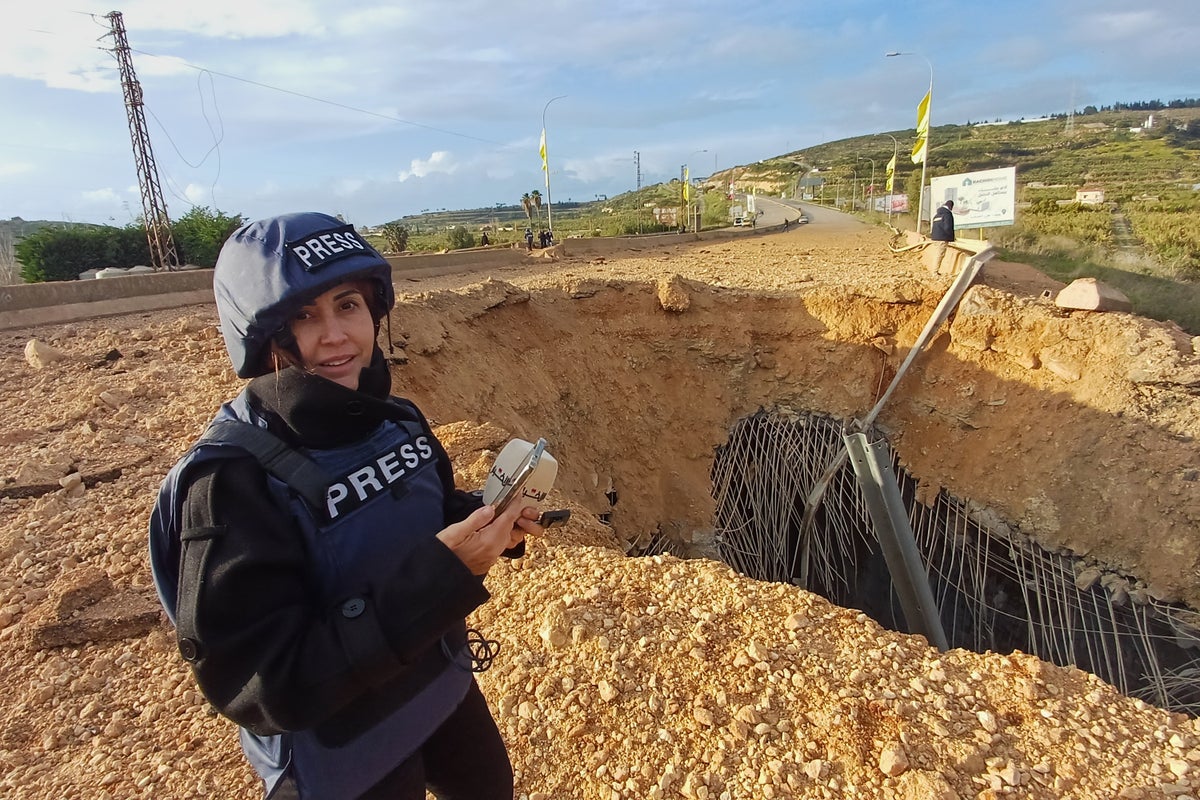
The death of a journalist in a high-intensity combat zone is rarely a statistical anomaly or a byproduct of "fog of war" when the engagement involves specific technological prerequisites. Modern precision-guided munitions (PGMs) and Intelligence, Surveillance, and Reconnaissance (ISR) cycles are designed to eliminate ambiguity. When a strike hits a non-combatant in a stationary, identifiable position, the event must be analyzed through the lens of three operational variables: targeting intent, platform capability, and the breakdown of deconfliction protocols.
The ISR Kill Chain and Target Identification
The execution of a precision strike follows a structured sequence known as the "Kill Chain"—Find, Fix, Track, Target, Engage, and Assess (F2T2EA). In the context of the strike in Lebanon, the "Fix" and "Target" phases are the most critical for determining culpability.
Military-grade ISR platforms, including Medium-Altitude Long-Endurance (MALE) drones, utilize electro-optical and infrared (EO/IR) sensors capable of identifying specific markings on vehicles and clothing from altitudes exceeding 15,000 feet. The presence of "PRESS" identifiers serves as a visual deconfliction signal. If a target is stationary for an extended period, the "Track" phase provides the operator with a high-fidelity pattern of life.
The mechanism of a "targeted" attack on a journalist implies a failure or a deliberate bypass of the Positive Identification (PID) requirement. PID is the reasonable certainty that a target is a legitimate military objective. In high-precision environments, the margin for "misidentification" shrinks as sensor resolution increases. A strike on a clearly marked non-combatant suggests that either the PID threshold was lowered by command or the visual data was overridden by secondary intelligence streams, such as signals intelligence (SIGINT) linked to the location rather than the individual.
Spatial Deconfliction and The Shelter Fallacy
The assumption that seeking shelter provides safety in a kinetic environment ignores the geometry of modern urban warfare. Shelter selection is often reactive, but for a military force, every structure is categorized within a Joint Prioritized Target List (JPTL) or a No-Strike List (NSL).
- The Protected Status Variable: Journalists, like medical personnel, carry protected status under International Humanitarian Law (IHL). This status is not a physical shield but a legal constraint on the attacker's "Targeting Logic."
- The Proportionality Calculation: Every strike requires a collateral damage estimation (CDE). If a journalist is identified within the blast radius of a legitimate target, the strike must be aborted if the civilian risk outweighs the military advantage.
- The Proximity Trap: Combatants often utilize civilian infrastructure for cover. However, if a strike is characterized as "targeted" specifically at a journalist's location where no active combatants are present, the proportionality calculation becomes irrelevant because the initial "Military Necessity" pillar is absent.
The bottleneck in these scenarios is often the "Human-in-the-Loop" (HITL) element. While the technology can distinguish between a camera and a weapon system, the rules of engagement (ROE) provided to the operator dictate whether that distinction matters during high-tempo operations.
Forensic Reconstruction of Kinetic Events
Determining whether an attack was "targeted" requires a forensic audit of the munition remnants and the impact pattern.
Munition Type and Precision Metrics
The Circular Error Probable (CEP) is the measure of a weapon system's precision. For laser-guided or GPS-guided munitions, the CEP is often under three meters. A direct hit on a specific room or vehicle indicates that the point of impact was intentional. If the munition used was a low-collateral-damage variant, such as those with inert warheads or directed fragmentation, the intent to hit that specific coordinate is indisputable.
Ballistic Origin and Sequential Fire
A single strike can be argued as an error. However, "double-tap" strikes or sequential fire on the same coordinate after a visual change in the environment (e.g., people rushing to help) signals a deliberate intent to deny the area or ensure the elimination of the specific target. Analysis of the interval between shots reveals the "Decision Cycle" of the battery or pilot. A short interval suggests a pre-planned engagement; a longer interval suggests the operator observed the results of the first strike and chose to engage again.
The Legal Framework of War Crimes in Asymmetric Conflict
The transition from a "tragic accident" to a "war crime" hinges on the concept of mens rea—the intent or knowledge of wrongdoing. Under the Rome Statute, intentionally directing attacks against civilians not taking direct part in hostilities is a war crime.
The challenge in the Lebanese theater is the lack of transparency in the "Targeting Folder." Each strike is backed by a folder containing the justification for the attack. To prove a journalist was targeted, investigators must bypass the "secret intelligence" defense. This is achieved through:
- Pattern of Conduct Analysis: If multiple journalists are hit across different geographic sectors within a specific timeframe, the "anomaly" defense collapses, suggesting a systemic shift in ROE.
- Signal Interference: Evidence of localized GPS jamming or drone loitering patterns can indicate that the area was under active surveillance long before the kinetic event.
- Deconfliction Logs: Non-governmental organizations (NGOs) and media outlets often provide "Live" coordinates to military forces to avoid accidental targeting. A strike on a "cleared" coordinate is a direct violation of the deconfliction contract.
Structural Failures in Military Accountability
Accountability mechanisms in modern militaries are often circular. Internal investigations prioritize the protection of operational security (OPSEC) over transparency. This creates a "Data Silo" where the evidence required for a legal conviction—the sensor footage and the radio logs—is classified.
The systemic bottleneck is the "Precautionary Principle." IHL requires forces to take all feasible precautions to avoid civilian loss. In the case of the Lebanese strike, the "feasible precaution" would have been a prolonged observation phase (ISR soak) to verify the identity of the individuals. If the strike was launched without this phase, it constitutes criminal negligence; if it was launched after the phase, it constitutes intentional targeting.
Strategic Realignment of Media Safety
The current safety protocols for journalists in conflict zones are based on the 20th-century assumption that visibility equals safety. In a 21st-century ISR environment, visibility is merely a data point for a targeting algorithm.
Media organizations must shift from "Passive Visibility" (wearing blue vests) to "Active Deconfliction." This involves the use of real-time digital "Blue Force Tracking" for non-combatants, integrated directly into the digital maps used by military command centers. However, this creates a secondary risk: the same data used to protect journalists can be used to track and eliminate them if the state actor views the media as a strategic threat rather than a neutral observer.
The targeting of a journalist is a move to control the "Information Environment." By removing the independent observer, a combatant can regain control over the narrative of the conflict. Therefore, the protection of journalists is not just a humanitarian issue but a fundamental requirement for the "Veracity Metric" of global news.
The only viable path toward reducing these events is the internationalization of the targeting audit. Military forces involved in high-precision strikes must be held to a "Translucent Targeting" standard, where the ISR data for every strike involving civilian casualties is automatically triggered for review by a neutral third-party body. Without the threat of an external audit, the ISR kill chain will continue to be used as a tool for surgical silencing rather than surgical warfare.