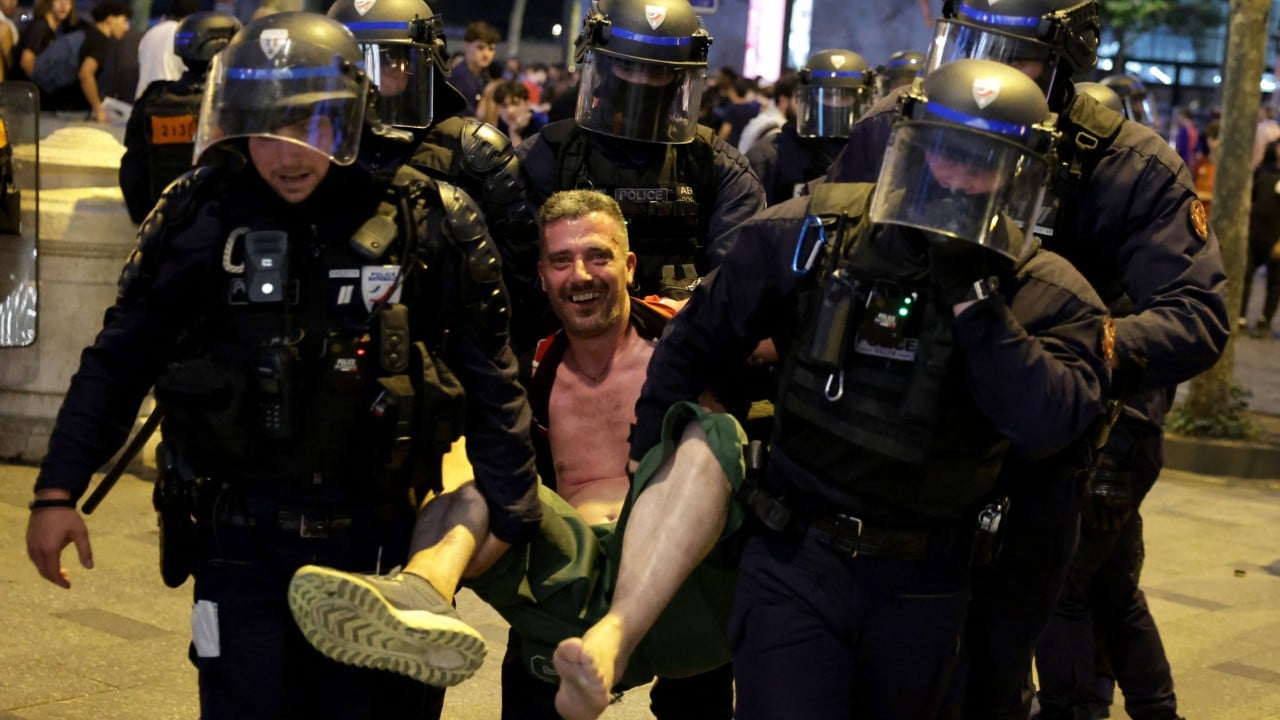
Four hundred arrests in Paris. Cue the predictable media outrage.
The standard editorial template practically writes itself: "Football fans turn celebrations into chaos." Headlines scream about rowdy supporters, property damage, and the supposed inherent criminality of sports culture. The public nods along, comfortable in the lazy consensus that football fans are a monolithic horde of Neanderthals who cannot handle a victory without burning down a bus stop.
It is a comforting lie. It is also entirely wrong.
When four hundred people end up in zip-ties after a major sporting event, you are not looking at a failure of fan behavior. You are looking at a catastrophic, systemic failure of crowd management and a policing strategy designed to provoke rather than pacify. The media focuses on the broken glass because analyzing tactical deployment requires actual effort.
Stop asking why football fans cannot behave. Start asking why European police forces keep using mid-century containment tactics to manage modern human psychology.
The Containment Paradox: How Modern Policing Creates the Riots It Claims to Prevent
Mainstream reporting treats a crowd like a liquid that suddenly decides to boil over for no reason. In reality, crowd dynamics operate on predictable feedback loops.
For decades, sports sociology units—most notably researchers adhering to the Elaborated Social Identity Model (ESIM)—have proven that indiscriminate policing turns peaceful crowds hostile. When police treat a diverse group of celebratory fans as a single, dangerous threat, the crowd begins to act like one.
Look at the mechanics of the typical Paris deployment.
- The Kettle: Riot police form tight perimeters, trapping thousands of people in a confined space. Escapes routes are blocked. Subways are shut down.
- The Pressure Cooker: When you compress human beings who have been drinking and celebrating for six hours into a tight geographic bottleneck, anxiety rises. Dehydration sets in.
- The Spark: A single firecracker goes off. The police, dressed like interstellar warlords and lacking individual visibility, respond with tear gas. The gas does not hit the person who threw the firecracker; it hits the family, the casual tourist, and the fan three rows back.
Suddenly, the crowd's internal logic shifts. The police are no longer guardians of order; they are the aggressors. Self-defense becomes the unifying identity of the crowd.
I have spent fifteen years embedded in sports operations and stadium logistics. I have watched security directors spend millions on high-tech surveillance while completely ignoring basic spatial psychology. When you treat people like animals, some of them will eventually bite. The four hundred arrests in Paris are not a metric of criminal intent; they are a metric of tactical incompetence.
Dismantling the "People Also Ask" Flawed Premises
The internet is flooded with recurring questions every time a European capital gets tear-gassed after a match. The premises of these questions are fundamentally broken.
Why do football fans riot after winning?
They don't. The overwhelming majority of the 100,000 people on the streets of Paris went home without committing a single infraction. By focusing entirely on the 0.4% who were arrested, the media creates a false equivalence between celebration and criminality. Winning creates an intense release of dopamine and collective effervescence. If given open channels to disperse, that energy dissipates naturally. When blocked by shield-bearing CRS officers, that energy deflects into the nearest immovable object.
Why can't Europe adopt American-style stadium security?
This is the favorite talking point of corporate consultants who want to sell expensive metal detectors. American sports culture is built around corporate franchising, isolated suburban stadiums surrounded by miles of parking lots, and a total lack of organic fan movement. European football is deeply tribal, urban, and woven into the fabric of city centers. You cannot manage the Champs-Élysées like it is a corporate parking lot in Arlington, Texas. The solution isn't more walls; it's better communication.
Should matches be played behind closed doors to prevent violence?
This is the nuclear option favored by bureaucrats who prefer sterile environments to human reality. Empty stadiums do not stop fans from gathering in city squares. It merely moves the gathering point away from the stadium's infrastructure—where there are turnstiles, stewards, and medical staff—and into unmanaged public spaces. It creates a far more dangerous, unpredictable environment.
The Swedish Model: Proof That the Status Quo is a Choice
The most frustrating part of the "out-of-control fan" narrative is that we already have the blueprint to fix this. It just requires dropping the tough-on-crime posturing that politicians love.
Look at the "Enablement" strategy pioneered in Denmark and Sweden, specifically through the use of event dialogue officers. These are un-armored, highly visible police officers whose sole job is to talk to fans, understand their plans, and facilitate their movement. They do not carry shields. They do not look like they are invading Fallujah.
| Attribute | Traditional Tactical Policing (Paris) | Dialogue-Based Enabling Policing (Stockholm) |
|---|---|---|
| Primary Objective | Containment and intimidation | Facilitation and communication |
| Visibility | Shielded, anonymous, militarized | Recognizable, approachable, un-armored |
| Response Trigger | Collective punishment for individual acts | Targeted extraction of specific agitators |
| Crowd Perception | Hostile occupying force | Legitimate authority figure |
| Result | Escalation, mass arrests, property damage | De-escalation, high cooperation, minimal incidents |
When Swedish researchers analyzed the dialogue approach, the data was undeniable: low-profile policing reduces the likelihood of collective violence by over 70%. Why? Because it maintains the psychological barrier between the 99% of fans who want to drink beer and sing, and the 1% who want to smash windows.
Paris refuses to learn this lesson. The French policing apparatus relies heavily on the CRS (Compagnies Républicaines de Sécurité), a force trained in regime survival and urban combat, not sports fan psychology. They enter the scene expecting a riot, and through their sheer presence and tactics, they guarantee they get one.
The High Cost of the Easy Explanations
Admitting that the police and city planners are responsible for urban chaos is uncomfortable. It requires reworking municipal budgets, retraining thousands of officers, and acknowledging that the state often acts as the primary instigator of civil disorder.
It is much easier to blame the guy in the jersey. It plays well on the evening news. It allows politicians to promise "harsher penalties" and "increased surveillance" without actually fixing the underlying operational rot.
But this approach has a shelf life. Every time a city uses indiscriminate force against its own citizens under the guise of sports security, it erodes the legitimacy of law enforcement. It turns young, working-class sports fans into permanent enemies of the state.
The next time you see a headline about four hundred football fans arrested in a European capital, do not shake your head at the decline of civilization. Look past the smoke from the tear gas canisters. Look at the barricades blocking the exits. Look at the lines of riot police charging into a crowd that has nowhere to run.
The riot didn't start because a team won a trophy. The riot started because the people in charge forgot that a crowd is made of human beings, not a hostile army requiring containment. Stop buying the narrative that justifies the batons.