The Pentagon quietly authorized a contract worth up to $499.5 million to sustain and modernize its fleet of highly specialized, sensor-laden aircraft designed to track ballistic and hypersonic missiles. The award went to Aeromet, a specialized division of L3Harris Technologies, to manage the Missile Defense Agency Airborne Sensors program through 2036. While the contract notice reads like routine defense bureaucracy, it represents a massive financial escalation in the Pentagon's rush to solve its most glaring intelligence blind spot: capturing precise telemetry data from high-speed weapons tracking through the upper atmosphere.
Ground radar cannot easily see over the horizon, and satellites often lack the resolution or the viewing angles required to track the violent, unpredictable trajectories of atmospheric hypersonic glide vehicles. This massive capital injection proves that the military remains heavily reliant on heavily modified business jets packed with optical and infrared sensors to shadow test flights across vast oceanic ranges.
The half-billion dollar contract hiding in plain sight
The Department of War published the award with minimal fanfare, characterizing it as a follow-on indefinite-delivery, indefinite-quantity contract. The single-bid contract ensures that Aeromet will continue to run mission planning, flight execution, and hardware modernization for the Airborne Sensors program.
For decades, the Pentagon has relied on a tiny, gray-world fleet of modified civilian airframes to perform the dangerous work of flying adjacent to missile paths. These aircraft operate out of highly restricted airfields, acting as mobile laboratories that intercept electromagnetic signals and thermal signatures emitted by experimental missiles.
The money allocated here does not go toward buying off-the-shelf combat aircraft. Instead, it funds the ongoing surgery required to keep delicate, high-altitude optical tracking systems working inside airframes subjected to extreme vibrations and thermal stress. The high ceiling of this contract signals that the frequency of missile testing in the Pacific and domestic ranges is set to skyrocket over the next decade.
Chasing hypersonics across the Pacific
The modern theater for missile testing has moved beyond traditional ballistic arcs. Weapons developed by near-peer adversaries, as well as America's own experimental programs like the Conventional Prompt Strike initiative, fly at speeds exceeding Mach 5 while maneuvering wildly inside the atmosphere.
Traditional tracking infrastructure is poorly equipped for this reality.
- Radars suffer from line-of-sight limitations caused by the curvature of the earth.
- Satellites are bound by orbital mechanics, meaning they cannot easily linger over a specific patch of ocean where a test might drift off course.
- Ships move too slowly to reposition when a flight profile changes at the last minute.
Modified high-altitude business jets solve this by flying above the dense weather layers, positioning their specialized windows directly adjacent to the missile's projected flight path. They carry massive infrared telescopes and multi-spectral sensors that can spot the heat generated by a hypersonic vehicle slicing through the air from hundreds of miles away. Without the data gathered by these planes, engineers would have no way of knowing whether a failed test was caused by a structural breakup, a guidance error, or thermal shielding failure.
Why satellites fail where modified business jets succeed
A common misconception in modern defense strategy is that the proliferation of low-Earth orbit satellite constellations will eventually render atmospheric tracking aircraft obsolete. This view ignores the physics of data collection. Space-based sensors look down through the entire thickness of the atmosphere, battling thermal noise, cloud cover, and background radiation from the planet itself.
An aircraft flying at 45,000 feet bypasses the vast majority of atmospheric interference.
The sensors mounted on these planes do not just take pictures; they collect raw telemetry, measuring the plasma sheath that forms around a missile at hypersonic speeds. They intercept the radio frequencies transmitted by the missile's internal diagnostic systems. By adjusting their flight paths in real time based on live range telemetry, these aircraft offer a level of mission flexibility that an orbital asset simply cannot match. If a missile launch is delayed by hours due to bad weather or a technical glitch, the aircraft can hold its position or land and refuel, whereas a satellite constellation keeps moving along its fixed orbit, completely missing the window of interest.
The invisible fleet of the Missile Defense Agency
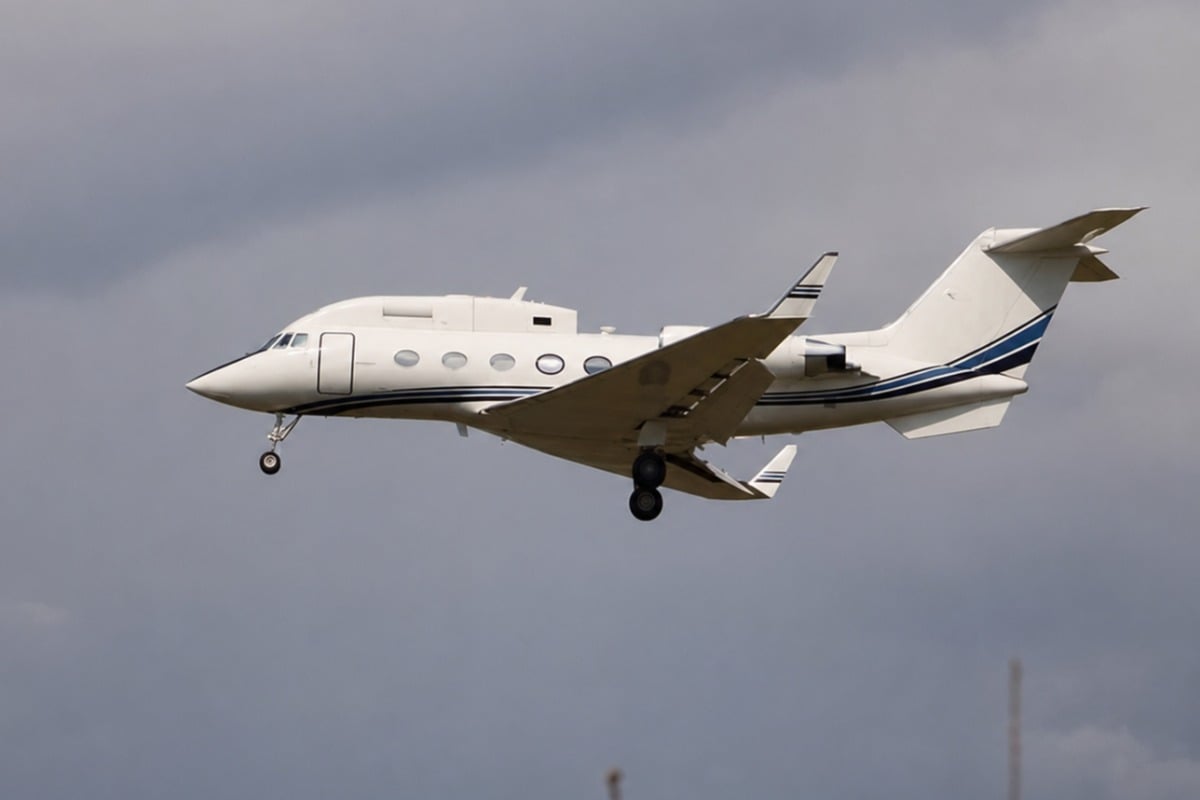
Most of the airframes used in this program are heavily altered Gulfstream or Bombardier aircraft, stripped of their luxury interiors to make room for equipment racks, liquid-cooling loops, and massive optical windows made of exotic materials like zinc selenide. These windows must remain perfectly flat and flawless to prevent distortion when the onboard telescopes lock onto a target moving at thousands of miles per hour.
The operation of these aircraft is a logistical nightmare managed by private defense technicians and military coordinators who operate far from the public eye. They must coordinate with international aviation authorities to clear vast corridors of airspace before a test occurs, ensuring that commercial airliners are nowhere near the path of an incoming missile or the high-powered tracking lasers used by the sensors.
This latest half-billion-dollar commitment highlights a stark reality within the defense establishment. Even as the Pentagon spends billions developing next-generation space architectures, the immediate, existential need to validate hypersonic and missile defense technologies means keeping an aging, highly specialized fleet of flying laboratories in the air for another ten years. The race to master high-speed warfare is completely dependent on these flying observers, and the cost of keeping them in the air is only going to go up.