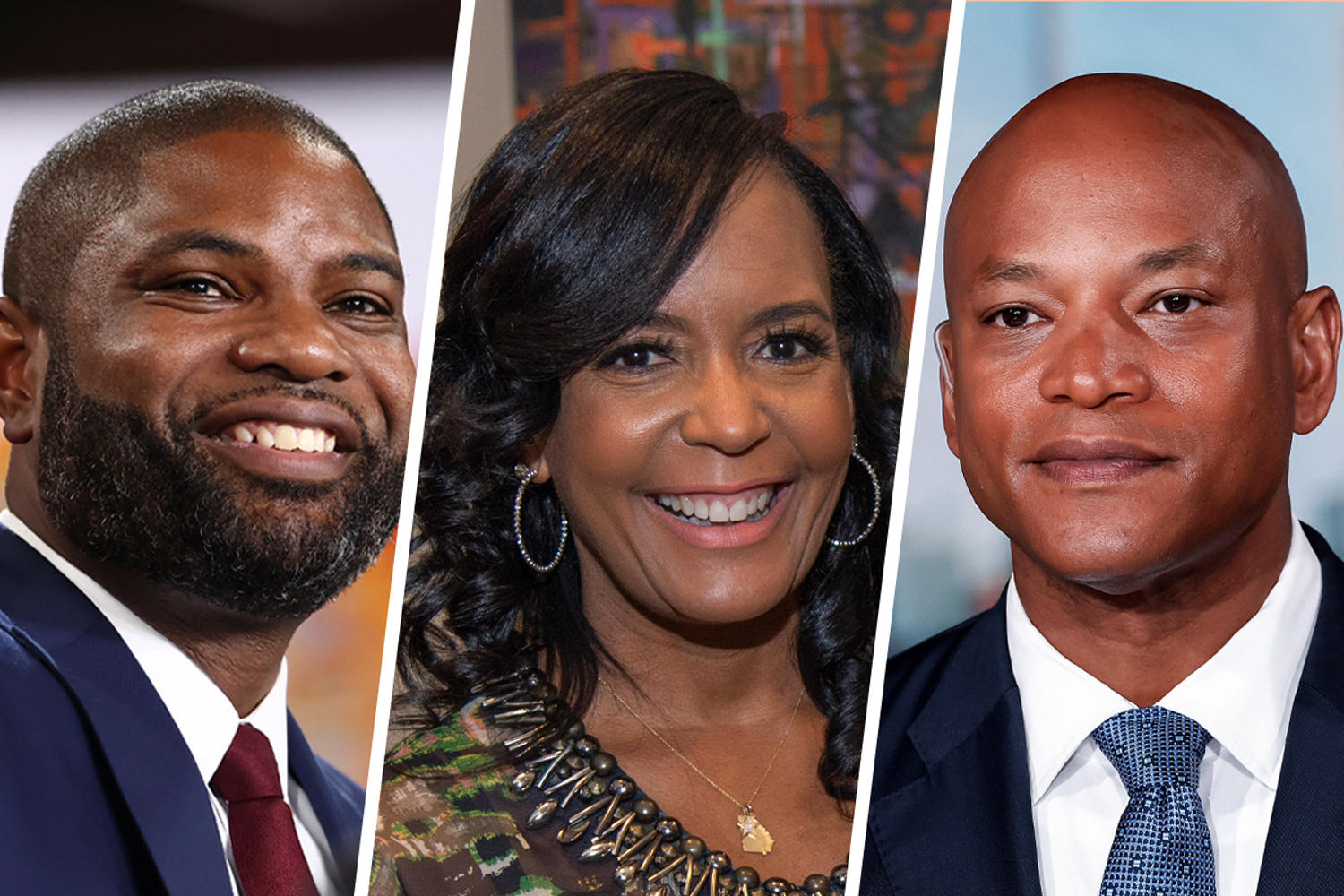
Most political pundits talk about gubernatorial races like they're just warm-up acts for the presidency. They're wrong. When Tuesday’s elections bring a historic first for Black governors, the real story isn't just about breaking a symbolic glass ceiling on election night. It's about raw executive power over state budgets, judicial appointments, and voting laws that affect millions of lives every single morning.
Look at the numbers. Before the 2022 midterm cycle, only three Black men had ever served as governor in the entire history of the United States. Just three. Out of more than 2,300 people who have held the top job in an American state since 1776. Let that sink in for a second.
For decades, the pipeline to the governor's mansion was practically sealed shut for Black candidates. Voters would send Black politicians to Congress, city halls, and state legislatures, yet statewide executive offices remained stubbornly out of reach. When Wes Moore won in Maryland in 2022, becoming the state's first Black governor and only the third elected in U.S. history, it cracked that door open. Subsequent election cycles—including the November 2026 midterms—have tested whether those breakthroughs were rare exceptions or the start of a permanent shift in American statehouses.
Why Statewide Executive Races Are So Different
Running for the U.S. House is one thing. You campaign in a single district, often drawn with specific demographic boundaries where a candidate can build a reliable base. Running for governor is an entirely different beast. You have to win the whole map.
I've watched countless campaigns crash and burn because strategists treated a statewide race like an oversized congressional campaign. It doesn't work. To win a governor's mansion, a Black candidate has to build a coalition that stretches from dense urban centers through skeptical suburban ring counties and out into rural farming communities.
Here's why that hurdle tripped up so many candidates in the past:
- The "Electability" Trap: Donors and party bosses spent decades convinced that white suburban swing voters wouldn't pull the lever for a Black executive. Because of that fear, promising candidates got starved of early fundraising cash before they could even introduce themselves on television.
- Executive Experience Myths: Voters apply a harsher scrutiny to minority candidates regarding budget management and public safety. A white businessman with zero government experience can run as an "outsider" and win easily. A Black candidate usually has to prove twice the resume—serving as an attorney general, lieutenant governor, or big-city mayor—just to be taken seriously.
- Turnout Asymmetry: Midterm elections notoriously suffer from lower turnout among younger voters and voters of color compared to presidential years. Winning on a Tuesday in November requires a ground game that doesn't rely on a presidential candidate at the top of the ticket to drag people to the polls.
When those barriers finally break down, the impact isn't merely cosmetic. A governor controls the state National Guard, holds veto power over every bill passed by the legislature, and appoints the judges who interpret state constitutions.
The Real Timeline of Black Governors in America
If you ask ten people on the street to name the first Black governor in the United States, almost nobody gets it right. Most guess Douglas Wilder. They're close, but they miss a massive chapter of Reconstruction history.
P.B.S. Pinchback actually held the title first, serving as acting governor of Louisiana for 35 days between December 1872 and January 1873 after the sitting governor was impeached. Because he wasn't elected to the top spot directly, historians categorize him separately, though his brief tenure proved what was possible before Jim Crow violently slammed the door on Black political participation across the South.
After Pinchback left office, 117 years passed without a single Black governor anywhere in the country. Think about how long that is. Entire generations were born, grew old, and died without ever seeing a Black person lead a state government.
Then came L. Douglas Wilder in Virginia. In November 1989, Wilder won a razor-thin victory by less than 7,000 votes out of nearly 1.8 million cast. He ran a disciplined, fiscally conservative campaign that neutralized racial anxieties among moderate voters in Northern Virginia and the Tidewater region. Wilder proved a Black candidate could win a statewide election in a former Confederate state.
Yet instead of opening the floodgates, Wilder's win was followed by another long drought. Deval Patrick didn't win in Massachusetts until 2006—seventeen years later. Patrick, a former civil rights attorney and corporate executive, bypassed the traditional political establishment by building a grassroots movement focused on public education and clean energy, serving two full terms until 2015.
Between 1990 and 2022, two other Black men served as governor without being elected to the post: David Paterson in New York, who stepped up from lieutenant governor in 2008 following Eliot Spitzer's resignation, and Pickney Benton Stewart Pinchback back in the 1870s. Meanwhile, several high-profile Black candidates—including Andrew Gillum in Florida, Stacey Abrams in Georgia, and Ben Jealous in Maryland—came agonizingly close in 2018, only to fall short.
What Changed in Recent Election Cycles
So what finally broke the logjam? It wasn't a single magic formula, and it certainly wasn't that race stopped mattering in American politics. Rather, three concrete shifts changed the math on the ground.
First, demographic evolution in key battleground states altered the baseline electorate. Suburbs around major metro areas—places like Baltimore, Atlanta, Detroit, and Richmond—grew far more diverse and less monolithic in their voting habits. Candidates no longer had to win rural counties outright; they just needed to lose them by smaller margins while running up the score in urban and inner-ring suburban precincts.
Second, the bench got deeper. By the 2020s, a new generation of Black politicians had spent years holding statewide offices like lieutenant governor, attorney general, and state treasurer. Look at figures like Antonio Delgado in New York, Winsome Earle-Sears in Virginia, Austin Davis in Pennsylvania, and Garlin Gilchrist in Michigan. Having multiple Black lieutenant governors serving simultaneously meant voters were already accustomed to seeing Black leaders in executive roles, removing the novelty factor that opponents used to exploit.
Third, campaign messaging matured. Successful candidates stopped running strictly on the historic nature of their candidacies. Honestly, voters don't pay their grocery bills with history. The winners focused relentlessly on kitchen-table economics, infrastructure, workforce training, and public schools, letting the historic milestone speak for itself rather than making it the centerpiece of every stump speech.
The Question Nobody Wants to Answer About Black Women
You can't talk honestly about historic firsts for Black governors without pointing out the glaring omission in the history books. Every single Black governor in U.S. history—Pinchback, Wilder, Patrick, Paterson, and Moore—has been a man.
As of the 2026 election cycle, no Black woman has ever served as governor of an American state. Not one.
Black women are widely recognized as the most loyal and organized voting bloc in modern American politics, consistently turning out at higher rates than almost any other demographic group. Yet when Black women step up to run for governor, they face a double bind that male candidates rarely encounter to the same degree.
They get hit from both sides. On one hand, they face skepticism about whether they're "too progressive" for moderate swing voters, regardless of their actual policy platforms. On the other hand, they often struggle to secure the same level of institutional financial backing from major party committees during primary fights. Stacey Abrams raised an unprecedented amount of money in Georgia across her 2018 and 2022 campaigns, proving that grassroots small-dollar fundraising could rival traditional donor networks, yet she still couldn't quite clear the final electoral hurdle in a conservative-leaning state.
Until a Black woman takes the oath of office on a state capitol steps, any celebration of "historic firsts" in gubernatorial politics remains incomplete.
Why Governor Mansions Matter More Than Congress Right Now
If you're trying to figure out why these races draw tens of millions of dollars from out-of-state donors, look at what happens in Washington versus what happens in state capitols.
Congress is routinely gridlocked. Major federal legislation stalls out for years over razor-thin partisan majorities and Senate filibuster rules. Meanwhile, state governments are moving at breakneck speed.
A governor sits right at the center of that action. Consider what a governor actually controls:
- Redistricting Vetoes: In states where legislatures draw congressional and state legislative maps, a governor's veto pen is often the only thing stopping extreme partisan gerrymandering.
- State Supreme Courts: In dozens of states, governors appoint judges to fill vacancies on appellate and supreme courts. Those state courts now have the final word on abortion access, voting rights, environmental regulations, and labor laws.
- Medicaid and Healthcare: Governors decide whether to expand Medicaid programs, how to allocate federal health grants, and how state hospitals are funded.
- Clemency and Criminal Justice: Through pardon powers, parole board appointments, and state police leadership, a governor shapes criminal justice policy far more directly than a single member of Congress ever could.
When a Black governor sits in that chair, the lived experience they bring to judicial appointments and budget priorities fundamentally shifts how state resources are distributed. In Maryland, for instance, Wes Moore immediately directed state agencies to address the racial wealth gap through targeted procurement contracts and apprenticeship programs—policies that didn't even require waiting on a contentious legislative vote.
How to Track the Real Impact After Election Day
Don't fall for the trap of paying attention only on election night when the confetti falls and the cable news panels declare history made. The real measure of any historic governorship happens in the unglamorous grind of the first 100 days and the annual budget cycle.
If you want to know whether a newly elected governor is actually delivering on the promise of their historic win, ignore the press releases and watch three specific things over the next six months:
- Cabinet and Judicial Appointments: Look at who gets named to lead the state departments of transportation, health, and education, and who gets appointed to state judgeships. Personnel is policy.
- The Capital Budget: Check where state infrastructure money actually goes. Are transit upgrades, broadband expansion, and school construction funds reaching historically neglected communities, or are they flowing to the same wealthy districts as always?
- Veto Patterns: Pay close attention to which bills the governor quietly lets become law without a signature versus which ones they publicly veto. That tells you where their real political courage lies when party leaders push back.
Electing a diverse slate of governors isn't the finish line for representative democracy—it's just the starting gun for governing a state that actually looks like the people paying the taxes.