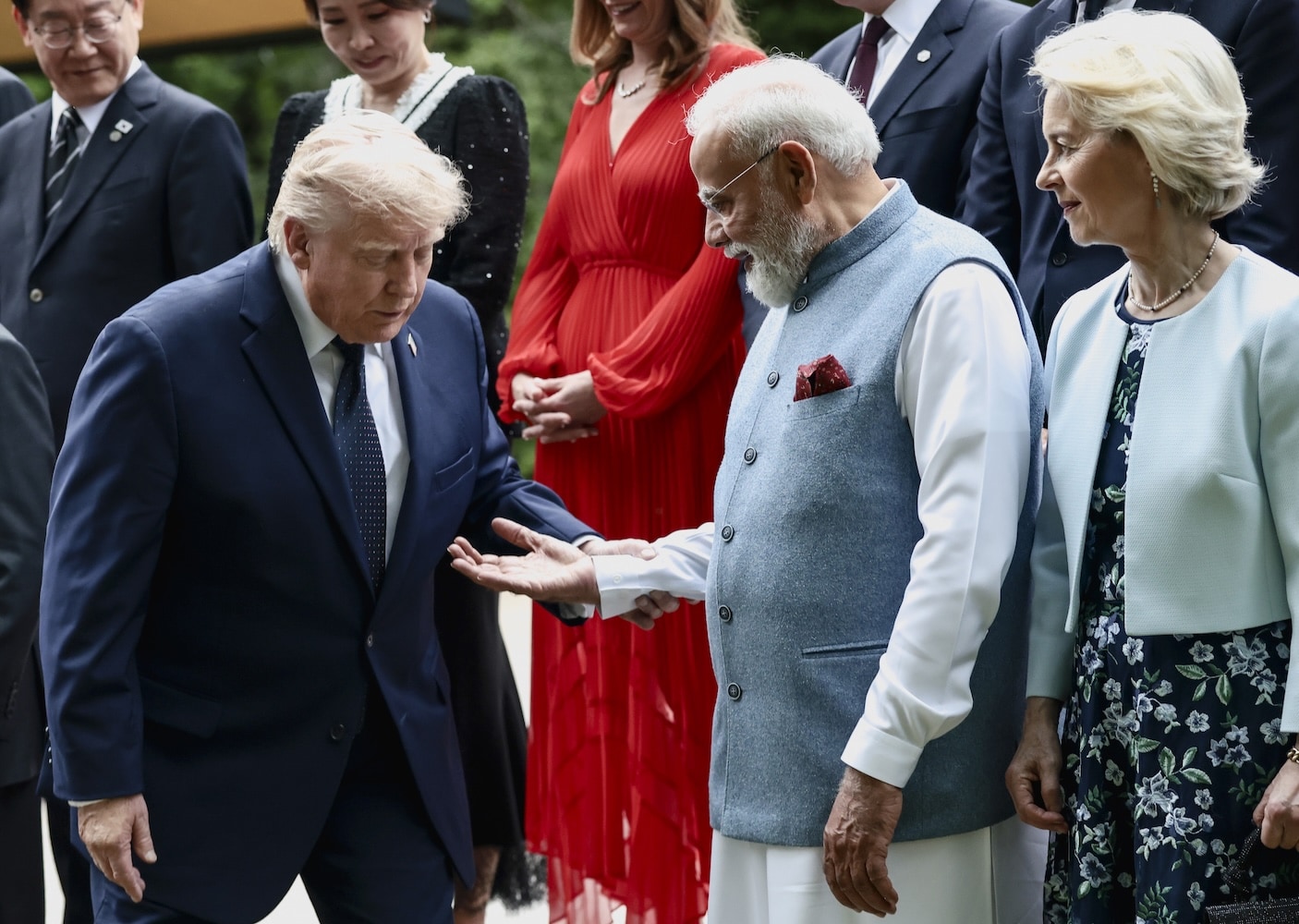
Donald Trump just put a massive condition on America's defense of India. Sitting next to Narendra Modi at the G7 summit in Evian, France, Trump made a statement that turned heads globally. He promised the US would step in if India ever faced an attack.
But he didn't stop there. He added a twist that upends decades of predictable foreign policy.
Trump specified that the US defense guarantee applies only if Modi remains India's leader. "If anybody attacks that man, we're going to be there," Trump told reporters during their bilateral press briefing. He then explicitly doubted whether he'd offer the same protection to a different Indian Prime Minister.
This isn't standard diplomatic protocol. It's an aggressive privatization of international alliances, tying a superpower's military might to a single individual rather than a sovereign nation.
The Fine Print of Trump's Military Guarantee
Washington and New Delhi don't share a formal mutual defense treaty. Unlike NATO allies or Japan, India has never had a contractual guarantee of American military intervention. Trump acknowledged this reality directly, noting that while no written contract exists, his personal commitment fills the gap.
This transactional approach changes how the world views the Indo-Pacific balance. By saying "if there's a new leader, I'm not sure about it," Trump signals that institutions mean less to him than personal loyalty. It's a strategy he's applied to domestic politics for years, but applying it to a nuclear-armed partner facing complex border realities with China and Pakistan creates a highly volatile framework.
Treating a state-to-state alliance like a personal pact ignores the long-term stability built by professional diplomats. It means India's security calculations could face dramatic swings based entirely on democratic election outcomes in New Delhi.
Fixing a Relationship Bruised by Tariffs and Gulf Casualties
The Evian meeting was the first time Modi and Trump sat down in person for sixteen months. Their last face-to-face interaction happened back in early 2025 at the White House. Since then, the relationship has suffered real friction.
Trade arguments have been brewing for a year over heavy US tariffs. Immigration policies and hikes in H-1B visa fees also irritated New Delhi. Then came a far more dangerous flashpoint in the Gulf of Oman.
As part of a US maritime blockade surrounding Iranian ports, an American military action recently hit merchant vessels crewed by Indian citizens. The strike killed three Indian seafarers. The tragedy sparked intense, quiet fury in New Delhi, putting Modi under severe pressure to address maritime safety directly with Washington.
Modi didn't look past the issue in France. He used his press remarks to remind Trump that thousands of Indian sailors operate on global trade routes. Modi noted that their safety remains a top priority for India, linking their future protection to the success of the fragile US-Iran peace agreement.
Why Trump Called Modi a Killer
Trump doesn't negotiate like a traditional diplomat, and his descriptions of world leaders reflect that. While trying to project absolute warmth, he handed reporters a classic, jarring headline. He remarked that while Modi looks like an angel, the Indian Prime Minister is "as tough as a killer" at the negotiating table.
That colorful language centers heavily on ongoing trade talks. US Trade Representative Jamieson Greer is headed to India later this month to finalize a long-delayed interim trade pact. Negotiators have already held intense sessions in Washington and New Delhi since March, trying to untangle agricultural access, digital trade regulations, and manufacturing tariffs.
By calling Modi a tough negotiator, Trump is setting expectations back home. He's preparing his base for a trade deal that will require American compromises, framing Modi as an adversary worth respecting rather than a partner who folded easily.
Reading Between the Lines for New Delhi's Strategy
For Indian defense planners, Trump's personalized defense offer is a double-edged sword. On one hand, having the US President state that Washington will back India against external aggression offers immediate deterrence, particularly along the disputed Line of Actual Control with China. On the other hand, the conditional nature of the statement introduces systemic weakness.
Relying on a foreign policy that expires when a specific politician leaves office is dangerous. Modi's current mandate doesn't last forever. If Indian foreign policy relies too heavily on personal chemistry between individual leaders, it sacrifices the institutional continuity that has allowed India to navigate global conflicts independently for nearly eighty years.
India will likely continue its traditional path of strategic autonomy. It wants American technology, joint military exercises, and defense manufacturing partnerships. But it won't rely on American troops to defend its borders. New Delhi knows that a promise made at a press conference in France can evaporate with a tweet or a change in administration.
The smarter path forward for watchers of this space involves looking past the theatrical praise. Watch the upcoming trade meetings in New Delhi this month and observe the specific defense technology transfers. The real strength of the alliance lives in those boring, institutional details, not in conditional promises shouted over the noise of a G7 media room.