Walk into the Carriage Pavilion at the Vatican Museums, and you'll expect to see bulletproof glass. Everyone does. You've seen the news clips of white SUVs gliding through packed crowds in St. Peter's Square, flanked by dark-suited security guards jogging alongside the doors.
You're wrong about almost all of it. Discover more on a related subject: this related article.
Most of the vehicles in the Vatican's collection don't have armored glass at all. In fact, the actual history of the popemobile exhibition at the Vatican stretches back to 1930, long before security bubbles became standard protocol. When Pope Pius XI accepted the first motorized papal vehicles after the signing of the Lateran Treaty in 1929, the goal wasn't protection. It was visibility and modernity. The Vatican had just become an independent sovereign state, and the papacy needed to show the world it was stepping out of the horse-drawn era.
If you visit Rome expecting a garage full of tactical tanks, you're going to be surprised. What you'll actually find is an accidental history of twentieth-century automotive design, political theater, and one terrible afternoon in May 1981 that changed everything forever. Additional reporting by Travel + Leisure highlights similar perspectives on the subject.
Why the 1930 Starting Date Matters
People love to throw the word "popemobile" around like it's an ancient institution. It isn't. The term itself didn't even enter the public vocabulary until the late 1970s during Pope John Paul II's early international trips.
Before 1930, popes relied on the sedia gestatoria—a portable ceremonial throne carried on the shoulders of twelve footmen—or ornate, horse-drawn carriages. Those carriages are still sitting right there in the Vatican Museums alongside the cars, which makes the contrast jarring. You walk past gilded, velvet-lined coaches built for Pius IX, and suddenly you're staring at a 1929 Graham-Paige Type 837.
That Graham-Paige is the real anchor of the 1930 milestone. Detroit-based brothers Joseph, Robert, and Ray Graham gifted the custom limousine to Pius XI shortly after the Lateran Pacts resolved the "Roman Question" and established Vatican City. Look closely at the back seat of that car when you visit. There isn't a bench. Instead, there's a single, elevated red damask armchair positioned right in the center so the pope could sit alone in state, almost like a motorized version of his ceremonial throne.
Around the same time, Mercedes-Benz entered the chat. In 1930, Daimler-Benz delivered a custom Nürburg 460 Pullman limousine to Pius XI. It took the engineers in Stuttgart months to adapt the interior, equipping it with a silk-upholstered throne and specialized signaling buttons so the pope could silently tell the chauffeur to speed up, slow down, or stop without having to shout through a partition.
Honestly, these early cars were rolling palaces. Nobody was worried about snipers. They were worried about dignity.
The Open-Air Era and the Illusion of Safety
For fifty years after 1930, papal transport got progressively more open, not more closed. As television grew and crowds at St. Peter's Square ballooned into the tens of thousands, a closed limousine became a problem. People couldn't see the pontiff.
By the 1960s and 1970s, the Vatican started favoring open-top convertibles and modified utility vehicles. During the Second Vatican Council, Pope Paul VI used a custom-built Lincoln Continental Lehmann-Peterson limousine with a removable roof section and a hydraulic seat that lifted him nearly a foot higher than the bodywork. When he visited New York in 1965, millions of people lined the streets to see him standing upright in that open car.
Then came John Paul II in 1978, and the whole vibe shifted.
He was younger, athletic, and obsessed with physical proximity to crowds. The Vatican began using white Fiat Campagnola off-roaders—basically rugged Italian military-style jeeps—stripped of their roofs and fitted with simple grab bars. No doors. No glass. Just a white steel rail for the pope to hold onto while the driver crept through cheering pilgrims at walking speed.
That exact Fiat Campagnola is the centerpiece of the Vatican's exhibition, and standing next to it gives you chills. It looks tiny. Almost fragile. On May 13, 1981, Mehmet Ali Ağca stood in the crowd in St. Peter's Square and fired four shots at John Paul II while the pope was standing in the back of that exact open jeep.
Everything changed before the ambulance even reached Gemelli Hospital.
How 1981 Forced the Glass Bubble
The assassination attempt killed the open-air era overnight. When John Paul II recovered and returned to public appearances, the Vatican didn't just add a windshield. They completely re-engineered what a papal vehicle had to be.
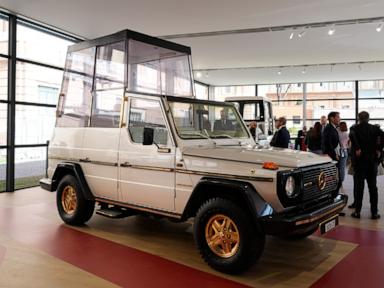
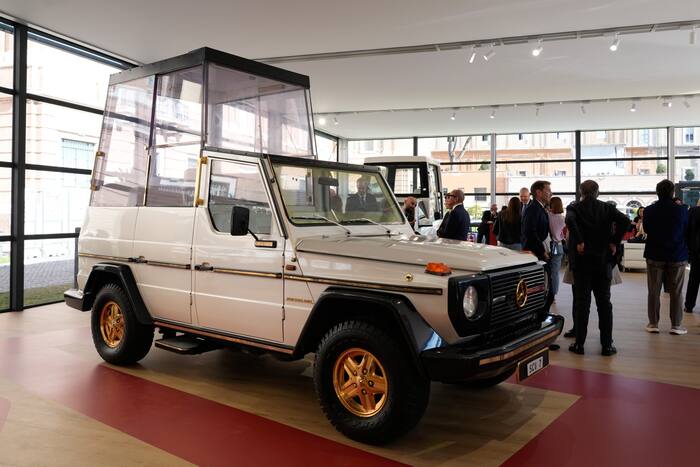
You can see the immediate aftermath in the exhibition's late-twentieth-century lineup. Look at the modified Mercedes-Benz G-Class (the iconic 230 G) introduced in the early 1980s. Suddenly, the back half of the vehicle is encased in a towering, boxy cupola of thick, transparent armored glass. It looks a bit awkward—like a greenhouse bolted onto a rugged German off-roader—because it was built under urgent pressure to solve two contradictory problems at once.
Security teams wanted the pope inside an impenetrable steel box. The pope wanted the faithful to see him clearly from fifty yards away.
The compromise was intense interior lighting aimed directly at the pontiff inside the glass cabin, combined with air conditioning systems powerful enough to stop the thick acrylic and ballistic glass from fogging up under the Roman sun. Those cars weighed several tons more than their factory counterparts. Their suspensions had to be heavily reinforced just to carry the glass, and their transmissions were tuned to crawl smoothly at two miles per hour without overheating or lurching—because a sudden jerk could knock a standing elderly man off balance.
The Weirdest Vehicles in the Collection
If you only pay attention to the Mercedes and the Fiats, you'll miss the best parts of the Vatican's garage. Heads of state and automakers have been gifting strange, one-off vehicles to the papacy since 1930, and many of them end up parked in the pavilion.
Take the 1975 Toyota Land Cruiser FJ40. Yes, a rugged Japanese bush truck. It sits right there among the European luxury sedans, painted white and fitted with a rear standing platform. It wasn't built for glamour; it was built to survive rough terrain during pastoral visits outside Rome.
Even wilder is the 1982 Leyland T45 Constructor truck—a massive, twenty-four-ton commercial lorry converted into a mobile glass fortress for John Paul II's historic six-day visit to Great Britain. Imagine a heavy-duty British freight truck stripped down and rebuilt with a carpeted lounge, bulletproof glazing, and heavy armor plating. It looked completely ridiculous compared to sleek Italian sedans, yet it worked brilliantly for navigating rainy British motorways and massive crowds in Edinburgh and Cardiff.
You'll also spot a white Renault 4 from 1984. Unlike the custom factory builds, this was a humble, used economy car with nearly 190,000 miles on the odometer, gifted to Pope Francis by an Italian priest named Father Renzo Zocca in 2013. Francis didn't just accept it for the museum; he actually drove the stick-shift hatchback around Vatican City himself.
Why Pope Francis Pushed Back Against the Glass
Spend twenty minutes studying the chronology of the exhibition, and you'll notice a sharp philosophical U-turn after 2013.
For three decades following 1981, the popemobile kept getting heavier, thicker, and more isolated. By the time Pope Benedict XVI was using the custom Mercedes-Benz M-Class in the late 2000s, the vehicle featured oxygen supplies, advanced ballistic protection, and a completely sealed cabin.
Pope Francis hated it.
He famously referred to the enclosed glass popemobile as a "sardine can." Early in his papacy, he started refusing the armored enclosures for routine Wednesday audiences in St. Peter's Square and during several international trips, opting instead for open-top white jeeps—including a modified Hyundai Santa Fe and a Kia Soul—where people could reach out, hand him babies to bless, or toss him a cup of yerba mate.
His argument wasn't that he didn't care about security. His point was theological and practical: a bishop cannot be separated from his flock by a wall of bulletproof plexiglass. At his age, he said, he didn't have much to lose anyway.
What You Need to Know Before Visiting the Exhibition
Most tourists sprint right past the Carriage Pavilion on their way to the Sistine Chapel. That's a massive mistake, especially since it's included in your standard Vatican Museums ticket and takes zero extra money to see.
Here is how to actually experience it without wasting your time in Rome:
- Go to the Square Garden first. The Carriage Pavilion (Padiglione delle Carrozze) is tucked underneath the Square Garden (Giardino Quadrato), near the entrance pinacoteca. If you follow the main crowd flow straight toward the Raphael Rooms and the Sistine Chapel, you'll walk right past the stairs leading down to the garage. Check the museum map the second you clear security.
- Look at the license plates. Almost every vehicle in the room carries the iconic SCV 1 plate (Stato della Città del Vaticano 1). Because the Vatican doesn't keep dozens of active cars registered under the same number simultaneously, that famous plate gets transferred from one generation of popemobile to the next.
- Inspect the tires and floorboards. Don't just look at the seats. Look at the height of the step-ups on the 1930s limousines versus the 1980s G-Wagons, and look at the heavy-duty run-flat tires on the modern vehicles. You can literally see the engineering compromises made as popes aged and struggled with mobility.
- Skip the midday rush. The pavilion is subterranean and stays cool, making it a great refuge around 1:00 PM when the main galleries become unbearable. You'll practically have the 1930 Graham-Paige and the 1981 Fiat Campagnola to yourself while everyone else is packed shoulder-to-shoulder under Michelangelo's ceiling.
Book a morning entry slot through the official Vatican Museums website at least sixty days ahead of your trip, head straight down to the Carriage Pavilion before hitting the main galleries, and see the 1930 timeline up close before the tour groups figure out what they're missing.