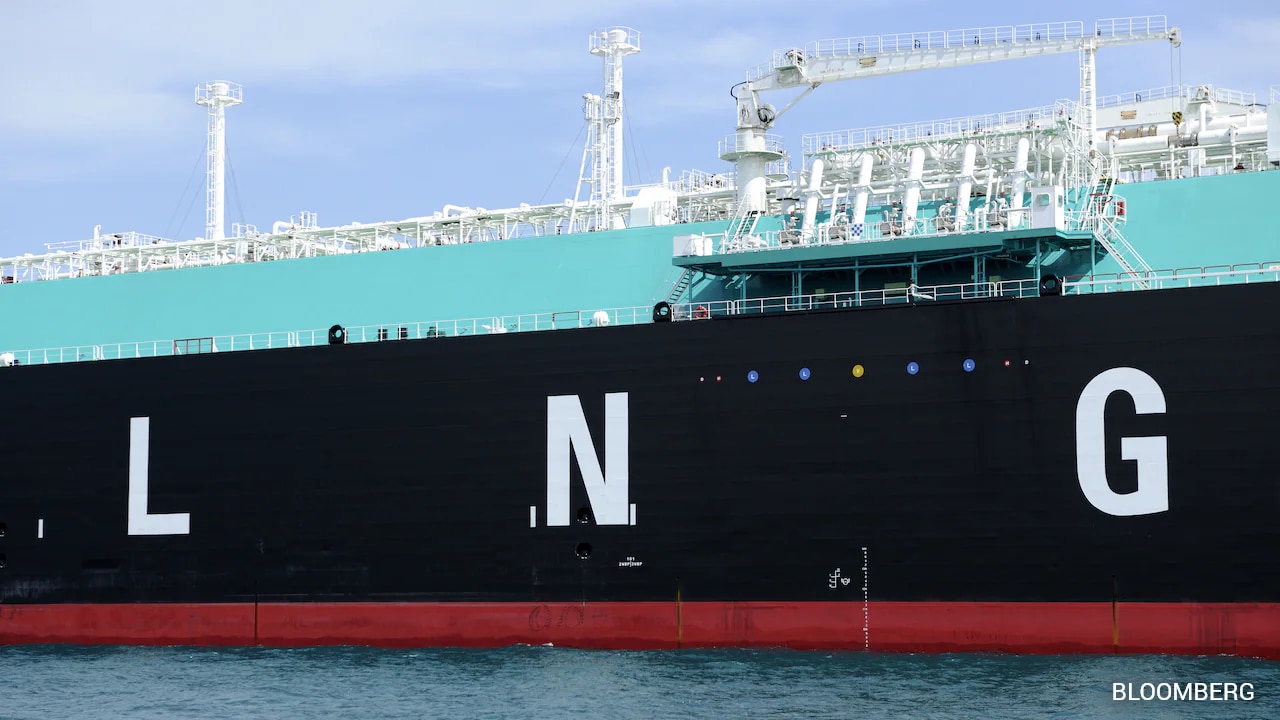
When an LNG carrier bound for Pakistan comes under fire just hours after receiving explicit transit clearance from Tehran, the incident exposes a brutal truth about maritime security in the Strait of Hormuz. Diplomatic permission from a regional power no longer guarantees safe passage through the world's most critical energy chokepoint. The gap between state-level assurances and tactical reality on the water has grown wide enough to swallow multi-million-dollar energy shipments whole, leaving energy-starved nations like Pakistan caught between fractured command structures, opportunistic proxy militias, and skyrocketing maritime insurance premiums.
The maritime shipping industry runs on predictable risk. For decades, even during periods of acute geopolitical tension in the Persian Gulf, informal backchannels and sovereign assurances carried weight. If Tehran cleared a vessel, the implicit understanding was that the Islamic Revolutionary Guard Corps Navy and its affiliated networks would stand down. That calculus has broken down.
The Anatomy of a Broken Chokepoint
The Strait of Hormuz is barely 21 miles wide at its narrowest point, with shipping lanes squeezed into two-mile-wide corridors in each direction. Roughly a fifth of the world's liquefied natural gas passes through this narrow stretch of water, primarily originating from Qatar's massive North Field. For Pakistan, this corridor is not merely a trade route; it is a lifeline.
Unlike European buyers who can pivot to pipeline gas from Norway or regasification terminals along the Atlantic coast, Pakistan relies heavily on seaborne LNG imports to keep its power grid running and its industrial sector operational. When a single cargo is delayed, damaged, or diverted, the impact ripples through Islamabad's economy within days. Power outages lengthen. Fertilizer plants throttle back production. The state-owned Pakistan LNG Limited and Pakistan State Oil face immediate liquidity crunches as they scramble to secure replacement cargoes on a volatile spot market.
An attack occurring immediately after Iranian clearance points to a severe disconnect in operational control. In modern asymmetric naval warfare, the entity granting diplomatic passage in a capital city is rarely the same entity holding the trigger on a coastal missile battery or a fast-attack drone boat.
Consider the command architecture operating along the northern shore of the Gulf and the adjacent Gulf of Oman. While Iran's conventional navy and diplomatic corps operate within a recognizable state framework, the Islamic Revolutionary Guard Corps (IRGC) maintains an independent maritime command with decentralized rules of engagement. Further complicating the picture are semi-autonomous regional militias and intelligence-gathering vessels that operate with plausible deniability. A clearance granted through diplomatic channels can easily fail to reach a forward-deployed tactical unit operating under radio silence, or worse, be deliberately ignored by hardline factions seeking to demonstrate leverage.
Why Diplomatic Clearance Fails in Modern Maritime Warfare
To understand how a cleared vessel becomes a target, you have to look at how targeting happens at sea today. It is rarely a cinematic standoff between a warship captain and a merchant mariner.
Commercial LNG carriers are massive, slow-moving targets with minimal defensive capabilities. Their transponders—the Automatic Identification System (AIS)—broadcast their identity, speed, heading, and destination to anyone with a basic receiver. Even when a vessel turns off its AIS to "go dark" in high-risk zones, commercial satellite imagery, coastal radar, and spotter vessels make hiding a 300-meter liquefied natural gas tanker nearly impossible.
Once a vessel enters the transit zone, multiple actors track its movement:
- State Naval Forces: Monitoring compliance with territorial waters and international transit lanes.
- Paramilitary Fast-Attack Units: Operating swarms of small craft, explosive-laden unmanned surface vessels, and shore-based anti-ship cruise missiles.
- Third-Party Intelligence Networks: Foreign naval coalitions and regional rivals continuously mapping vessel movements and electronic emissions.
In a hypothetical scenario, imagine a carrier chartered to deliver Qatari gas to Port Qasim near Karachi. Diplomatic channels in Islamabad confirm with counterparts in Tehran that the vessel poses no threat and carries cargo vital to a neighboring Muslim nation. The message goes out. Yet, three hours later, as the ship exits the strait into the Gulf of Oman, a loitering munition or a limpet mine strikes its hull.
The failure lies in the communication latency and compartmentalization inherent to asymmetric warfare. Tactical commanders on the coast are often given broad standing orders to harass, interdict, or strike specific categories of commercial shipping—often linked to vessel ownership, flag state, or insurer nationality rather than the cargo's final destination. A ship carrying Pakistani gas might be owned by a Greek shipping magnate, managed by a firm in Singapore, and insured by a syndicate in London. To a coastal operator looking at ownership registries rather than diplomatic cables, that vessel looks like a Western asset.
The Illusion of Neutrality in Global Shipping
Pakistan has spent years walking a tightrope in Middle Eastern geopolitics. Islamabad maintains deep economic and military ties with Gulf Arab states, relies on Qatar for long-term LNG supply contracts, and simultaneously seeks to manage a delicate, often tense border and energy relationship with Iran.
The assumption in Islamabad has long been that neutrality buys immunity. If Pakistan stays out of regional naval coalitions and avoids taking sides in Gulf disputes, its energy shipments should pass unmolested.
That assumption ignores the structural reality of global maritime logistics. Countries do not own the ships that carry their energy. When Pakistan buys a cargo of LNG on a Delivered Ex-Ship (DES) basis, the seller—often a major international trading house or a Qatari state entity—arranges the vessel. That ship is part of a global pool of specialized tankers with complex, multi-layered corporate ownership.
- The Registered Owner: Frequently a special-purpose shell company registered in jurisdictions like the Marshall Islands, Panama, or Liberia.
- The Commercial Operator: Often a European or Asian maritime management firm handling crew, maintenance, and routing.
- The Charterer: The energy trader or state utility leasing the vessel for a specific voyage.
- The Financier and Insurer: Western banks and protection and indemnity (P&I) clubs underwriting the hull and cargo.
When a militant group or a rogue naval unit selects a target, they rarely care who is going to burn the gas at the end of the voyage. They target the financial and logistical web behind the ship. By striking a vessel tied to Western finance or European management, the attackers inflict economic pain on their primary adversaries while treating the importing nation—in this case, Pakistan—as acceptable collateral damage.
The Hidden Financial Toll on Energy Importers
An attack on an LNG carrier does not need to sink the ship to achieve a strategic objective. Liquefied natural gas tankers are built with heavy double hulls and sophisticated containment systems—such as membrane or Moss spherical tanks—specifically designed to prevent catastrophic ruptures. Even a direct hit from a drone or a small missile often results in localized structural damage rather than a massive explosion.
The real damage happens in the financial markets of London and Singapore before the smoke even clears.
The moment a vessel is struck in the Strait of Hormuz or the Gulf of Oman, war risk insurance premiums spike. Marine insurers recalculate the probability of loss across the entire region within hours. For a single voyage into a designated high-risk zone, additional war risk premiums are calculated as a percentage of the vessel's total hull value. On a modern LNG carrier valued at upwards of $200 million, a sudden jump in war risk rates adds hundreds of thousands of dollars to the cost of a single delivery.
For wealthy Asian buyers like Japan or South Korea, these surcharges are an annoying operational expense. For Pakistan, whose foreign exchange reserves are perpetually under strain and whose energy sector is buried under trillions of rupees in circular debt, those surcharges are devastating.
Furthermore, shipowners begin refusing to charter vessels for deliveries to Pakistani ports unless the buyer absorbs all war risk costs and provides sovereign guarantees against vessel detention or damage. Trading houses invoke force majeure clauses or demand steep risk premiums on spot cargoes. The result is a silent blockade—not enforced by warships, but by actuaries and maritime lawyers.
The Security Vacuum and Naval Realities
Following repeated attacks on commercial shipping in the Middle East over the past several years, Western nations have launched various maritime security initiatives to patrol the Strait of Hormuz and the Bab el-Mandeb Strait. Yet, these coalitions have consistently failed to deter targeted strikes.
The math works against conventional navies. A multi-billion-dollar guided-missile destroyer cannot escort every merchant vessel transiting the Gulf. Even when warships are present in the region, the sheer volume of maritime traffic—hundreds of tankers, container ships, and bulk carriers moving through congested waters alongside thousands of local fishing dhows—creates an overwhelming surveillance problem.
Attackers exploit this congestion. Small radar cross-section drones launched from coastal caves or disguised merchant vessels can reach a target within minutes, leaving defensive systems almost no reaction window.
Pakistan's own naval capabilities, while formidable in the North Arabian Sea and tailored to counter regional rivals, are not configured to maintain continuous, high-intensity air and missile defense escorts inside the Persian Gulf. Relying on Iranian diplomatic assurances was Pakistan's low-cost alternative to naval power projection. The strike proves that diplomacy without an enforcement mechanism is merely wishful thinking.
What This Means for Global LNG Markets
The vulnerability of the Strait of Hormuz has been a staple of energy security briefings for forty years, yet the market consistently underprices the risk until steel actually bends. Global gas markets have grown dangerously complacent, assuming that because Iran needs the strait open for its own oil exports and imports, Tehran will ultimately keep a lid on escalation.
This logic is flawed. It assumes a monolithic, rational actor in complete control of every asset along its coastline. In reality, the Persian Gulf has entered an era of managed instability, where calibrated violence is used routinely as a negotiating tool, and where tactical errors or unauthorized strikes are inevitable byproducts of keeping forces on a hair-trigger alert.
For energy importers across South and East Asia, the lessons are immediate and unforgiving:
- Sovereign Assurances Are Worthless Without Tactical Verification: Diplomatic green lights must be backed by real-time maritime deconfliction channels, not verbal promises from foreign ministries.
- Supply Chain Diversification Is No Longer Optional: Over-reliance on a single maritime chokepoint leaves national economies hostage to regional conflicts they cannot control.
- Chartering Structures Must Adapt: State buyers must rethink how they contract for LNG, scrutinizing vessel ownership profiles and insurance structures to avoid inadvertently booking ships that sit high on militant target lists.
The attack on a Pakistan-bound carrier after Iranian clearance is not an anomaly or a simple communications glitch. It is a clear signal that the old rules of Gulf transit have evaporated, leaving every vessel entering the Strait of Hormuz to navigate on borrowed time.


