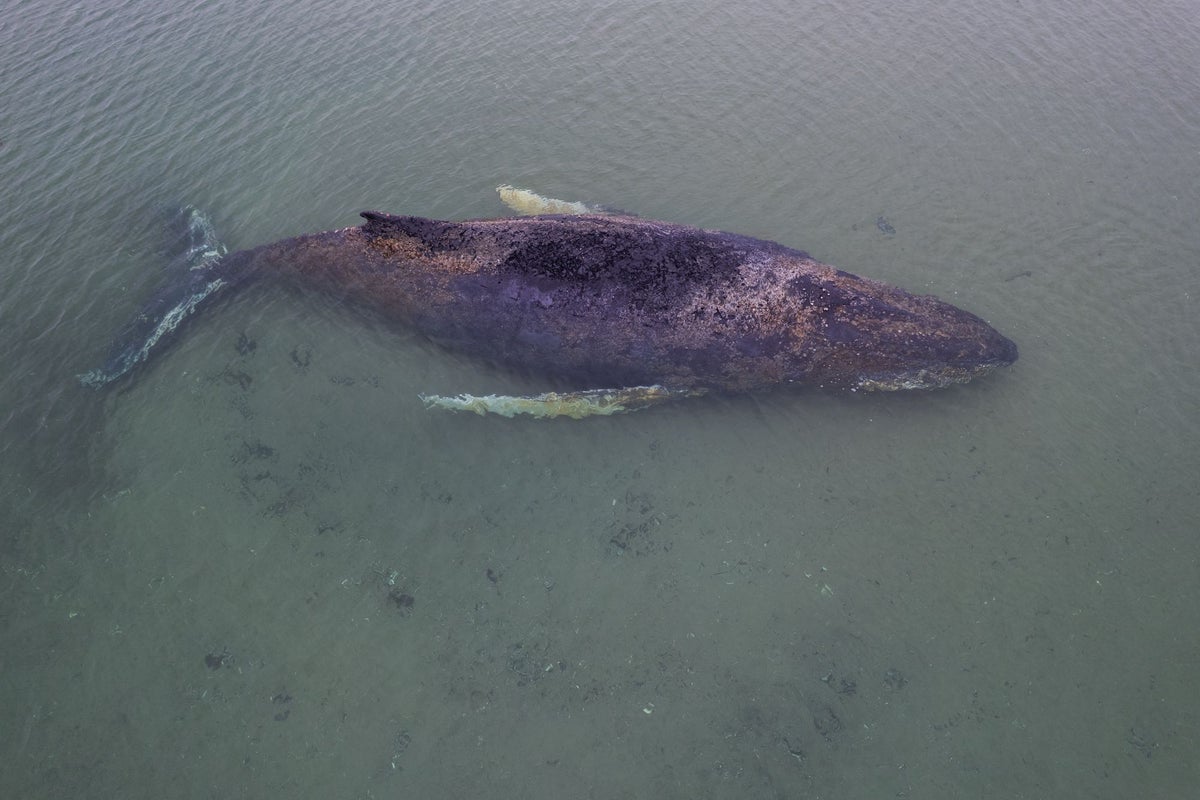
Biological survival in large-scale cetacean strandings is dictated by a brutal intersection of thermodynamics, structural engineering, and renal physiology. When a 30-ton humpback whale (Megaptera novaeangliae) leaves the buoyancy of the water column, its own mass becomes a lethal mechanism. The 76-hour rescue window is not a arbitrary countdown; it is the calculated limit of a biological system's ability to withstand gravitational crushing and systemic toxification. To understand why a 0.1% survival chance is the baseline for such operations, one must analyze the three structural failures that occur the moment the animal hits the shoreline.
The Triad of Physiological Collapse
The transition from a marine to a terrestrial environment initiates a cascade of systemic failures that rescue teams must counteract simultaneously.
1. Mechanical Compression and Myopathy
In the ocean, a whale’s internal organs are supported by neutral buoyancy. On land, the force of gravity ($F = mg$) compresses the ventral surface. This pressure restricts blood flow to the massive muscle groups, specifically the peduncle and the pectorals. Deprived of oxygen, muscle tissue begins to break down—a process known as rhabdomyolysis. This is not merely a localized injury; it is a systemic poisoning. As muscle cells rupture, they release myoglobin into the bloodstream.
2. Renal Failure via Myoglobinuria
The whale’s kidneys are designed to process salt and metabolic waste, not the massive influx of heme proteins released by crushed muscles. Myoglobin is nephrotoxic. As the rescue effort passes the 24-hour mark, the primary risk shifts from external trauma to internal organ failure. Even if the whale is successfully returned to the water, the accumulated myoglobin often leads to acute tubular necrosis. A successful "refloat" does not equate to a successful "rescue" if the renal system has already crossed the threshold of irreversible damage.
3. Hyperthermia and Thermoregulatory Dysfunction
Whales are wrapped in blubber, a highly efficient insulator designed to retain heat in near-freezing depths. On a beach, this insulation becomes a furnace. Without the convective cooling of seawater, the animal’s core temperature rises rapidly. Thermal stress accelerates metabolic rates, which in turn increases the demand for oxygen in tissues already suffering from restricted circulation. This creates a feedback loop that leads to cardiovascular collapse.
The Logistical Cost Function of a 76-Hour Operation
Rescue operations are often criticized for their perceived lack of speed, but the 76-hour duration is frequently a byproduct of the tension between two conflicting variables: the tide cycle and the mechanical safety of the animal.
The Tidal Window Constraint
Operations are tethered to the lunar cycle. A whale stranded at high tide is often left high and dry as the water recedes, requiring a minimum of two tidal cycles (approximately 24 hours) before the water is deep enough to provide natural buoyancy again. If the initial refloat attempt fails, the team is forced to wait for the next optimal window. Every hour spent waiting increases the "crush depth" of the animal’s own weight on its lungs.
Strategic Weight Distribution
Moving a 30,000-kilogram organism requires specialized slings and heavy machinery. If the lift is poorly executed, the rescue itself becomes the cause of death. Using a single point of contact—such as a tail tow—can dislocate the vertebrae or sever the spinal cord. The logistics of a 76-hour effort are dominated by the "Slow Lift" protocol:
- Phase 1: Stabilization. Cooling the skin with water and shade to mitigate hyperthermia.
- Phase 2: Positioning. Manual excavation around the pectoral fins to reduce pressure.
- Phase 3: Sling Integration. Threading industrial-grade webbing beneath the torso during the transition between low and incoming tide.
Quantifying the 0.1 Percent Survival Probability
The "0.1% chance" frequently cited in these scenarios is an actuarial reflection of historical data rather than a guess. This probability is derived from the "Stranding Severity Index," which calculates survival based on three primary metrics:
- Time Out of Water (TOW): Survival rates drop exponentially after the 12-hour mark. By 72 hours, the probability of long-term survival (defined as living more than 30 days post-release) nears zero.
- Species-Specific Mass: Smaller odontocetes (dolphins, porpoises) have higher survival rates because their mass-to-surface-area ratio allows for better heat dissipation and less internal crushing. Large baleen whales, like the humpback, occupy the lowest end of the survival spectrum.
- Substrate Composition: A sandy beach allows for some molding to the animal's shape, distributing weight. A rocky or hard-packed mud substrate increases localized pressure points, accelerating tissue necrosis.
The 0.1% figure also accounts for "post-release mortality." Public-facing narratives often end when the whale swims away. However, satellite tagging data indicates that a significant portion of refloated whales die within weeks due to the delayed effects of rhabdomyolysis or infectious complications from skin lesions sustained during the stranding.
The Ethics of the Intervention Delta
When the probability of survival is so low, the strategy shifts from "Rescue" to "Data-Driven Management." Experts must decide if the resources—hundreds of personnel, heavy machinery, and significant financial expenditure—are justified.
The value of a 76-hour effort is not solely found in the survival of the individual. These operations serve as critical data-gathering opportunities. Blood samples taken during the effort provide insights into the stress physiology of cetaceans that are impossible to obtain in the wild. Necropsies of failed rescues reveal the underlying health of the local population, including parasite loads, plastic ingestion, and acoustic trauma.
From a strategic standpoint, the intervention is also a mitigation of public health risks. A 30-ton carcass on a public beach is a significant biohazard. The gases produced during decomposition—methane and hydrogen sulfide—can lead to explosive carcass ruptures. Managing the whale while it is alive, even with a 0.1% survival rate, is often more logistically sound than dealing with the disposal of a massive, decaying organism in a populated area.
The Critical Path for Future Interventions
To move beyond the 0.1% survival plateau, the focus must shift from reactive mechanical lifting to proactive physiological stabilization. Current research into injectable vasodilators and portable cooling systems represents the next logical step in field medicine. If we can chemically mitigate the effects of myoglobinuria while the animal is still on the beach, the 76-hour window becomes a manageable recovery period rather than a death sentence.
The fundamental bottleneck remains the "First Response Gap." Most strandings are reported hours or days after the event begins. Improving survival rates requires an automated acoustic monitoring network that can detect the specific "distress vocalizations" often emitted by pod-affiliated whales before they beach.
The success of future operations will be measured by the reduction of internal pressure during the first six hours, not by the sheer duration of the effort. We must prioritize the immediate deployment of inflatable pontoons that can be inserted beneath the animal at low tide, providing an artificial "buoyancy cushion" that stops the clock on muscle degradation. This shift from brute force lifting to early-stage structural support is the only viable path to increasing the statistical probability of a successful return to the deep.