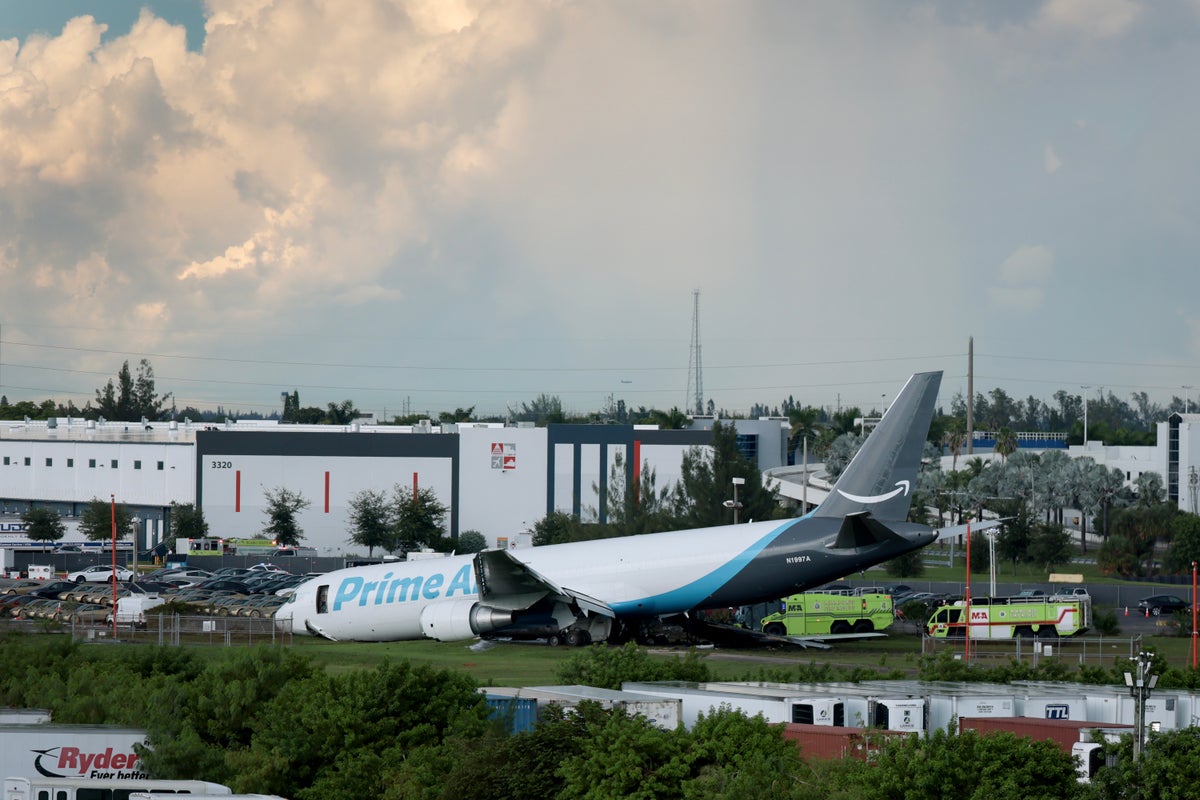
The fatal overrun of a Boeing 767-300 freighter operated by 21 Air on behalf of Amazon Prime Air at Miami International Airport exposes a catastrophic failure chain in terminal energy management. When a widebody aircraft exits the paved surface at 112 knots, structural containment fails and kinetic energy converts directly into localized destruction. Federal investigators from the National Transportation Safety Board are focusing on touchdown dispersion and decision timing. Deconstructing the mechanics of this event requires analyzing the operational variables that dictate stopping distance limits on commercial runways.
The Kinematics of Energy Dissipation
An aircraft landing sequence is a controlled deceleration exercise governed by kinetic energy formulas where velocity squared dictates stopping distance requirements. The nominal touchdown zone occupies the first 3,000 feet of a standard runway. Entering this zone with excess ground speed or an extended float phase reduces the available stopping runway exponentially.
Three physical forces dictate whether an aircraft stops within safe boundaries:
- Aerodynamic drag via spoilers and reverse thrust deployment.
- Wheel braking friction controlled by anti-skid systems.
- Runway surface conditions, including macro-texture and contaminant films like standing water.
When a flight crew elects to salvage a landing past the midpoint of the usable tarmac, the remaining distance becomes mathematically insufficient for maximum braking deceleration. The Miami incident featured an extended airborne float above the runway surface without immediate nose-down application to force wheel contact, consuming critical deceleration length before ground friction could be engaged.
The Go Around Decision Threshold
Commercial aviation protocols mandate a rejected landing—known as a go-around—whenever an aircraft misses the targeted touchdown zone or experiences destabilizing environmental vectors below decision height. Executing this maneuver requires an immediate thrust transition from idle to takeoff power, establishing a positive rate of climb, and retracting landing gear.
The human and organizational factors governing this threshold involve cognitive lock-in. Flight crews face schedule pressures, fuel constraints, and environmental anomalies such as localized wind shear or tailwinds associated with nearby convective storm cells. A tailwind component increases ground speed relative to air speed, creating a longer float duration during flare. When pilots attempt to force a floating aircraft onto the ground rather than initiating a go-around, they violate energy management boundaries. The failure to execute a missed approach transforms a routine weather-impacted arrival into an unrecoverable high-speed excursion.
Infrastructure Deficits and Containment Limits
Runway safety margins depend heavily on passive engineering controls. Miami International Airport lacks engineered materials arresting systems, commonly known as EMAS, on the specific runway involved. These crushable concrete beds are designed to deform under an aircraft's weight, absorbing kinetic energy and bringing an overrunning jet to a controlled halt without structural disintegration.
Without an arresting bed, the margin between runway end safety areas and perimeter infrastructure vanishes. Perimeter roads, support facilities, and vehicular traffic sit directly in the path of uncontained momentum. The absence of physical deceleration beds shifts the entire burden of containment onto flight deck decision-making and onboard braking mechanics. When both fail simultaneously, the vehicle breaches airport boundaries, resulting in catastrophic kinetic transfers with civilian infrastructure.
Operational Fleet Dynamics and Oversight
The aircraft involved was a 32-year-old airframe originally manufactured as a passenger transport before undergoing freighter conversion. While airframe age does not inherently dictate structural safety, older digital avionics, aging hydraulic actuators, and legacy anti-skid braking configurations demand rigorous maintenance tracking. Outsourced cargo operations, where major logistics brands contract regional or specialized air carriers like 21 Air to fly dedicated routes, introduce complex multi-tier supervisory structures. Oversight divisions must audit whether contracted flight crews maintain identical training thresholds for unstabilized approach recognition as legacy scheduled passenger carriers.
Mandate rigorous threshold-crossing speed audits and enforce automatic safety management system alerts whenever commercial freighters exceed target touchdown zones by more than 1,500 feet.