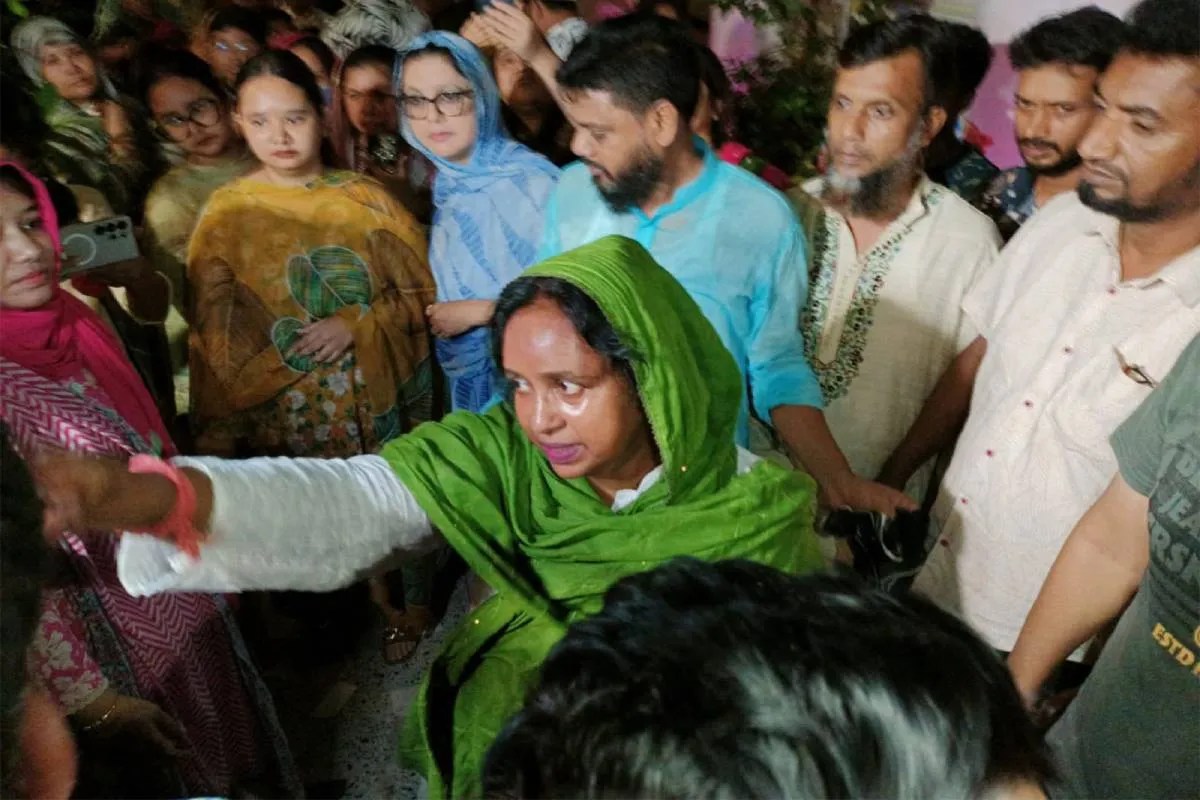
The release of Selina Hayat Ivy, the former mayor of Narayanganj and a prominent figure within the Awami League, marks a critical inflection point in Bangladesh’s transitional governance. Following the departure of former Prime Minister Sheikh Hasina, the interim administration has faced a dual challenge: stabilizing state institutions while executing judicial and political accountability measures against the former ruling elite. Ivy’s release from jail provides a structural case study in how the interim legal framework distinguishes between systemic regime complicity and localized, high-administered political capital.
Understanding this development requires moving past sensationalist media narratives. Instead, the situation must be analyzed through the lens of political risk, judicial precedent, and the structural stabilization of municipal governance.
The Dual-Track Accountability Framework
The interim government’s approach to former Awami League officials operates on a dual-track mechanism. The first track targets the regime's core leadership, focusing on command responsibility for state-sanctioned violence and systemic financial corruption. The second track addresses regional administrators who, while affiliated with the party, maintained distinct local power bases and operational variance from the central command in Dhaka.
Ivy’s legal trajectory falls firmly into the second category. Her political profile rests on three structural pillars that differentiate her from the broader Awami League leadership:
- Independent Local Legitimacy: Unlike many contemporary politicians who relied entirely on central party nomination and managed elections, Ivy secured her position through competitive municipal contests in Narayanganj, establishing a direct mandate that often bypassed or openly clashed with local party factions, most notably the Osman family.
- Administrative Governance Record: Her tenure as mayor was characterized by structural municipal development rather than active participation in central law enforcement or national security policy, insulating her from the primary legal liabilities faced by the cabinet.
- Public Dissidence Alignment: Historically, Ivy maintained a public stance against the criminalization of local politics within her own party, providing her with a degree of civic insulation during the post-regime backlash.
The judicial decision to grant her release indicates that the interim judiciary is applying a standard of specific material liability rather than collective guilt. This distinction is vital for maintaining the credibility of the legal transition and preventing a complete collapse of administrative continuity at the local government level.
Municipal Governance Bottlenecks and Post-Regime Stabilization
The departure of a long-standing regime invariably triggers a governance vacuum at the municipal level. In Bangladesh, local government institutions are heavily centralized and dependent on executive leadership. When mayors and city corporation officials fled or were detained, urban service delivery mechanisms stalled.
The operational bottleneck manifests across specific vectors:
[Regime Collapse]
       │
       ▼
[Administrative Vacuum] ──► [Budgetary Stagnation] ──► [Infrastructure Decay]
       │
       ▼
[Law & Order Deficit] ──► [Supply Chain Disruption]
The breakdown of this system directly affects economic stability. Narayanganj serves as a primary industrial hub for Bangladesh’s Ready-Made Garment (RMG) sector and inland river trade. Extended administrative paralysis in this zone compounds national supply chain vulnerabilities.
By allowing figures with deep localized operational knowledge and minimal direct implication in state violence to re-enter the civic sphere, the transitional framework attempts to mitigate these economic disruptions. This is not a political concession; it is an administrative stabilization tactic designed to keep critical economic zones functional while national legal processes unfold.
The Fragmentation of the Awami League Infrastructure
The release of a prominent figure like Ivy raises immediate questions regarding the future structural integrity of the Awami League. The party is currently undergoing a process of forced decentralization, split into three distinct echelons.
The Exiled Leadership
Comprising the highest tier of the party executive currently residing outside Bangladesh. This group retains symbolic control but lacks the operational capacity to influence day-to-day domestic politics or protect lower-tier cadres from legal prosecution.
The Detained Bureaucracy
Former cabinet ministers, members of parliament, and security officials currently facing formal charges. This tier is functionally neutralized for the foreseeable future, as their legal outcomes are tied directly to the systemic accountability processes of the interim government.
The Localized Survivors
Figures like Ivy who possess independent political capital and local networks. This echelon faces the complex task of navigating a hostile political environment without central coordination. Their primary objective is political survival through legal compliance and the preservation of local constituent relationships.
The strategic challenge for this third tier is the complete absence of a unified party apparatus. The central command structure has dissolved, leaving local leaders to negotiate their political and legal survival on an individual, case-by-case basis. Ivy’s release demonstrates that individual survival is possible through strict adherence to judicial processes, but it does not signal a broader, coordinated resurgence of the party as a cohesive national force.
Strategic Risks for the Interim Administration
The management of high-profile political detainees presents significant strategic risks for the interim administration. The primary risk is the management of public perception versus judicial independence.
If the judiciary releases former officials based on a lack of specific evidence, the administration risks public backlash from student movements and civil society groups demanding comprehensive accountability. Conversely, if the administration detains individuals without rigorous, evidence-based legal procedures, it undermines its own stated goal of restoring institutional integrity and the rule of law.
Furthermore, the selective release of local leaders can inadvertently trigger localized power struggles. In regions like Narayanganj, where political rivalries are historically volatile, the re-emergence of established political figures alters the local power equilibrium. The interim government must deploy adequate civil-military law enforcement assets to ensure that these transitions do not result in street-level turf wars or retaliatory violence between competing factions.
Operational Forecast for Regional Political Dynamics
The structural reality of Bangladesh’s political transition dictates that local governance cannot remain vacant indefinitely. The interim government's long-term stability depends on its ability to transition from reactive legal measures to proactive institutional restructuring.
Over the next two quarters, the judicial processing of mid-tier political figures will likely accelerate. The administration will utilize a strict evidentiary filter to categorize detainees. Individuals tied directly to financial misappropriation or human rights abuses will face prolonged prosecution, while those involved primarily in routine municipal administration will likely find pathways to bail, provided they do not attempt to mobilize mass political resistance.
The critical variable to monitor is whether released regional figures choose to enter political retirement, attempt to operate as independent civic actors, or covertly rebuild local party networks. In highly industrial zones, the priority will remain the maintenance of law and order to protect export-oriented manufacturing assets. Therefore, any attempt by released political figures to disrupt economic activities will trigger an immediate and severe security response from the state apparatus, nullifying any legal leniency previously obtained.


