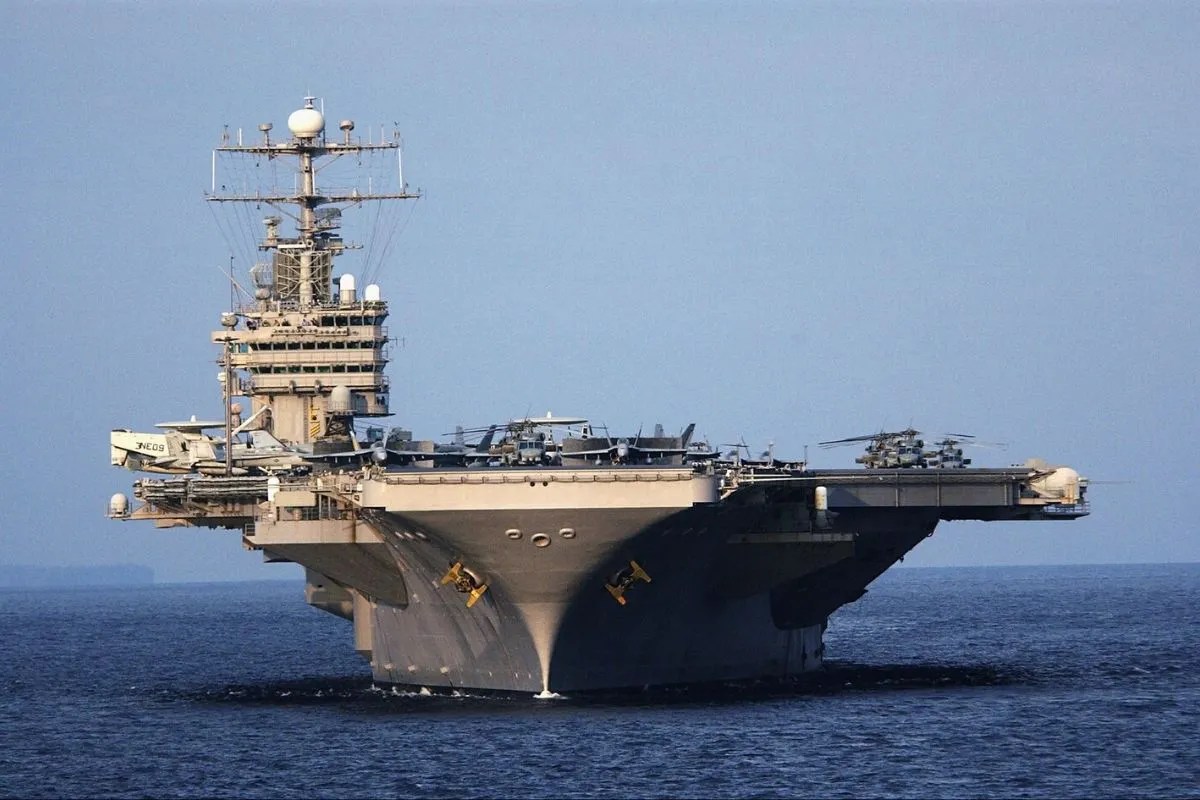
The deployment of a United States carrier strike group to the Arabian Sea is not merely a reactionary movement of hardware; it is a calculated recalibration of the regional security architecture. While conventional reporting focuses on the "presence" of a warship, a rigorous analysis must dissect the specific operational capabilities and the resulting economic-military feedback loops. The strategic objective is the neutralization of Iranian asymmetric threats while securing the Strait of Hormuz—a maritime artery responsible for approximately 21 million barrels of oil flow per day.
The Triad of Deterrence Components
The arrival of a nuclear-powered aircraft carrier (CVN) introduces three distinct operational shifts that fundamentally alter the risk profile for regional actors. You might also find this related coverage insightful: The Crumbling Transatlantic Alliance of the Far Right.
- Electronic Warfare Supremacy: Modern carrier groups utilize integrated suites like the AN/SLQ-32(V)7 to create a "digital bubble." This degrades the guidance systems of anti-ship cruise missiles (ASCMs) and disrupts the command-and-control (C2) links of unmanned aerial vehicles (UAVs). In the confined waters of the Gulf of Oman, the ability to blind an adversary is more critical than the ability to outgun them.
- Extended Kinetic Reach: The strike group provides a persistent combat air patrol (CAP) that can intercept threats hundreds of miles from the hull. This pushes the "red line" further from the Strait of Hormuz, forcing Iranian assets to operate in a high-risk environment long before they reach their targets.
- Subsurface Denial: Given Iran’s reliance on Kilo-class submarines and midget subs (Ghadir-class) for asymmetric denial, the carrier group's accompanying destroyers and specialized ASW (Anti-Submarine Warfare) aircraft create a multi-layered acoustic net.
The Logistics of the Hormuz Choke Point
The Strait of Hormuz is roughly 21 miles wide at its narrowest point, but the shipping lanes (the Traffic Separation Scheme) consist of two-mile-wide channels for inbound and outbound traffic, separated by a two-mile buffer zone. This geographic compression creates a specific tactical bottleneck where the "cost of defense" is significantly higher than the "cost of disruption."
Iran’s strategy utilizes a "Swarm and Mine" doctrine. Small, fast-attack craft (FAC) armed with short-range missiles can overwhelm a vessel's point-defense systems through sheer volume. The deployment of a carrier strike group acts as a counter-weight to this by providing over-the-horizon surveillance. This allows for the identification of swarm launches at the point of origin, shifting the engagement from a defensive reaction to a preemptive disruption. As reported in detailed reports by Reuters, the effects are notable.
Economic Implications of Maritime Security Insurance
The primary casualty of instability in the Arabian Sea is not usually a sunken vessel, but the skyrocketing cost of Marine Hull and Machinery (H&M) and War Risk insurance. When a carrier enters the theater, it serves as a de facto subsidy for global energy markets.
- Risk Premiums: Without a stabilizing naval presence, insurance underwriters apply "Additional Premium" (AP) areas. These can increase shipping costs by tens of thousands of dollars per transit.
- Buffer Stocks: Volatility in the Arabian Sea forces net energy importers to increase their Strategic Petroleum Reserves (SPR), locking up capital that could be used for infrastructure or internal growth.
The presence of the US Navy reduces the "probability of closure" variable in global pricing models. If the Strait were to be successfully blocked, even for a duration of 72 hours, the resulting supply chain shock would trigger a non-linear spike in Brent Crude prices, potentially exceeding $120 per barrel due to panic-buying and the activation of force majeure clauses in delivery contracts.
Iranian Asymmetric Response Framework
Tehran recognizes the futility of a symmetrical naval engagement. Their counter-strategy relies on the "Three No's" of littoral warfare: No visibility, No predictability, and No fixed targets.
- Coastal Defense Cruise Missiles (CDCMs): Mobile launchers hidden in the rugged terrain of the Makran coast can fire and relocate within minutes. These represent a persistent threat to any vessel within 300 kilometers of the shoreline.
- Loitering Munitions: The proliferation of Shahed-style drones allows Iran to conduct low-cost, high-frequency harassment. While a carrier group can easily shoot these down, the cost-exchange ratio is skewed. Expending a $2 million interceptor missile to destroy a $20,000 drone is a losing proposition in a prolonged war of attrition.
- Proxy Integration: The operational link between Iranian IRGC-QF (Quds Force) and regional proxies creates a "multi-front dilemma." A carrier in the Arabian Sea must monitor not only the Iranian coast but also potential launch sites in Yemen or unconventional threats from merchant vessels converted into "base ships."
Technological Parity and the Hypersonic Variable
The strategic landscape is being complicated by the alleged development of hypersonic or high-supersonic anti-ship missiles. Standard Aegis Combat Systems are designed to track and intercept targets following predictable ballistic or sea-skimming trajectories. A missile traveling at Mach 5+ with terminal maneuverability reduces the reaction window for a carrier's defense to seconds.
The current deployment serves as a real-world test for the "Distributed Maritime Operations" (DMO) concept. Instead of keeping the strike group in a tight formation, assets are spread out to increase the search area and reduce the impact of a single successful strike. This fragmentation makes the group harder to target but requires flawless, jam-resistant satellite communication.
The Geopolitical Cost Function
Maintaining a carrier strike group in the Arabian Sea is an expensive endeavor, both in terms of fuel and "readiness debt." The US Navy is currently facing a crunch in ship maintenance schedules. Deploying a carrier to deter Iran means diverting assets that would otherwise be used for the "Pivot to Asia."
This creates a strategic vacuum. Every month a carrier stays in the Middle East is a month it is not conducting Freedom of Navigation Operations (FONOPs) in the South China Sea. Iran’s goal is to maximize this "time on station" for the US, hoping to wear down the machinery and the political will of the administration.
The immediate tactical play for the US-led coalition involves three specific maneuvers:
First, the establishment of a "Maritime Security Highway" where commercial tankers are tracked in real-time by UAVs.
Second, the integration of regional partners—specifically Saudi Arabia and the UAE—into a shared sensor network to provide a "Common Operational Picture."
Third, the clear communication of "Rules of Engagement" that define a drone approach as a hostile act, permitting immediate kinetic response without the need for a formal declaration of hostilities.
Security in the Arabian Sea is currently a holding pattern. The carrier strike group provides a temporary shield, but it does not address the underlying proliferation of precision-guided munitions among non-state actors. The long-term stability of the Hormuz corridor will depend on the transition from reactive naval presence to an automated, persistent surveillance grid capable of neutralizing threats at the "launch phase" rather than the "impact phase."