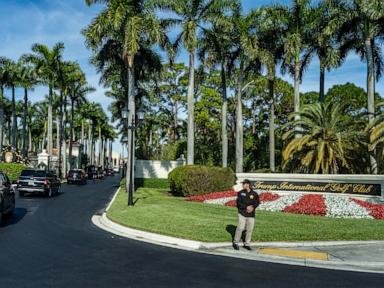
Converting a private commercial golf club into an official Camp David-style presidential retreat shifts the operational, security, and financial architecture of the American presidency from a state-owned monopoly to a hybrid public-private entanglement. When President Donald Trump proposed establishing an official retreat at his private golf property in Florida—historically centered on Trump National Doral or Mar-a-Lago—he introduced a structural divergence from eighty years of executive branch logistics. Standard media coverage frames this proposal through partisan ethics or superficial real estate comparisons. That framing misses the underlying mechanics. To evaluate the viability and consequences of a private presidential retreat, one must analyze three core systems: the physical security perimeter, the federal procurement cost function, and the constitutional friction created by mixing sovereign state functions with private commercial equity.
The Structural Divergence Between Camp David and Private Resorts
Camp David, officially Naval Support Facility Thurmont, operates as a closed military installation inside Catoctin Mountain Park in Maryland. Its primary operational value lies in total sovereign control. The United States Navy manages the facility, the United States Marine Corps provides perimeter security, and the White House Military Office (WHMO) controls all communications and logistical pipelines. No commercial foot traffic exists within miles of the core compound. Every square foot of terrain is owned by the federal government, eliminating third-party property rights, civilian leaseholders, and commercial liability.
A private Florida golf club operates under the exact opposite premise. Commercial clubs are designed for maximum permeability, high-throughput hospitality, and revenue generation through dues, green fees, and event hosting. Transforming a commercial property in South Florida—such as the 800-acre Trump National Doral resort in Miami-Dade County or the Mar-a-Lago Club in Palm Beach—into a permanent executive retreat requires superimposing a military-grade Sensitive Compartmented Information Facility (SCIF) and a multi-tiered Secret Service perimeter onto an active civilian business.
This structural mismatch creates immediate operational friction across four distinct domains:
- Airspace and Maritime Sovereignty: Camp David sits beneath restricted airspace (Prohibited Area P-40) that remains active continuously without disrupting major commercial aviation corridors. Conversely, Doral sits directly adjacent to Miami International Airport, one of the busiest passenger and cargo hubs in the Western Hemisphere. Mar-a-Lago sits directly under the flight path of Palm Beach International Airport and borders the Intracoastal Waterway and the Atlantic Ocean. Establishing a permanent Camp David-style perimeter in South Florida forces the Federal Aviation Administration (FAA) and the United States Coast Guard to impose recurring, economically disruptive Temporary Flight Restrictions (TFRs) and maritime exclusion zones over high-density commercial transit corridors.
- Acoustic and Electronic Hardening: Modern presidential retreats require hardened subterranean or shielded facilities capable of resisting signals intelligence (SIGINT) collection and supporting nuclear command-and-control architecture. At Thurmont, federal engineers have had decades to bury fiber-optic lines, install Tempest-shielded enclosures, and sweep the surrounding woodland for foreign surveillance hardware. Retrofitting a commercial resort built on porous Florida limestone—where high water tables prevent deep subterranean construction—presents severe engineering constraints. Communications infrastructure must be deployed modularly or housed within existing commercial structures that civilian contractors originally built without clearance protocols.
- Human Terrain and Vetting Bottlenecks: In a military installation, every cook, groundskeeper, and HVAC technician holds a security clearance and undergoes continuous vetting under the Uniform Code of Military Justice or federal civil service rules. At a private club, the workforce consists of seasonal hospitality staff, third-party vendors, and transient delivery personnel. Maintaining operational security (OPSEC) requires the Secret Service to conduct continuous background checks on hundreds of private employees while simultaneously screening paying club members and their guests. Every wedding, corporate conference, or golf tournament hosted on the property introduces unvetted individuals inside the outer security ring.
- Topological Vulnerability: Catoctin Mountain provides natural elevation, dense canopy cover, and a buffer of federal parkland that complicates line-of-sight surveillance and unmanned aerial system (UAS) incursions. Florida golf courses are flat, open landscapes surrounded by dense suburban or urban development, multi-story condominiums, and public roadways. Securing a flat, open perimeter against modern commercial drone threats or long-range optical surveillance requires exponentially more manpower and electronic countermeasure deployment than defending a secluded mountain basin.
The Cost Function of Hybrid Executive Logistics
Evaluating the financial impact of a Florida presidential retreat requires separating direct federal outlays from externalized local costs and private revenue capture. Conventional reporting often reduces this issue to the price of hotel rooms or golf cart rentals. The actual cost function is driven by force projection and mobilization logistics.
Every time the executive branch relocates outside the National Capital Region, the federal government executes a massive logistical deployment. The mobilization cost function ($C_{total}$) for a non-military presidential retreat can be expressed through four primary variables:
- Airlift and Transport ($C_{air}$): Operating Air Force One (VC-25A) costs taxpayers roughly $180,000 to $200,000 per flight hour, excluding the accompanying C-17 Globemaster transport aircraft required to ferry the presidential motorcade, Marine One helicopters, and communications vehicles ahead of the president's arrival. Camp David is accessible via a 30-minute flight on Marine One directly from the South Lawn of the White House, bypassing fixed-wing airlift entirely. A South Florida retreat requires a minimum 2.5-hour fixed-wing flight each way, triggering the full C-17 heavy-lift logistics chain for every single weekend trip.
- Protective Detail Overtime and Per Diem ($C_{sec}$): The Secret Service, White House Communications Agency (WHCA), and military support personnel must be housed in commercial hotels near the Florida property. Unlike Camp David, which contains dedicated barracks and quarters for support staff, a private Florida club forces hundreds of federal agents and military technicians into the local hospitality market at peak seasonal rates. This accelerates Secret Service overtime burn rates, frequently pushing agents past statutory pay caps.
- Local Municipal Externalities ($C_{loc}$): When the president occupies Camp David, local municipal law enforcement in Frederick County, Maryland, experiences virtually zero operational burden because federal military police manage all access roads. In Palm Beach or Doral, municipal police departments and county sheriff's offices must deploy marine units, bomb squads, and traffic containment teams around the clock. While Congress periodically appropriates grant money to reimburse local jurisdictions, municipalities routinely absorb millions of dollars in uncompensated overtime and lost commercial tax revenue from closed streets and shuttered local businesses near the perimeter.
- Direct Commercial Capture ($C_{rev}$): Under federal travel regulations, the Secret Service and White House staff must pay fair market value for workspace, lodging, and amenities used at private properties to avoid violating federal ethics rules regarding improper gifts to the government. When the property is owned by the sitting president's private corporate entity, these mandatory federal expenditures flow directly into the president's commercial balance sheet.
The causal chain is straightforward: designating a private Florida club as a primary presidential retreat permanently locks the federal government into the highest-cost operational tier of executive travel while converting fixed taxpayer security requirements into recurring private revenue.
Sovereign Immunity Versus Commercial Liability
Beyond logistics and expenditure, establishing an official presidential retreat on private property creates an unresolved legal collision between sovereign immunity and private premises liability.
Camp David operates entirely under federal jurisdiction. If a foreign dignitary, journalist, or support staffer suffers an injury on the grounds, or if a security incident occurs, the legal framework is governed by the Federal Tort Claims Act and sovereign immunity doctrines. The federal government controls the rules of engagement, physical access, and evidentiary preservation.
A private golf club remains a state-chartered commercial entity subject to Florida tort law, municipal zoning codes, and private insurance underwriting. When the Secret Service establishes a hard perimeter on private land, it effectively commandeers commercial assets for sovereign defense. If a private club member or guest is injured due to security infrastructure—such as temporary barriers, K-9 units, or electronic countermeasure interference—liability fractures between the private property owner and the federal government.
Insurance carriers underwrite commercial golf resorts based on predictable hospitality risks, not the geopolitical target profile of the Commander-in-Chief. The designation of a private club as a regular seat of executive power drastically alters its risk profile, exposing the private entity to heightened terrorism risk and infrastructure wear-and-tear that standard commercial policies exclude. Historically, private entities resolve this by demanding federal indemnification or shifting operational costs onto government leases. When the landlord and the chief executive are the same individual, the arm's-length negotiation required to protect taxpayer interests ceases to exist.
The Emoluments and Diplomatic Leverage Mechanism
Camp David has historically functioned as an instrument of statecraft precisely because of its austerity and neutrality. From Franklin D. Roosevelt and Winston Churchill planning the Normandy invasion to Jimmy Carter brokering the 1978 Camp David Accords between Egypt and Israel, the facility's lack of commercial luxury forced foreign leaders into an isolated, egalitarian environment where neither side held a commercial stake in the venue.
Hosting foreign heads of state at a private presidential golf resort fundamentally alters the diplomatic incentive structure. It introduces a transactional variable into bilateral diplomacy:
- Coercive Patronage: Foreign delegations, lobbyists, and domestic political allies recognize that patronizing the president's private resort—booking blocks of rooms, hosting gala dinners, or purchasing club memberships—places them in physical proximity to the chief executive. Even without explicit solicitation, the venue itself acts as a financial filter. Access becomes correlated with commercial expenditure at the president's business.
- Diplomatic Reciprocity Friction: Under the Foreign Emoluments Clause of the U.S. Constitution (Article I, Section 9, Clause 8), federal officeholders are prohibited from accepting payments, gifts, or benefits from foreign states without congressional consent. When a foreign government pays for lodging, security staging, or banquet services at a presidentially owned retreat during a diplomatic summit, those payments cross directly into contested constitutional territory. While legal defenders argue that market-rate commercial transactions for hotel rooms do not constitute "emoluments," the structural reality remains that a foreign treasury is enriching the sitting president's private enterprise as a direct consequence of official diplomatic business.
- Public-Private Brand Subsidization: Every official White House press briefing, diplomatic photo opportunity, and executive order signing broadcast from a private golf club generates global earned media for the commercial brand. Taxpayer-funded communications infrastructure, military personnel, and the presidential seal serve as the backdrop for a private commercial asset. In marketing terms, the federal government subsidizes the brand equity of the resort, increasing its pricing power for future private memberships and commercial bookings long after the president leaves office.
Operational Limitations of the Proposal
Even if an administration disregards ethics norms and absorbs the elevated financial costs, a private Florida club cannot replicate the core strategic functions of Camp David.
First, a commercial resort cannot achieve operational continuity during a high-tier national security crisis. During a DEFCON elevation or an active military conflict, Camp David transitions seamlessly into an auxiliary continuity-of-government command post. Civilian staff are non-existent, and the surrounding airspace and road networks can be sealed entirely within minutes without displacing thousands of local residents or shutting down a major international airport. A commercial resort in Miami-Dade or Palm Beach County is inextricably embedded in a dense civilian metropolis; evacuating or locking down the surrounding urban grid during a kinetic crisis is a logistical impossibility.
Second, the psychological effect of Camp David relies on isolation. Stripping away external distractions, media access, and social obligations forces principals in high-stakes negotiations to focus exclusively on diplomatic deadlock resolution. A luxury golf resort filled with paying members, socialites, and commercial events provides constant distraction and leaks operational details in real time via cell phone cameras and social media posts from civilian bystanders. You cannot maintain strict diplomatic confidentiality when non-cleared civilians share the dining room and the driving range with cabinet secretaries and foreign ministers.
Third, the weather profile of South Florida introduces seasonal operational vulnerability. Hurricane season runs from June through November, regularly threatening coastal and low-lying properties in Miami and Palm Beach with storm surge, high winds, and power grid failures. Camp David, situated at an elevation of 1,850 feet in the Catoctin Mountains, is immune to coastal storm surge and maintains hardened, independent power generation capable of operating off-grid indefinitely. Relying on a coastal Florida property as a primary executive retreat means accepting predictable annual windows where the facility becomes an operational liability rather than a secure command center.
The Strategic Play for Executive Infrastructure
If an administration intends to modernize executive retreats or expand presidential operational capacity in the southern United States without triggering constitutional friction or degrading national security, it must decouple the geographic preference for Florida from private commercial ownership.
The Department of Defense already maintains massive, secure, federally owned installations throughout Florida, including MacDill Air Force Base in Tampa (headquarters of U.S. Central Command and U.S. Special Operations Command), Naval Air Station Key West, and Patrick Space Force Base. Establishing an official southern presidential retreat within the perimeter of an existing military installation—such as MacDill Air Force Base—captures every climatic and geographic advantage of Florida while preserving absolute sovereign control, existing SCIF infrastructure, restricted military airspace, and zero commercial entanglement.
For policymakers, oversight committees, and taxpayers, the rule is clear: sovereign executive functions require sovereign physical infrastructure. Any attempt to permanently fuse the logistical apparatus of the presidency with a private commercial enterprise will inevitably degrade operational security, inflate federal expenditure through avoidable mobilization costs, and subordinate national statecraft to private balance sheets.


