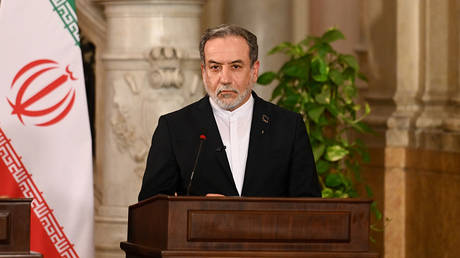
The warning arrives on a glowing screen at three in the morning.
In a quiet apartment three hundred miles from the nearest military base, a shipping logistics coordinator named Tariq—a hypothetical composite drawn from the thousands of maritime workers who keep global trade moving—stares at a breaking news alert. Iranian officials have issued a stark declaration, warning that they will "rain down hell" if the United States escalates the conflict further. To a cable news anchor reading from a teleprompter, the phrase is a sharp soundbite designed to dominate a broadcast segment. To Tariq, who spends twelve hours a day tracking container vessels through the Strait of Hormuz, those four words translate immediately into rising insurance premiums, rerouted hulls, and a sudden, cold knot in his stomach.
Words do not stay on paper in the Persian Gulf. They turn into fuel surcharges, delayed medicine, and sleepless nights for families watching the horizon.
When political leaders trade threats of total retaliation, the public tends to picture cinematic explosions or distant diplomatic podiums. We rarely see the invisible architecture of deterrence—how two nations lock themselves into a room where backing down looks like defeat, and moving forward looks like catastrophe. Yet understanding what actually sits behind Iran's latest warning requires looking past the dramatic rhetoric and examining the mechanics of modern brinkmanship, the historical scars that shape both Washington and Tehran, and the ordinary lives caught in the narrowing space between them.
The Anatomy of a Warning
Rhetoric in international crises functions like a pressure valve. Sometimes it releases domestic tension; sometimes it signals genuine intent to strike.
According to statements reported across international media, Iranian military and political figures framed their threat to "rain down hell" specifically as a conditional response—a vow tied directly to whether the United States expands its military operations. Analysts who study the Islamic Republic's communication patterns note that Tehran frequently uses maximalist language to project strength to both foreign adversaries and domestic audiences, even when its actual military doctrine relies on calculated, asymmetric calibration.
Consider the distinction between a threat and a trigger.
Think of deterrence like two people standing in a room soaked in gasoline, each holding a match. Neither wants to strike the flame, because both know the room will burn down around them. Instead, each shouts louder about how bright their match will burn, hoping the other drops theirs first and steps outside. The danger is never that someone calmly decides to burn the house down; the danger is that someone slips on the wet floor, drops the match by accident, and leaves the other person no choice but to react.
In Washington, defense officials view Iranian warnings through the lens of force protection and regional stability. American policymakers argue that maintaining a credible military posture—including carrier strike groups, air defense batteries, and targeted deterrence operations—is essential to prevent attacks on U.S. personnel, allied nations, and international shipping lanes. From the Pentagon's perspective, failing to respond to provocations invites wider aggression.
In Tehran, the calculus looks entirely inverted. Iranian leaders view American military buildup along their borders not as defensive containment, but as an existential siege. Having spent decades under severe economic sanctions and watching neighboring governments topple during earlier U.S. interventions, Iran's leadership treats every American deployment as a prelude to regime change. When Tehran threatens massive retaliation, it is attempting to raise the perceived cost of any U.S. strike high enough to paralyze decision-makers in Washington.
Both sides believe they are acting defensively. Both sides believe the other only understands force.
Ghosts in the Gulf
You cannot understand the tension in the Strait of Hormuz today without remembering the ghosts that already haunt its waters.
History in this region does not pass; it accumulates like salt on a ship's hull. For Iranians, collective memory stretches back to the 1953 CIA-backed coup that overthrew Prime Minister Mohammad Mossadegh, through the long, brutal Iran-Iraq War of the 1980s—when Washington tilted toward Saddam Hussein—and into the modern era of nuclear negotiations, the 2018 U.S. withdrawal from the Joint Comprehensive Plan of Action, and the 2020 assassination of General Qasem Soleimani.
For Americans, the timeline carries its own deep wounds. It begins with the 1979 hostage crisis in Tehran, continues through the 1983 Beirut barracks bombing, stretches across years of roadside attacks against U.S. troops in Iraq, and includes ongoing clashes with Iranian-aligned militias across the Middle East.
I remember sitting in a cramped café in Amman several years ago during an earlier spike in U.S.-Iran tensions, listening to a retired Jordanian diplomat stir sugar into a tiny glass of black tea. Outside, traffic hummed normally, indifferent to the headlines flashing on the television mounted above the counter. He pointed a spoon at the screen and said something I have never forgotten: "Washington reads the news like a newspaper—each day is a fresh page. Tehran reads it like a ledger—every entry from forty years ago is still waiting to be settled."
That asymmetry in memory makes de-escalation extraordinarily difficult. When American officials speak of "restoring deterrence" through a single targeted action, they often view it as a discrete, self-contained message. Iranian commanders receive that same action as the latest chapter in a continuous, multi-decade campaign—one that demands a visible answer so they do not appear weak before their own hardliners or regional allies.
And uncertainty hangs over every move. Even seasoned intelligence analysts admit they cannot always tell where Iranian bluster ends and operational readiness begins. Will Tehran rely on regional proxies to absorb the pressure, or would an expanded U.S. campaign trigger direct ballistic missile salvos against bases across the Gulf? Nobody outside a handful of fortified command centers knows for certain, and even inside those rooms, plans change the moment the first radar screen lights up.
The Invisible Chokepoint
While generals study maps of airbases and missile silos, the rest of the world lives inside an economic web that runs directly through the line of fire.
Look at a map of the Persian Gulf. At its eastern mouth, the waterway pinches into a narrow curve between Oman and Iran—a channel barely twenty-one nautical miles wide at its narrowest navigable point. Roughly one-fifth of the world's petroleum liquids and a massive share of global liquefied natural gas pass through this single corridor every day.
Let us return to Tariq, our hypothetical shipping coordinator, staring at his monitor before dawn.
If tensions cross from verbal threats into open naval confrontation, the Strait of Hormuz does not even need to be physically blockaded to freeze global commerce. Insurance underwriters in London simply raise war-risk premiums to levels that shipowners cannot afford. Tankers drop anchor outside the Gulf. Refineries in Asia and Europe scramble for alternative supplies. Within days, the shockwave travels from deep-water ports to suburban gas stations, grocery store aisles, and heating bills thousands of miles away.
Consider what happens next:
- Energy markets react before a single shot is fired. Traders price in fear instantly, driving up crude oil benchmarks and triggering inflationary ripples across economies still recovering from previous supply shocks.
- Regional neighbors walk a tightrope. Gulf Arab states—home to vital energy infrastructure and major U.S. military facilities—face the terrifying prospect of catching collateral damage from a conflict they neither started nor control.
- Civilian aviation reroutes across crowded skies. Commercial airlines divert flights around contested airspace, adding hours to international travel and straining air traffic corridors from the Mediterranean to South Asia.
None of these consequences require a full-scale invasion. They happen automatically the moment escalation crosses an invisible threshold.
The Trap of Credibility
Why, if the stakes are so clear, do nations keep inching closer to the edge?
Political scientists call it the commitment trap. Once a leader draws a bright red line in public—whether in a televised address from the Oval Office or a fiery speech from Tehran—retreating from that line carries an immediate political penalty. Advisors warn that backing down will embolden adversaries elsewhere, unsettle allies, and invite criticism from domestic rivals.
So each side takes one careful step forward to prove it is not bluffing.
A naval deployment is answered by a missile drill. A sanctions package is met with enriched uranium stockpiles. An airstrike triggers a threat to "rain down hell." Each move is justified as proportional, necessary, and defensive. Yet stacked together, those proportional steps build a staircase leading straight into an unwanted war.
What makes the current moment particularly fragile is the speed of modern warfare. Hypersonic weapons, swarms of low-cost drones, and cyber operations compress decision-making windows from days to minutes. Commanders have less time to verify whether an incoming signal is a glitch, a rogue unit acting without orders, or the opening wave of a major offensive. In that compressed silence, fear fills the gaps that intelligence cannot cover.
Finding the Exit Door
History does offer moments when leaders stepped back from the precipice—not because they suddenly trusted one another, but because they recognized the mutual ruin waiting on the other side.
During the 1962 Cuban Missile Crisis, back-channel communications allowed Washington and Moscow to construct a face-saving exit even while public rhetoric remained uncompromising. Decades later, quiet Omani mediation helped lay the groundwork for diplomatic engagement between the United States and Iran when official channels were completely frozen.
De-escalation rarely looks dramatic. It does not produce triumphant headlines or viral clips. Instead, it looks like a quiet phone call through a neutral intermediary in Muscat or Doha. It looks like clarifying what a red line actually means before an adversary crosses it by mistake. It looks like giving an opponent room to claim victory at home while quietly pulling forces back from hair-trigger alert.
For ordinary people watching from afar, the noise of geopolitical brinkmanship can feel overwhelming, almost paralyzing. We cannot control what directives leave the Pentagon or the Supreme National Security Council in Tehran. What we can do is refuse to mistake loud threats for inevitability—and recognize that behind every grandiose phrase about "raining down hell" stands a fragile human calculation trying desperately not to blink.
Dawn eventually breaks over the water. Outside Tariq's window, the first delivery trucks begin rumbling down the coastal highway, their drivers checking fuel gauges and delivery schedules, trusting that the invisible machinery of peace will hold for one more day.


