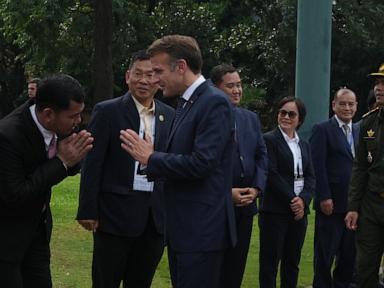
The heavy wooden doors of the diplomatic hall closed with a dull thud that sounded remarkably like a truce nobody actually wanted. Outside, the autumn air was crisp, carrying the faint scent of wet pavement and espresso from nearby cafes, while inside, the fluorescent lights hummed over half-empty water glasses and scattered briefing papers. French President Emmanuel Macron walked briskly toward the waiting motorcade, his jaw set in that familiar, tight line that signals a leader who has just spent forty-eight hours managing a crisis by refusing to let it detonate.
Pause.
Look at what just happened behind those doors. On the surface, a routine gathering of the Organisation internationale de la Francophonie—the sprawling, eighty-eight-member bloc of nations bound together by the French language—had wrapped up its latest summit. Headlines across wire services flatly reported that Macron left the summit with a simmering leadership dispute placed firmly on hold. It sounds dry, bureaucratic, the kind of diplomatic footnote you scroll past while waiting for your morning train. Yet beneath that sanitized phrasing lies a deeply human drama about pride, post-colonial memory, shifting global alliances, and the quiet, agonizing erosion of a cultural empire that once assumed its dominance was permanent.
To understand why a paused leadership dispute matters so much, you have to step out of the marble corridors of Paris and walk into a crowded classroom in Dakar, a bustling tech hub in Kigali, or a sunlit market square in Montreal. Language is never just grammar and vocabulary; it is oxygen, currency, and power. For decades, the Francophonie operated like an exclusive family dinner where Paris sat permanently at the head of the table, carving the roast and deciding who got served first. Now, the younger members of the family have grown up, built their own houses, and started asking why the seating chart never changes.
The Ghost at the Head of the Table
Let us create a hypothetical scene to make this visceral—a composite portrait drawn from countless real diplomatic briefings and late-night hotel bar conversations during these summits. Meet Amadou, a thirty-four-year-old cultural attaché from West Africa, standing near the coffee station outside the main plenary room. His tailored suit is slightly wrinkled from a red-eye flight, and his phone buzzes endlessly with messages from ministries back home watching every camera angle of the summit. Beside him stands Claire, a veteran French diplomat whose family has worked in the Quai d'Orsay for three generations, her posture effortless, her diction crisp as winter apples.
When they talk about the future of the Francophonie, they are using the exact same words—solidarité, rayonnement, partenariat—yet they are speaking entirely different emotional languages. For Claire, the organization is a precious, fragile bridge preserving shared values and cultural influence in an increasingly Anglophone, algorithm-driven world. For Amadou, that same bridge often feels like a one-way toll road where the rules were written long before his country gained independence, and where leadership succession gets frozen the moment it threatens established comfort zones.
This tension is not a sudden squall; it is a slow-moving front that has been gathering pressure for years. Historically, the Francophonie was born in 1970 out of the vision of leaders like Léopold Sédar Senghor of Senegal and Habib Bourguiba of Tunisia, who saw the French language not as a chain of subjugation, but as a tool for international solidarity among newly independent nations. Over the next half-century, the institution expanded dramatically, swelling to represent over 320 million French speakers across five continents, a demographic engine powered overwhelmingly by Africa’s booming youth population. By 2050, projections suggest that roughly eighty-five percent of the world’s French speakers will live on the African continent.
Numbers like that change the gravity in a room. You cannot tell a continent that holds the demographic future of your language that its turn at the wheel has been indefinitely postponed.
When Paused Means Fractured
When diplomats say a leadership dispute has been put "on hold," they are using polite vocabulary for a high-stakes standoff. Usually, selecting or renewing the Secretary-General of the Francophonie—or determining the political direction of its executive leadership—requires consensus, that sacred, exhausting ritual where nobody gets everything they want, so everybody agrees not to walk out. When consensus fractures, leaders face a brutal choice: force a bruising public vote that exposes deep regional fault lines, or freeze the clock and pretend the consensus still breathes.
Macron chose to freeze the clock.
Walking out of the summit without a resolved leadership mandate allowed the French presidency to avoid an immediate, humiliating rupture on live television. In the short term, it looked like tactical restraint, the move of a seasoned statesman keeping the train on the tracks while geopolitical fires rage in Eastern Europe and the Middle East. Look closer, though, and you see the hidden cost of buying time without buying trust.
I remember sitting in a cramped press room during an earlier international summit years ago, watching spokespeople spin a nearly identical deadlock as "constructive reflection." The coffee had gone cold, the carpets smelled faintly of damp wool, and veteran correspondents from Bamako, Brussels, and Beirut traded exhausted glances. We all knew what constructive reflection meant in plain speech. It meant the gap between what Paris wanted and what the rest of the room demanded had grown too wide to paper over with a press release.
Think of the Francophonie right now like an old, sprawling apartment building where the landlord still holds the master keys, even though the tenants now pay ninety percent of the maintenance bills and outnumber the landlord’s family ten to one. When the elevator breaks down, the tenants demand a seat on the building board. If the landlord says, "Let’s table the board elections until next year so we can focus on painting the lobby," the lobby might get a fresh coat of paint, sure. Nobody is fooled about why the election was delayed.
The Weight of Unspoken History
Why does a leadership question inside a linguistic organization provoke such raw emotion? Because every debate over procedure carries the heavy freight of colonial history and modern geopolitical anxiety.
Over the past few years, France’s influence across parts of West and Central Africa has suffered historic reversals. Military coups in Mali, Burkina Faso, and Niger were accompanied by fierce anti-French sentiment in the streets, the expulsion of French troops, and the tearing down of colonial-era symbols. Even in countries that remain close partners—places like Senegal, Côte d'Ivoire, and Benin—a new generation of citizens, artists, and policymakers is demanding a relationship stripped of paternalism. They do not hate the French language; they love it, bend it, remix it into Afrobeats lyrics, literary prizes, and startup pitches. What they reject is the assumption that speaking French requires deferring to Paris.
Meanwhile, other heavyweight members of the Francophonie bring their own competing agendas to the table. Canada and Quebec view the organization through the prism of bilingual identity, multilateralism, and progressive diplomacy. Central and Eastern European members like Romania and Armenia see it as a vital diplomatic anchor connecting them to Western Europe and global institutions. Gulf and Middle Eastern states engage with it as a bridge for trade, education, and cultural prestige.
Amid this swirling constellation of interests, the leadership of the Francophonie becomes a lightning rod. Who gets to define what the organization actually is? Is it a cultural and educational network focused on teachers, books, and digital literacy? Or is it a political club that passes resolutions on democracy, human rights, and armed conflict?
If it is strictly cultural, critics argue it becomes irrelevant—a nostalgic book club trading poetry while the world burns. If it becomes fiercely political, member states immediately clash over double standards, accusing Paris and its Western allies of lecturing African nations on governance while ignoring geopolitical compromises elsewhere. Put a contested leader at the center of that tug-of-war, and every routine decision turns into an existential referendum.
The Invisible Stakes in Everyday Lives
It is dangerously easy to view diplomatic standoffs as victimless theater played out by people in dark suits. That would be a mistake. When the Francophonie stalls at the top, the tremor travels all the way down to the ground, hitting ordinary people who never step foot inside a summit hall.
Consider what the organization actually funds and coordinates when it is firing on all cylinders:
- Mobility and scholarships that allow a biology student in Antananarivo to spend a semester researching tropical ecosystems in Montreal.
- Teacher training programs in rural communities where overcrowded classrooms rely on shared textbooks and underpaid educators fighting to keep literacy rates climbing.
- Digital content initiatives ensuring that artificial intelligence models, scientific databases, and open-source software actually understand and generate accurate French—and local African languages alongside it—rather than leaving hundreds of millions of people stranded in an English-only digital future.
- Independent media grants supporting local journalists in fragile democracies where reporting the truth carries a physical price.
When leadership disputes freeze the executive machinery, budgets slow down, strategic priorities blur, and political energy gets burned on internal survival instead of external impact. Every hour diplomats spend negotiating who chairs a committee is an hour stolen from figuring out how a twenty-two-year-old entrepreneur in Kinshasa accesses cross-border venture capital without hitting a wall of visa rejections and bureaucratic red tape.
And yes, visa rejections are the unspoken elephant sitting right in the middle of every Francophone summit. You cannot preach linguistic brotherhood on Monday morning and deny entry visas to Francophone artists, scholars, and business owners on Tuesday afternoon. That contradiction stings. It leaves a bitter taste in the mouths of people who grew up reading Victor Hugo and Aimé Césaire, only to discover that the border gates of the Francophone world swing smoothly in only one direction.
A Fragile Truce on Borrowed Time
Let us be honest about the uncertainty hanging over this moment. Nobody walking out of that summit hall knows for certain whether freezing the leadership dispute was a masterstroke of patience or the beginning of a slow unraveling. Diplomacy rarely offers clean, cinematic endings where everyone shakes hands and the credits roll. Sometimes, keeping the room intact is the only victory available, even if the cracks in the plaster remain visible to anyone willing to look up.
Macron understands this tightrope intimately. Throughout his presidency, he has tried to reinvent France’s relationship with the Francophone world—commissioning landmark reports on the restitution of African cultural artifacts, acknowledging colonial abuses in starker terms than many of his predecessors, and insisting that the French language no longer belongs exclusively to France. Yet intention and execution frequently collide. Between domestic political turbulence in Paris, tightening European budgets, and an increasingly multipolar world where Russia, China, Turkey, and Gulf powers actively court France’s traditional partners, the margin for diplomatic error has shrunk to a razor’s edge.
Pause again.
Think about what happens over the next twelve months while this leadership dispute sits in diplomatic deep freeze. The world will not wait for the Francophonie to sort out its internal hierarchy. Young creators in Abidjan and Algiers will keep inventing new slang, building global audiences on TikTok and Spotify, and collaborating across borders whether the institutional architecture supports them or not. English will keep expanding its gravitational pull in global business and science, while Spanish, Arabic, and Mandarin assert their own cultural ecosystems.
If the Francophonie wants to be more than an ornate museum dedicated to a fading century, it cannot afford to treat shared leadership as a threat to be delayed. True partnership requires the courage to step back from the head of the table, pull up an ordinary chair, and trust the people you helped educate to help steer the ship.
Outside the summit venue, the last motorcade taillights bled red into the evening mist, disappearing down the boulevard toward the airport. Inside the empty hall, a janitor wheeled a cart past the deserted podium, gathering up discarded agendas and wiping away the faint water rings left behind on the polished wood. The microphones were switched off, the flags stood still in the quiet air, and eighty-eight nations went home carrying the exact same language—still waiting to see who would finally be allowed to speak for all of them.