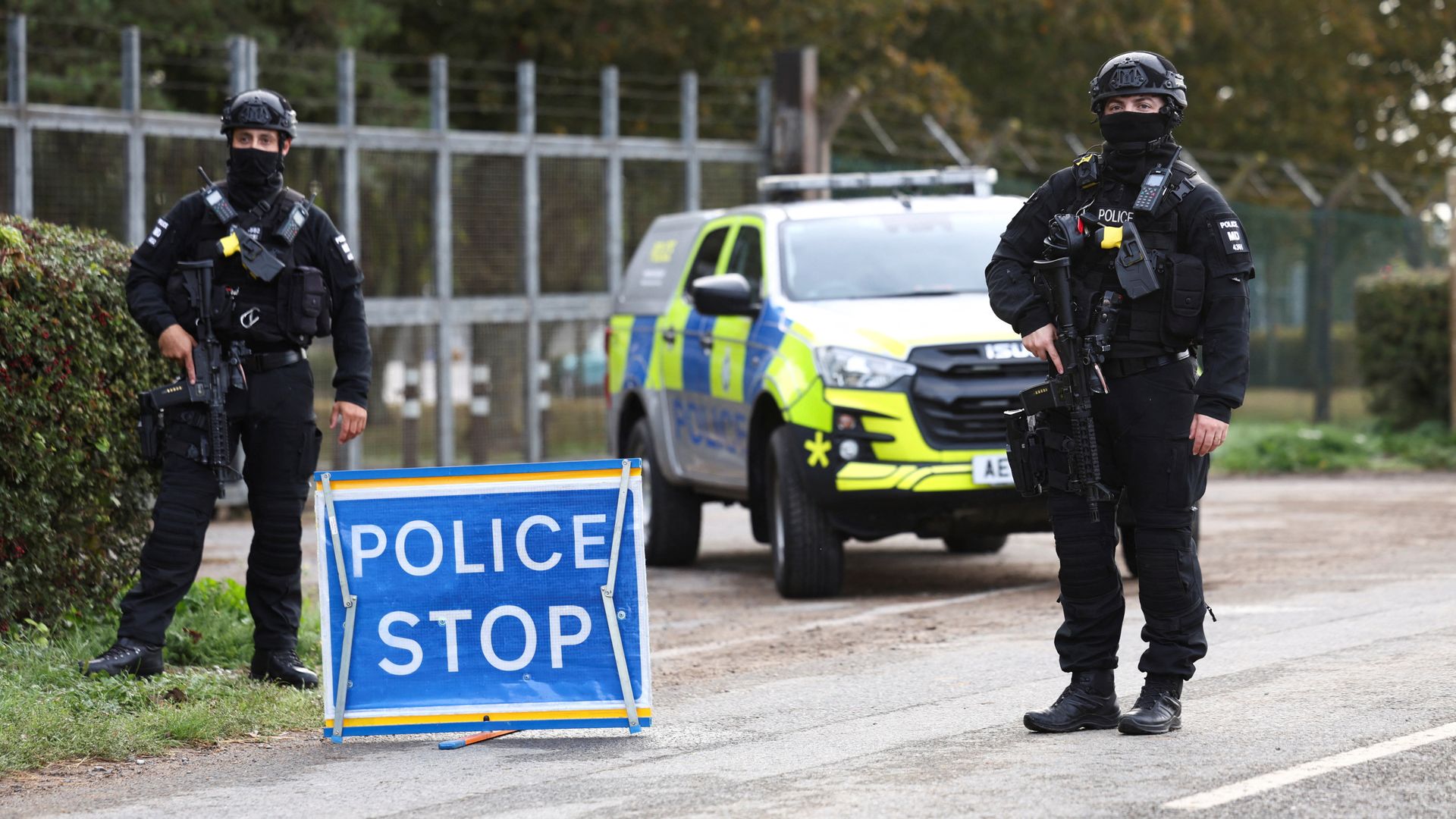
Two suspects face criminal charges following a serious security incident at RAF Fairford, with prosecutors alleging one of the accused actively assisted a foreign intelligence service linked to Iran. The charges bring the Gloucestershire airfield—Europe's primary forward-operating base for United States heavy strategic bombers—into the center of an escalating counter-espionage battle on British soil. Under the expanded powers of the UK's National Security Act 2023, authorities are treating perimeter breaches, unauthorized surveillance, and proxy recruitment not as minor trespassing offenses, but as direct threats to allied military readiness.
For decades, RAF Fairford has occupied a unique, high-stakes position in Western defense architecture. While formally a Royal Air Force station, the base functions primarily as an operational hub for the United States Air Force's 501st Combat Support Wing and the 420th Air Base Squadron. Its massive, reinforced runway is one of the few in Europe capable of supporting the full weight and operational logistics of the B-52 Stratofortress, the B-1B Lancer, and the B-2 Spirit stealth bomber. When Washington deploys Bomber Task Force missions to deter adversaries in Eastern Europe or the Middle East, those aircraft routinely touch down in the quiet Cotswold countryside. That operational reality makes Fairford an irresistible target for foreign intelligence services seeking real-time data on troop movements, munitions loading, and flight schedules.
Why RAF Fairford Draws Foreign Intelligence
Understanding the severity of the Fairford charges requires looking beyond the perimeter fence. Modern military intelligence rarely relies on dramatic, Hollywood-style infiltration. Instead, hostile state actors look for patterns of life. By monitoring the arrival of specialized support aircraft, tracking the movement of fuel tankers, or photographing the specific configuration of external pylons on a heavy bomber, an observer outside the wire can deduce the nature and timing of an impending global deployment days before an official Pentagon announcement.
Fairford's geography complicates its defense. Surrounded by public roads, agricultural land, and popular aviation enthusiast viewing spots, the base sits in an open rural environment where civilian access approaches remarkably close to high-security zones. For years, legitimate plane spotters have lined the perimeter with long-range telephoto lenses and radio scanners, documenting aircraft serial numbers as a hobby. Intelligence services exploit this exact cover. An operative or a recruited proxy blending into a crowd of aviation hobbyists attracts far less immediate suspicion than an intruder cutting through barbed wire in the dead of night.
The geopolitical context makes this vulnerability acute. Whenever tensions flare in the Middle East—particularly involving Iranian regional proxies, ballistic missile exchanges, or maritime security in the Red Sea—RAF Fairford's operational tempo spikes. Heavy bombers staged at Fairford sit well within striking range of the Levant and the Persian Gulf, supported by aerial refueling tankers operating out of nearby bases like RAF Mildenhall. Knowing precisely when those bombers launch, what airframes are active, and how many sorties are planned provides Tehran with invaluable early warning.
The Shift to Proxy Tradecraft and Criminal Proxies
The allegation that a suspect assisted Iranian intelligence reflects a documented, systemic shift in how Tehran conducts operations in the United Kingdom and across Western Europe. Over the past several years, British security officials, including the head of MI5, have repeatedly warned that Iranian intelligence services—primarily the Ministry of Intelligence and Security (MOIS) and the Islamic Revolutionary Guard Corps (IRGC)—have moved away from deploying their own trained, diplomatic-cover officers for high-risk collection and disruption tasks.
Instead, they rely heavily on outsourced networks. This model involves identifying and recruiting local individuals—sometimes petty criminals, financially distressed residents, or ideologically motivated actors—through encrypted messaging platforms and anonymous intermediaries. The recruits are often paid in cryptocurrency or untraceable cash transfers to perform discrete, seemingly low-level tasks.
Those tasks might include:
- Conducting physical reconnaissance of military installations or dissident residences.
- Photographing vehicle registration plates, security checkpoints, and patrol schedules.
- Purchasing local SIM cards, burner phones, or commercial surveillance equipment.
- Testing perimeter response times by triggering minor security alerts.
This proxy approach offers foreign intelligence services two distinct advantages. First, it creates plausible deniability; if the operatives are arrested, Tehran can claim zero official connection to local residents with no formal ties to the Iranian state. Second, it allows intelligence services to run multiple parallel operations at minimal financial cost, treating low-level recruits as entirely expendable assets.
How the National Security Act 2023 Changes the Legal Battlefield
Before late 2023, British prosecutors faced a frustrating legal gap when confronting modern espionage. The legacy Official Secrets Acts of 1911 and 1989 were drafted for an era of Cold War traitors stealing paper blueprints from Whitehall filing cabinets. If a suspect was caught photographing a military base from a public road, or passing open-source logistical observations to a foreign handler, securing a conviction under traditional espionage statutes proved notoriously difficult. Prosecutors often had to fall back on lesser charges like aggravated trespass, public order offenses, or conspiracy to commit criminal damage—charges carrying sentences too light to deter state-backed interference.
The National Security Act 2023 fundamentally rewrote those rules. The legislation introduced specific, modern offenses tailored to counter proxy tradecraft and hybrid warfare. Under Section 3 of the Act, assisting a foreign intelligence service became a distinct, severe criminal offense, carrying a maximum penalty of 14 years imprisonment. Crucially, the law lowered the evidentiary threshold regarding state control; prosecutors do not need to prove the suspect held a formal rank within a foreign agency, only that their conduct was materially assisting an entity known or reasonably suspected to be a foreign intelligence service.
Furthermore, the Act established a new offense around prohibited places. Under Section 4, entering, inspecting, or even approaching or photographing a designated prohibited place—a category that explicitly covers sensitive military installations like RAF Fairford—for a purpose prejudicial to the safety or interests of the United Kingdom carries massive penalties. Even capturing imagery of security infrastructure from outside the boundary can trigger full counter-terrorism policing powers, including extended pre-charge detention and warrantless searches of digital devices.
The Fairford prosecution serves as a live test of this statutory framework. By bringing charges that explicitly link a physical security incident to foreign intelligence assistance, the Crown Prosecution Service is signaling that the era of treating perimeter incidents at sensitive defense sites as minor local policing matters is permanently over.
The Structural Tension Between Base Security and Public Access
Securing an installation like RAF Fairford presents an enduring operational headache for the Ministry of Defence and the United States Air Force. Unlike remote testing ranges in the Nevada desert, British airbases are woven tightly into civilian communities. Public footpaths, county roads, and parish boundaries press directly against the perimeter fences.
Base security falls under a layered, multi-agency model:
- Inside the wire, US Air Force Security Forces maintain direct physical control over flight lines, hardened aircraft shelters, and weapons storage areas.
- At the gates and perimeter, the Ministry of Defence Police (MDP)—an armed civilian police force with full constabulary powers—conducts patrols and access control.
- Beyond the boundary, local territorial forces like Gloucestershire Constabulary hold primary jurisdiction, working alongside Counter Terrorism Policing South East (CTPSE) whenever national security indicators emerge.
This jurisdictional handoff creates friction. A civilian walking along a public road outside the fence commits no automatic crime simply by being there. MDP officers cannot arbitrarily arrest every motorist who pulls over to watch a B-52 take off. Yet, from an intelligence perspective, the boundary line is artificial. A high-resolution camera or a commercial drone operated from a lay-by half a mile away can gather data just as sensitive as an intruder standing on the tarmac.
Counter-drone technology and automated perimeter sensors have improved dramatically over the last five years, yet human vigilance remains the primary tripwire. When police charge individuals following a physical incident at the base, it typically indicates that the suspects crossed a distinct behavioral line—either breaching the physical barrier, deploying unauthorized surveillance hardware, or demonstrating clear tasking from an external handler.
Counter-Arguments and the Risk of Overreach
While defense officials view aggressive enforcement under the National Security Act as overdue, civil liberties advocates and legal scholars point to significant gray areas in how these laws are applied. The broad language surrounding "assisting a foreign intelligence service" and actions "prejudicial to the safety or interests of the UK" places immense discretionary power in the hands of investigators and prosecutors.
Critics highlight several potential pitfalls:
- The Unwitting Recruit Dilemma: Under the proxy model, handlers frequently deceive low-level recruits about who they are actually working for. A handler might pose as a private security consultant, a commercial journalist, or an insurance investigator paying for photos of an industrial site. While the law includes a requirement that the suspect knew or ought reasonably to have known they were assisting a foreign power, proving that state of mind in court is complex and fraught with evidentiary disputes.
- Chilling Effects on Journalism and Research: Investigative journalists, open-source intelligence (OSINT) analysts, and aviation researchers routinely monitor military movements using satellite imagery, flight-tracking transponders, and roadside photography. Clear legal boundaries must separate legitimate public-interest reporting from hostile state reconnaissance, lest legitimate scrutiny of defense spending and military deployments be criminalized.
- Secrecy in the Courtroom: Prosecutions involving national security frequently rely on sensitive intelligence intercepts that authorities refuse to disclose in open court. The use of closed material procedures and reporting restrictions can limit public accountability, making it harder for independent observers to assess the true weight of the evidence behind high-profile espionage charges.
Acknowledging these legal tensions does not diminish the reality of the threat. Rather, it underscores how difficult it is for an open democracy to defend critical military infrastructure without eroding the transparency that defines it.
What the Fairford Case Means for UK Defense Posture
The charges arising from the RAF Fairford incident fit into a much wider pattern of heightened security alerts across NATO installations in Europe. Over the past two years, European security services have disrupted suspected sabotage plots, arson attacks on logistics warehouses, and reconnaissance operations targeting rail networks and airfields in Germany, Poland, the Baltic states, and the United Kingdom.
In Britain, the convergence of threats from Russia and Iran has forced a quiet overhaul of how military bases manage their external footprint. Base commanders are increasingly treating the surrounding civilian environment as an active battlespace. Community policing initiatives now actively brief local residents, farmers, and legitimate aviation enthusiasts on how to spot suspicious behavior—such as individuals asking unusual questions about shift changes, abandoning vehicles near perimeter gates, or operating drones in restricted airspace.
At the same time, the financial and operational burden of base defense is rising. Every incident that triggers a counter-terrorism investigation pulls specialized detectives, forensic analysts, and intelligence officers away from other active threats. When strategic bombers are deployed to Gloucestershire, the security perimeter effectively expands miles outward into the surrounding towns and villages, requiring continuous coordination between local police, British intelligence, and American military commanders.
Ultimately, the prosecution over the RAF Fairford incident proves that modern espionage no longer wears a trench coat in a dimly lit capital city. It operates in broad daylight along rural country lanes, utilizing disposable local proxies, encrypted phones, and commercial cameras to map the projection of Western air power—forcing Britain's counter-intelligence apparatus to treat every breach of the perimeter fence as a frontline engagement in an undeclared shadow war.