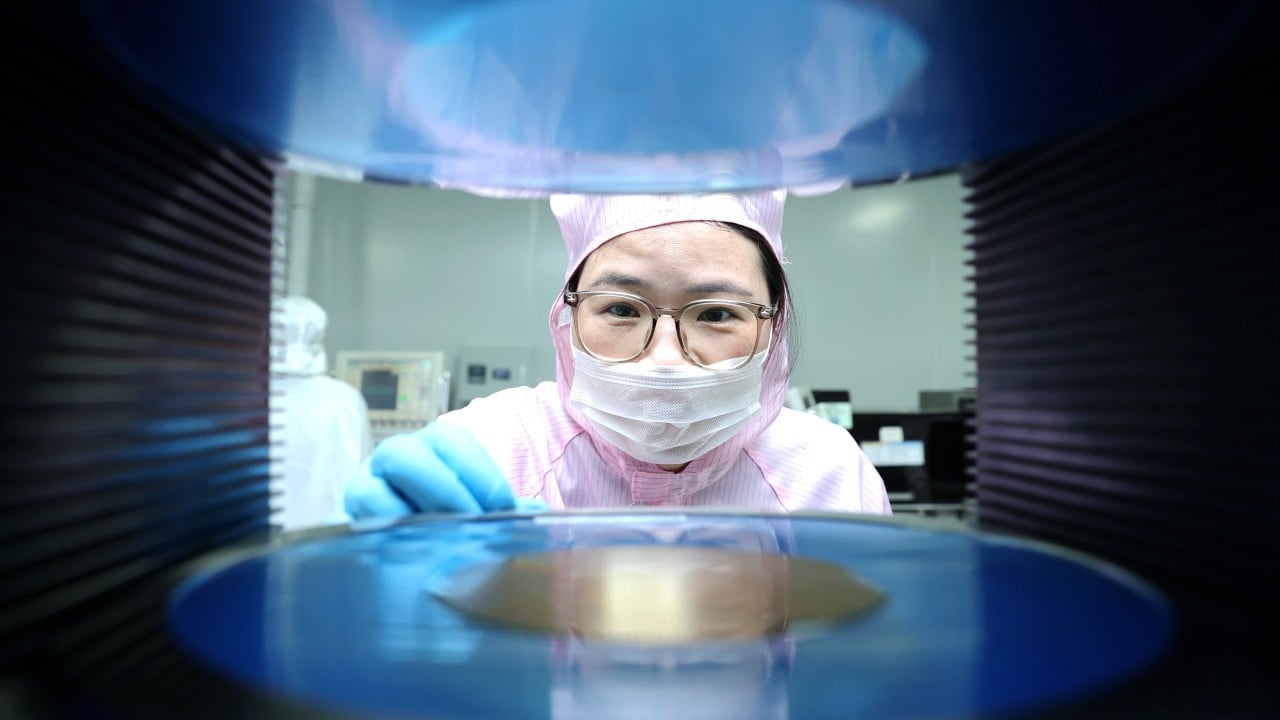
Fluorescent lights hum over a row of empty benches in a mid-sized university laboratory, their low buzz filling the silence where a grant renewal letter should have been.
A bottle of clear reagent sits untouched on a rubber mat. On the wall, a dry-erase board holds half-erased chemical pathways from a project that has run out of runway. For the past decade, a quiet certainty held together the daily rhythms of rooms like this across the United States: if you had a stubborn problem, a curious mind, and enough patience to survive three rounds of peer review, the public treasury stood behind you. You did not have to know yet whether the molecule would cure a disease, whether the battery chemistry would survive a thousand charge cycles, or whether the new algorithm would shave ten milliseconds off a grid load. You only had to prove the question was worth asking.
Now, that certainty feels thinner.
Across the Pacific, another set of lights stays on later into the night. New cleanrooms open in clusters that look less like isolated campus outposts and more like industrial cities built specifically for discovery. While Washington debates trimming federal research budgets and squeezing agency lines, China has maintained a steady, patient climb in research and development spending, pushing its share of global scientific output and engineering talent higher year after year.
Numbers, though. Numbers are easy to scroll past before your coffee cools.
A budget line in a congressional bill looks dry on a screen. A percentage-point shift in gross domestic expenditure on research and development sounds like something for trade economists to argue over at polite panels. Yet behind every decimal sits a human choice about who gets to try, who gets to fail twice before getting it right, and which country's workshops end up owning the tools everyone else eventually buys.
I have spent years watching how laboratories breathe when money flows and how they tighten when money dries up. You hear it before you see it in any annual report. It sounds like a principal investigator telling a bright graduate student that there is funding for one more semester, maybe two, so pick the safer experiment rather than the wild one. It smells like stale coffee at 6:00 a.m. in a windowless hallway where two postdocs are splitting a single piece of equipment because the replacement order was frozen. And it feels like a slow, gnawing doubt in the chest when you realize your best ideas might have to pack their bags and move somewhere with fewer budget hearings and longer horizons.
Two Different Bets on Time
To understand what is actually shifting between the United States and China, it helps to step back from headlines about "winning" or "losing" a race and look at how each system treats time.
(Note: The following story about Dr. Maya Lin and her lab is a hypothetical composite created to illustrate real structural pressures faced by early-career researchers and grant-funded teams.)
Picture Maya, a hypothetical materials scientist running a small team focused on next-generation grid storage—the kind of slow, unglamorous work that sits between a clever lab trick and a utility-scale battery that will not catch fire or degrade in winter heat. Maya does not need a miracle tomorrow. She needs five years of steady support to test four unsexy electrolytes, run thousands of charge-discharge cycles, and publish honest negative results when two of them fail.
In her world, public research funding acts like deep soil under a young orchard. A private venture fund often wants fruit in three years; a federal grant, at its best, feeds the roots so the tree can weather a drought. When proposals to cut federal R&D funding gain traction—even when final appropriations get negotiated down to smaller trims or targeted freezes—the shockwave travels faster than the paperwork. Labs hold off on hiring technicians. Equipment upgrades get pushed back. Young scientists watch senior mentors spend half the year writing grant applications with lower odds of approval, and they start asking whether building a life around basic science is too fragile a wager.
Now contrast that rhythm with what has driven China's R&D trajectory. China's rise in research spending has not been a single dramatic spike followed by a retreat; it has been a sustained, multi-year climb backed by state industrial priorities, provincial matching funds, expanding university pipelines, and massive domestic manufacturing scale. Where a grant freeze in one cycle can stall a lab's momentum in the U.S., sustained state-backed investment in China gives engineers and applied scientists a clearer runway to move from prototype to pilot line to factory floor.
Neither system is a fairy tale. Public budgets everywhere face real fiscal gravity, debt service, and competing domestic priorities, and top-down industrial push brings its own inefficiencies, duplication, and political constraints. Still, direction matters. One engine is facing calls to throttle back while the other keeps feeding fuel into the boiler.
What "Spending More" Really Buys
When people hear that China's R&D spending keeps rising while the U.S. looks at funding cuts, a common question surfaces: does raw money automatically equal better breakthroughs?
No.
If throwing cash at laboratories guaranteed genius, bureaucracy would invent a cure for aging by Tuesday. Money alone does not write a brilliant equation, and a single Nobel-caliber insight or garage-born software breakthrough can still reshape an entire industry on a modest budget. Anyone who has worked inside a sprawling organization knows that big budgets can also fund bloated meetings, duplicate projects, and slow committees.
Why, then, do economists and national security analysts pay so much attention to persistent R&D trajectories?
(Metaphor alert: Think of national R&D spending not as buying a finished trophy, but as laying down copper wire across a continent.)
You do not get electricity just because you bought copper. You still need generators, transformers, and homes wired to use the power. Yet without the wire, the current cannot reach the towns that need it. Steady R&D spending builds that underlying grid: the graduate students trained on modern instruments, the patent filings that turn into industrial standards, the specialized suppliers who already know how to machine a rare component to micron tolerances, and the sheer density of people solving hard problems side by side.
When the United States trims federal support for science and engineering—especially in foundational areas where private companies underinvest because the payoff is too distant or too broad to monopolize—it risks thinning out that grid. Private corporations are brilliant at scaling proven products and optimizing existing lines, yet they rarely want to pay for ten years of open-ended foundational research whose benefits will spill across competitors. That gap is precisely what public research dollars were built to bridge.
Meanwhile, as China climbs steadily in total R&D outlay and concentrates resources in strategic sectors—clean energy hardware, electric vehicles, advanced manufacturing, robotics, semiconductors, and applied AI—it is building both the wire and the factories at the end of it. A breakthrough tested in a lab today can be iterated on a massive manufacturing floor weeks later rather than years later.
The Invisible Stakes Outside the Lab
It is easy to treat science funding as an insider argument between university presidents, budget hawks, and policy wonks.
It isn't.
Every choice about who funds discovery echoes into ordinary kitchens, clinics, and living rooms years down the road. Consider what happens when a country steps back from funding early-stage research while a rival presses forward:
- Medical and biological resilience: Many life-saving therapies began as obscure basic biology questions funded by public agencies long before a pharmaceutical company saw a commercial product. Thinning early research pipelines does not empty a hospital tomorrow; it quietly narrows the menu of treatments available ten or fifteen years from now.
- Supply chains and leverage: Whoever masters the next generation of materials, energy storage, and precision manufacturing holds leverage when global trade frictions flare. You cannot easily reshore an industry if the foundational know-how and trained engineers have already moved elsewhere.
- The talent magnet: For generations, American universities and labs drew ambitious minds from around the world because the resources, freedom of inquiry, and funding stability were unmatched. Budget uncertainty chips away at that magnetic pull, making other research hubs look more predictable and better equipped.
- Economic renewal in ordinary towns: Discovery is not just coastal tech hype. Land-grant universities, regional labs, and advanced manufacturing hubs shape local economies, creating high-skill jobs and turning regional colleges into engines of regional pride.
There is a real vulnerability here that we ought to say out loud: this stuff is genuinely hard to balance. Taxpayers feel squeezed by the cost of living. Lawmakers wrestle with deficits that are not imaginary. Asking for patience on long-term science budgets when families are worried about groceries and housing is a tough political sell, and pretending the trade-offs do not exist only breeds cynicism.
Yet cutting the seed corn to save on storage costs has a predictable ending. You save a little in the spring and go hungry in the autumn.
Why Momentum Compounds
History has a habit of punishing complacency right after a long stretch of dominance.
Britain ruled nineteenth-century steam and textiles long enough for many leaders to assume industrial leadership was part of the natural order, even as Germany and the United States built deeper systems of technical education and industrial research. Later, in the mid-twentieth century, the United States surged ahead not by accident, but through deliberate, sustained public investment in science, engineering, and higher education alongside private enterprise.
Momentum in research compounds much like interest, except the currency is capability. One generation of funded researchers trains the next. A cluster of labs attracts specialized instrument makers; those makers lower costs for neighboring teams; new startups spin out of shared facilities; and the whole ecosystem becomes harder to replicate from scratch.
If the U.S. keeps flirting with R&D cuts while China keeps its steady upward climb, the gap does not have to open overnight to matter. A slow drift—a few percentage points here, a canceled program there, a decade of cautious budgets against a decade of determined expansion—can quietly rewrite who sets technical standards, who controls key supply chains, and whose economy captures the lion's share of high-wage innovation.
A Different Kind of Urgency
What if the real story is not panic, but waking up to how fragile leadership actually is?
Nobody hands a country the future on a silver platter. It has to be earned again in every budget cycle, every classroom, every cleanroom, and every tough conversation about what a society values enough to fund before the return is guaranteed.
Back in that quiet lab, the fluorescent lights still hum. A researcher looks at a blank page on a notebook, weighing whether to chase a bold hypothesis that could reshape a field or play it safe with something smaller and surer. Somewhere thousands of miles away, another researcher opens a fresh box of equipment under bright new lamps, already planning next year's trials.
The difference between those two rooms is not written in a single headline. It is written in who had the courage to keep the lights on.