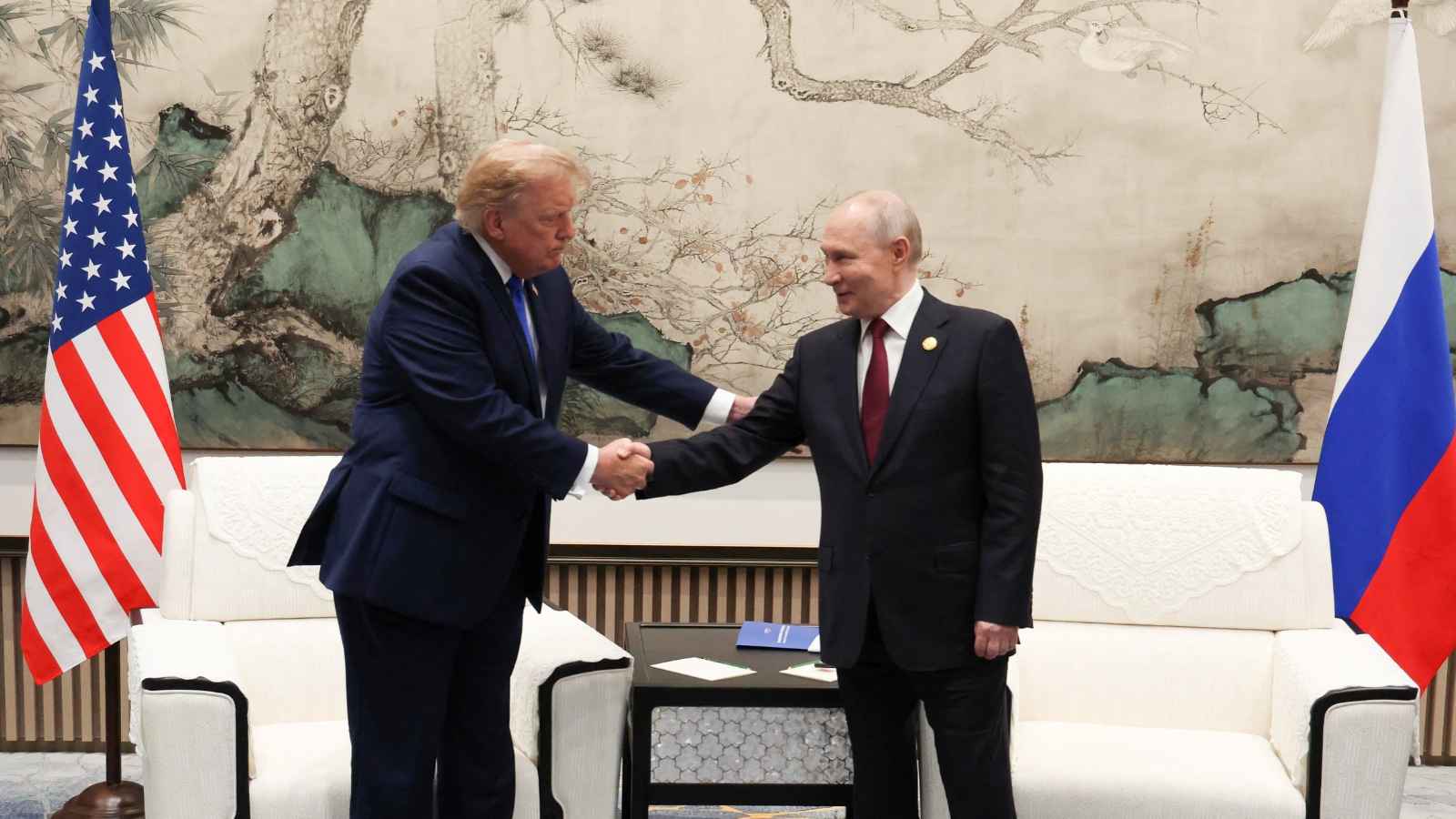
Diplomacy rarely announces itself with trumpets. More often, it happens in the margins—a hand lingering too long on a shoulder, a smile held half a second past politeness, or a joke tossed casually across a crowded room while cameras click like restless insects.
Consider what happened at the Asia-Pacific Economic Cooperation summit in Da Nang, Vietnam, back in November 2017. On the surface, the moment lasted barely longer than a commercial break. Donald Trump and Vladimir Putin crossed paths during the traditional "family photo" session, where world leaders stand shoulder-to-shoulder in matching ceremonial shirts, trying to look relaxed while carrying the weight of nuclear arsenals and fragile trade deals. According to reports from the press pool and video footage captured at the venue, Trump leaned in, exchanged warm words with the Russian president, joked with reporters by asking, "Who is he?" when questioned about Putin, and referred to the Russian leader as "my friend."
Blink. You miss it.
Yet years later, that fleeting interaction still echoes through foreign policy circles, intelligence briefings, and living room debates. Why does a three-second exchange of pleasantries between two men in silk shirts carry so much oxygen? Because in international statecraft, there is no such thing as small talk. Every syllable spoken near a microphone is a signal flare sent up into a dark sky, watched by allies in Warsaw, strategists in Beijing, and families in Kyiv trying to guess whether the ground beneath them is solid or shifting.
The Architecture of a Casual Remark
To understand the weight of a joke on a summit stage, it helps to step away from Washington and Moscow for a moment and picture a different room entirely.
Imagine a hypothetical scenario: two rival captains of neighboring shipping fleets meet at a neutral harbor banquet. Neither captain has signed a peace treaty. Just days earlier, their crews were accused of tampering with each other's navigation buoys. Their junior officers stand tense near the exits, hands resting near their belts, waiting for orders. Then, in front of the harbor master and every merchant in town, the first captain slaps the second on the back, laughs, and calls him an old friend.
What happens in the minds of the junior officers?
Confusion. Relief. Panic. Suddenly, the rules of engagement feel blurry. If the captains are friends, was the alarm over the navigation buoys an exaggeration? Or is the friendliness a mask worn before a sudden ambush?
That hypothetical harbor is the exact psychological space occupied by modern summit diplomacy. When reporters in Da Nang pressed Trump about whether Putin had meddled in the 2016 U.S. presidential election—a question rooted in formal assessments by U.S. intelligence agencies—Trump’s lighthearted deflection ("Who is he?") and his characterization of Putin as "my friend" landed like a stone dropped into still water.
According to contemporaneous accounts from White House press pool reporters, the remark drew chuckles in the room. It was classic Trump: disarming, improvisational, allergic to the stiff choreography that usually governs bilateral encounters. Supporters viewed it as pragmatic ice-breaking—a refusal to let bureaucratic friction prevent two nuclear superpowers from talking. Critics, including former intelligence officials and lawmakers from both parties, saw something far more perilous: the casual dismissal of documented cyber interference in exchange for personal rapport.
Both reactions stem from the same root truth. Words spoken by a president do not evaporate into the air conditioning. They harden into policy perceptions.
Behind the Curtain of the "Family Photo"
Anyone who has ever covered or worked behind the scenes of an international summit knows the strange sensory dissonance of those rooms. The air smells faintly of floor wax, stale espresso, and expensive cologne. Security details speak into wrist microphones in clipped murmurs. Behind the blue backdrop, aides with laminated badges frantically whisper last-minute talking points into the ears of exhausted principals who have flown across fourteen time zones.
For decades, American presidents approached Russian leaders with a carefully calibrated script. Even during moments of warmth—George W. Bush famously saying he looked into Putin’s eyes and got a sense of his soul in 2001, or Barack Obama’s "reset" button in 2009—the language was vetted by National Security Council staffers who spent weeks debating single adjectives. Every handshake was timed. Every camera angle was negotiated.
Trump tore up that playbook. His instinct, honed over decades in Manhattan real estate boardrooms and television studios, was to treat geopolitics as an extension of personal chemistry. In his framework, if two leaders like each other, deals follow; if they don't, nothing moves.
When he stood beside Putin in Vietnam, there was no formal bilateral meeting on the schedule. White House officials had explicitly stated beforehand that no official sit-down would take place due to scheduling conflicts. Yet the informal pull-aside happened anyway—first during the photo op, and again as the leaders walked toward the dining hall. Following those brief exchanges, Trump told reporters aboard Air Force One that Putin had again denied meddling in the U.S. election, adding, "Every time he sees me, he says, 'I didn't do that.' And I believe, I really believe, that when he tells me that, he means it."
That statement, paired with the "my friend" remark, created an immediate tremor in Washington. U.S. intelligence agencies—including the CIA, FBI, and National Security Agency—had published a declassified assessment in January 2017 concluding with high confidence that Russian President Vladimir Putin ordered an influence campaign aimed at the 2016 U.S. presidential election. By contrasting the word of a foreign adversary with the findings of his own intelligence apparatus, Trump turned a lighthearted summit moment into a constitutional and strategic flashpoint.
The Invisible Stakes for People Nowhere Near the Stage
It is easy to watch clips from APEC as political theater—a spectator sport where partisans cheer their champion and jeer the opponent. That distance is a luxury. For millions of people living along the fault lines of superpower competition, the tone struck between Washington and Moscow is never just entertainment.
Consider a hypothetical family living in Tallinn, Estonia, in late 2017. Estonia shares a border with Russia and relies on NATO’s Article 5 collective defense guarantee—the promise that an attack on one alliance member is an attack on all—for its survival as an independent democracy. When a parent in Tallinn turns on the evening news and sees the President of the United States joking warmly with the Russian leader, calling him a friend, and brushing aside questions about Russian covert operations, the calculation at their kitchen table changes subtly but unmistakably.
They ask themselves quiet, uncomfortable questions. If pressure mounts on our border, which instinct wins in Washington: the treaty obligations written on paper, or the personal warmth displayed on camera?
The same quiet recalculation happens in intelligence bullpens in Langley and London. Analysts who spend years tracking disinformation networks, cyber intrusions, and geopolitical maneuvers rely on clear signals from leadership that their work matters. When diplomatic warmth appears to override intelligence findings, the morale and clarity of those institutions suffer friction that takes years to repair.
At the same time, ignoring the human reality of diplomacy carries its own danger. History is littered with conflicts that escalated because leaders locked themselves into rigid hostility and refused to speak like human beings. During the Cuban Missile Crisis in October 1962, backchannel communications and a willingness by John F. Kennedy and Nikita Khrushchev to look past ideological posturing prevented nuclear catastrophe. Personal rapport, when paired with strategic discipline, can pull nations back from the brink.
The tension lies in the balance. Warmth without leverage looks like capitulation; leverage without warmth risks accidental escalation.
Why We Misread the Room
Part of why moments like the APEC exchange generate so much heat is that observers often confuse two completely different currencies: personal flattery and strategic alignment.
In everyday life, calling someone "my friend" means trust, shared values, and mutual loyalty. If you call your neighbor your friend, you expect them not to cut down your fence while you are on vacation.
In high-level diplomacy, the word "friend" is almost never literal. Leaders use it as a verbal lubricant—a way to lower the temperature in a room so hard bargaining can occur without losing face. Putin himself is a master of this dual-track language. Trained in the KGB’s foreign intelligence service, he spent years studying how to mirror an interlocutor’s style, offer calculated praise, and project calm reasonableness while pursuing uncompromising state objectives. When Trump offered warmth in Da Nang, Putin accepted it smoothly, projecting the image of a respected global statesman standing on equal footing with the American president—a vital domestic message for a Kremlin eager to show Russian citizens that Western isolation efforts had failed.
Watching the footage closely reveals the choreography beneath the spontaneity. Trump’s body language is expansive, expressive, leaning into the moment for the benefit of the press corps. Putin’s posture is compact, controlled, offering a measured smile that gives away very little while capturing every visual benefit of the encounter. One man is performing for the cameras in real time; the other is banking the footage for long-term geopolitical capital.
Admitting how difficult it is to read these moments honestly is part of understanding modern politics. If you look at that video clip looking for proof of collusion, you will see it in the warmth of the handshake. If you look at it hoping for a master negotiator disarming a rival, you will see that too. The footage itself acts like a Rorschach inkblot, reflecting the viewer's deepest assumptions about power, loyalty, and American leadership.
The Long Shadow of Brief Encounters
History rarely turns on a single sentence, yet single sentences often reveal the direction of the current.
In the months and years following the 2017 APEC summit, the gap between personal rhetoric and institutional policy became one of the defining features of U.S.-Russia relations. Even as Trump continued to praise Putin personally—culminating in their contentious 2018 Helsinki summit—his administration simultaneously expelled dozens of Russian diplomats, imposed sweeping sanctions on Russian oligarchs and entities, closed Russian diplomatic compounds, and approved the sale of lethal anti-tank weapons to Ukraine, a step the previous administration had hesitated to take.
That contradiction baffled allies and adversaries alike. Moscow discovered that personal flattery in the hallway did not stop sanctions packages from leaving the Treasury Department. Meanwhile, European partners found themselves constantly second-guessing whether American policy was driven by the State Department’s official cables or the president’s off-the-cuff remarks in front of a press pool.
Diplomacy thrives on predictability. Markets, alliances, and deterrence all depend on friends and foes knowing roughly where the lines are drawn. When leaders blur those lines for the sake of a clever quip or an instinctive gesture of camaraderie, they introduce static into a system that requires crystal-clear transmission.
Look back at that clip from Da Nang today, stripped of the immediate noise of breaking-news chyrons and partisan commentary. Strip away the sound entirely and just watch the faces.
You see two men standing under bright fluorescent lights in a convention center halfway across the world, surrounded by flags, lenses, and silent bodyguards. One leans in with a grin, tossing a joke into the air as if they were standing at a golf club bar. The other nods slightly, eyes watchful, measuring the distance between the joke and the truth. Around them, two dozen other world leaders stare straight ahead at the cameras, holding their smiles fixed in place, waiting for the flashbulbs to stop so everyone can finally step off the stage.