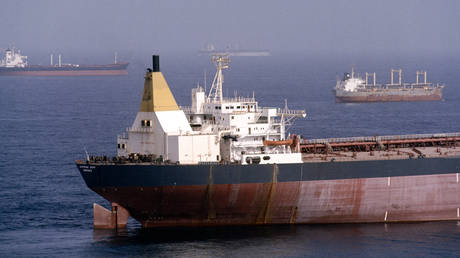
The concept of a "safe corridor" through the Strait of Hormuz is a geopolitical fiction sold to insurance underwriters to keep global oil prices from hitting triple digits. While recent diplomatic maneuvers suggest a formalization of transit lanes guarded by multilateral agreements, the reality on the water remains a high-stakes game of chicken. A narrow waterway that handles 21 million barrels of oil a day cannot be made safe by a signature in a boardroom. It is a choke point defined by its vulnerability, and the current efforts to stabilize it are less about absolute security and more about manageable risk perception.
The Strait of Hormuz is a geographical bottleneck only 21 miles wide at its narrowest point. Within that space, shipping lanes are divided into two-mile-wide paths for inbound and outbound traffic, separated by a two-mile buffer zone. When regional tensions flare, these lanes become shooting galleries. The recent push for a guaranteed transit zone isn't a new invention; it is a desperate rebranding of the existing Traffic Separation Scheme (TSS) that has been in place for decades. The difference now is the attempt to layer a "non-aggression" guarantee over the physical coordinates.
The Mechanics of the Choke Point
To understand why a safe corridor is more of a truce than a shield, one must look at the bathymetry of the region. The deepest waters, necessary for fully laden Very Large Crude Carriers (VLCCs), sit almost entirely within Iranian territorial waters. Even under the United Nations Convention on the Law of the Sea (UNCLOS), which grants "transit passage," the physical proximity of naval batteries on the mainland and the islands of Tunb and Abu Musa means that any vessel in the "safe" lane is always within range of short-range ballistic missiles and fast-attack craft.
The industry is currently betting on a two-pronged stabilization strategy. First, there is the naval escort program, where various international coalitions provide a "monitored" environment. Second, there is the back-channel communication between major energy consumers and regional powers to ensure that shipping remains a neutral zone even during proxy conflicts. But history shows this neutrality is a convenient myth. During the Tanker War of the 1980s, over 500 ships were attacked. The "safety" of those ships was entirely dependent on whether their flag state was willing to engage in direct combat to protect them.
The Insurance Illusion
London’s shipping insurance market is the true arbiter of Hormuz’s safety. When the Joint War Committee (JWC) designates the Persian Gulf as a high-risk area, premiums spike. A "safe corridor" is, in many ways, a financial instrument designed to provide "just enough" security to prevent the cost of transit from becoming prohibitive.
If a shipping company believes the corridor is safe, they continue to sail. If they continue to sail, the supply chain remains intact. If the supply chain remains intact, the global economy avoids a recession. The corridor is a psychological barrier against market panic.
However, the technical limitations of this safety are glaring. Consider the following factors that a diplomatic corridor cannot solve:
- Subsurface Threats: The Strait is shallow, making it a nightmare for traditional submarine detection but a playground for midget submarines and bottom-moored mines.
- Electronic Warfare: GPS jamming in the Strait is a frequent occurrence. Ships have reported their navigation systems showing them inland when they are clearly in the middle of the channel. A safe corridor is useless if the ship's sensors cannot reliably place it within that corridor.
- Asymmetric Swarms: No amount of international law stops a swarm of fast boats from harassing a slow-moving tanker. The rules of engagement for "guardians" in a safe corridor are often too restrictive to prevent boarding actions before they happen.
The Myth of Alternative Routes
The narrative of "bypassing the Strait" is often brought up as the ultimate solution to the Hormuz problem. Pipelines like the Habshan–Fujairah line in the UAE or the East-West Pipeline in Saudi Arabia exist. They are impressive feats of engineering. But they are not replacements.
The total capacity of all operational bypass pipelines combined is roughly 6.5 million barrels per day. That leaves nearly 15 million barrels with nowhere else to go but through the Strait. Any disruption in the "safe" corridor immediately creates a deficit that no pipeline can fill. This math is why the corridor is being pushed so hard by Western and Asian capitals. They are not protecting the ships; they are protecting the math.
The Geopolitical Price Tag
Establishing a safe zone requires a guarantor. Currently, that role is fractured. You have the U.S.-led International Maritime Security Construct (IMSC) and the European-led EMASoH. Each operates with different mandates and different levels of aggression. The lack of a unified command structure means that a "safe corridor" is actually a patchwork of overlapping patrol zones with different rules.
Iran, for its part, views these corridors as an infringement on its sovereignty. To them, "security" in the Gulf should be managed by Gulf nations, not outside powers. This creates a paradox where the very presence of the forces meant to make the corridor safe acts as a provocation that makes it dangerous.
We are seeing a shift where China is beginning to play a larger role as a mediator. As the primary buyer of the oil moving through these lanes, Beijing has a vested interest in the "safe" status of the Strait that outweighs its ideological stances. If the corridor ever becomes truly functional, it will likely be because of Chinese economic pressure on all sides of the water, rather than Western naval might.
Shadow Fleets and the Breakdown of Order
Perhaps the greatest threat to a structured safe corridor is the rise of the "shadow fleet"—thousands of aging, poorly maintained tankers operating under "flags of convenience" with no clear ownership. These vessels often turn off their AIS (Automatic Identification System) transponders to hide their origin or destination.
A safe corridor relies on transparency. You cannot have a secure lane when ten percent of the traffic is invisible to radar and operating outside of international maritime law. These ghost ships are prone to mechanical failure and collisions, which could physically block the narrow shipping lanes of the Strait more effectively than any naval blockade.
The Friction of Reality
A definitive safe corridor would require a level of international cooperation that currently does not exist. It would require the installation of permanent, neutral monitoring stations on both sides of the Strait and a commitment from all regional actors to de-escalate their maritime rhetoric.
Instead, we have a series of temporary fixes. The "safe" corridor is a moving target, a set of coordinates that changes based on the daily temperature of regional politics. For the captain of a VLCC carrying $200 million worth of crude, the corridor is only as safe as the horizon is clear.
The tension in the Strait is not a problem to be solved, but a condition to be managed. The talk of corridors and safety zones is an attempt to institutionalize that management. It provides a framework for de-confliction, but it does not remove the threat. The Strait remains what it has always been: a narrow, dangerous passage where the world’s energy security hangs by a thread of diplomatic goodwill that is fraying at the edges.
Watch the "dark fleet" activity over the next quarter. If the number of transponders being turned off in the Strait increases, the corridor is failing, regardless of what the diplomatic communiqués claim.