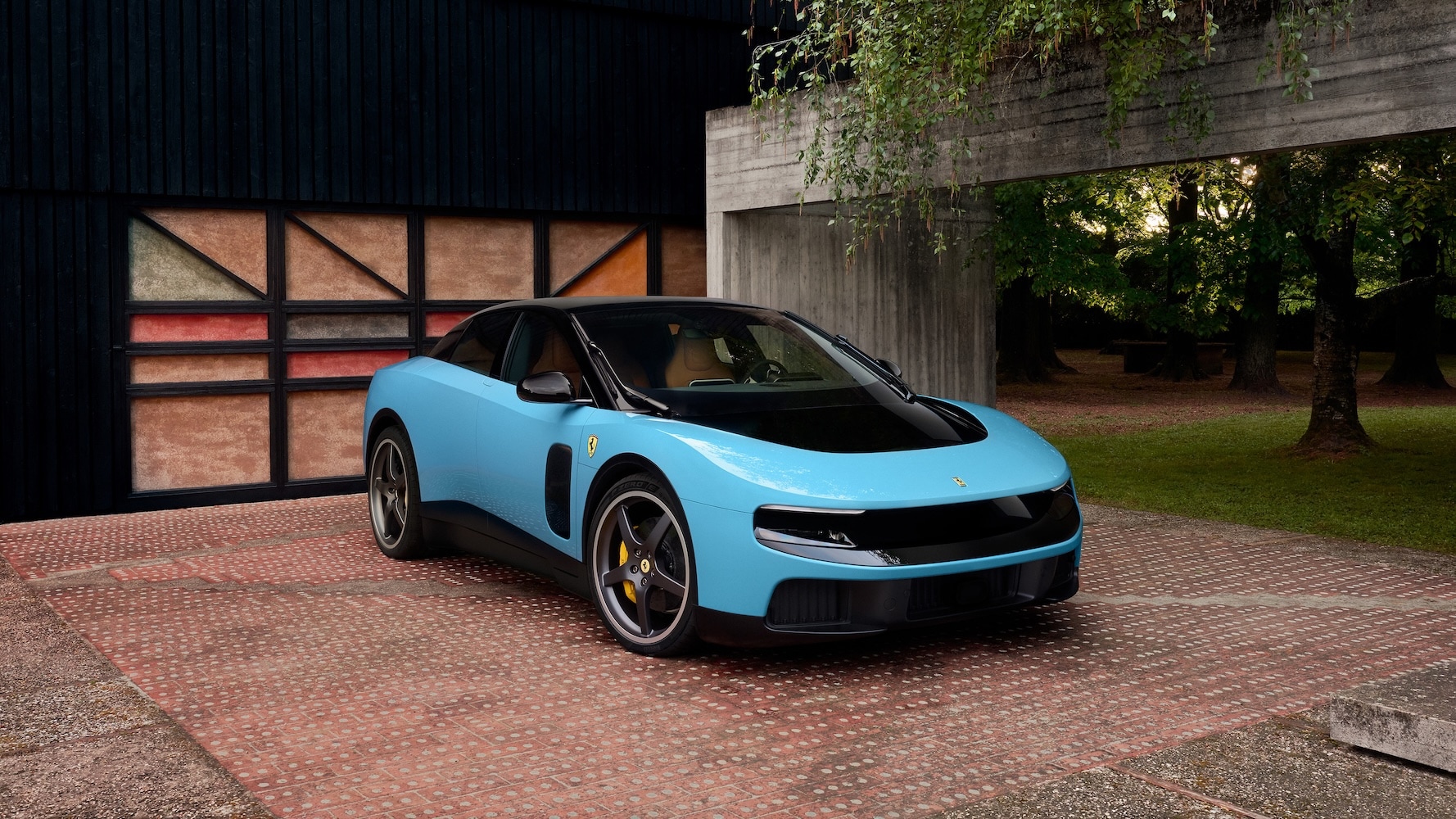
Ferrari has officially broken its most sacred vow, and the result is deliberately calculated to offend its most loyal fans.
When chief marketing officer Enrico Galliera stepped on stage in Rome to unveil the Ferrari Luce, the brand's first-ever fully electric vehicle, he delivered an unprecedented warning to the Tifosi. "To my petrolheads that I meet, I always tell them, please don't buy it."
This is not inverted psychology. It is survival.
The Ferrari Luce is a $649,000, five-seat, quad-motor luxury liftback that abandons nearly eight decades of Maranello tradition. Developed over five years in deep secrecy with LoveFrom, the design collective founded by former Apple design chief Sir Jony Ive and Marc Newson, the Luce completely bypasses the traditional supercar playbook. It drops the long-bonnet silhouette, kills the roaring V12, and swaps driver-focused minimalism for a massive, glass-domed five-seater cabin.
By launching a car meant to split public opinion down the middle, Chief Executive Benedict Vigna is executing a high-stakes corporate pivot. Ferrari is not trying to convert the collectors who keep internal combustion engines on life support. It is hunting for tech billionaires who already drive a Tesla or a Porsche Taycan but want the ultimate expression of zero-emission status. It is a brutal calculation born from a harsh luxury reality: collectors who are forced into buying EVs quickly flip them, destroying secondary market residual values and tanking the brand's exclusivity.
The Appification of Maranello
The exterior of the Luce is the first indication that Maranello has handed the keys to Silicon Valley sensibilities. Instead of the aggressive, low-slung stance of a traditional front-engine grand tourer, the Luce utilizes a monobox, cab-forward layout. The distance from the driver’s seat to the front axle is identical to the mid-engine 296 GTB, but the vehicle itself stretches over five meters long.
It looks less like a traditional sports car and more like a sculpted, aerodynamic glass house riding on massive, staggered wheels—23 inches at the front and 24 inches at the rear. By eliminating the internal combustion engine, Ive and Newson pulled the cabin forward, achieving a drag coefficient of just 0.254. That is the lowest figure in Ferrari's road-car history, helping the vehicle wring out a claimed 329 miles of range on the European WLTP cycle from its massive 122 kWh battery pack.
Yet, the true subversion happens inside the doors. The rear doors are rear-hinged coach doors that swing open electronically to reveal a genuinely spacious second row. This is the first time a production Ferrari has featured five functional seats and a split-folding 597-liter boot.
Where the automotive industry expected an array of massive, blinding touchscreens, LoveFrom went completely counter-cultural. The cabin relies heavily on material purity and tactile analog controls. The gear selector is machined from solid glass. The switchgear utilizes CNC-machined anodized aluminum and polished steel. It feels less like a modern EV dashboard and more like high-end Swiss horology mixed with peak-era Apple hardware.
The Guitar Pickup Solution to the EV Sound Problem
The engineering under the skin is where Ferrari attempts to rescue its DNA from the clinical silence of electric propulsion. The Luce does not use synthetic, artificial engine noises pumped through stereo speakers.
Instead, Ferrari engineers mounted a precision accelerometer directly to the rear axle subframe. This sensor captures the authentic, raw mechanical vibrations generated by the high-speed rotating components of the electric motors. The system then amplifies these physical frequencies, treating the drivetrain like the strings of an electric guitar. The resulting sound is a real-time, mechanical acoustic hum that scales with speed and load, audible both inside the cabin and to onlookers outside.
Performance figures match the extreme price tag. The custom 880-volt architecture feeds four independent radial-flow permanent-synchronous motors—one at each wheel. Together, they generate 1,113 horsepower in boost mode and 739 pound-feet of torque.
Because each wheel is powered by its own independent motor, the Vehicle Control Unit samples the road surface and adjusts torque distribution every five milliseconds. The rear motors do the heavy lifting, producing 416 horsepower each, while the front motors generate 141 horsepower each and completely disconnect during highway cruising to maximize efficiency. To activate maximum power for launch control, the driver reaches upward to pull a physical mechanical handle mounted on the ceiling, turning the entire digital cockpit a deep, warning orange. The sprint from 0 to 100 km/h takes 2.5 seconds, rushing onward to a top speed of 310 km/h.
The Cold Business Reality Behind the Open Defiance
Ferrari’s aggressive messaging around the Luce betrays a deeper anxiety gripping the ultra-luxury automotive sector. For years, legacy sports car manufacturers have watched collectors purchase limited-run hybrid or electric hypercars out of obligation to maintain their standing on VIP allocation lists, only to immediately dump them on the secondary market. This behavior destroys the carefully managed residual values that underpin the entire economic model of brands like Ferrari.
By telling traditional petrolheads to stay away, Galliera is trying to insulate the Luce from this cycle. The company intentionally invited an audience to the Rome premiere where 50% of the guests did not currently own a Ferrari—a staggering departure from the usual 10% to 20% ratio.
The corporate goals have also silently shifted. Ferrari previously targeted a product matrix where 40% of its lineup would be fully electric by 2030. Alongside the debut of the Luce, that target was quietly halved to 20%. The brand realizes that while the world is moving toward electrification, its core customer base is digging in its heels.
To mitigate the long-term risk of EV battery degradation killing the car's future value, Ferrari claims all major powertrain components, including the battery housing and electric motors, were designed and assembled in-house at its new Maranello E-Building. The brand has committed to making future battery advancements backwards-compatible, meaning a Luce owner can upgrade their cell chemistry decades from now without altering the structural recycled-aluminum chassis.
Whether this mechanical future-proofing and Jony Ive’s minimalist aesthetic can successfully attract a younger, tech-wealthy elite remains unproven. What is clear is that Ferrari has chosen to alienate its past to secure its financial future.


