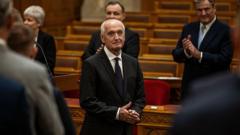
Hungary's parliament elected former Supreme Court chief András Baka as the nation's new president, marking a profound institutional break from the legacy of former Prime Minister Viktor Orbán. Lawmakers belonging to the governing Tisza party confirmed Baka in a secret ballot, securing 140 votes in favor against six opposed, while loyalists from Orbán's Fidesz party boycotted the process entirely. Baka steps into the role following the exit of Tamás Sulyok, an Orbán-appointed figure whose term was cut short by a constitutional amendment. This transition is not merely cosmetic. It reflects an aggressive overhaul of Hungary's state apparatus by a new administration attempting to dismantle entrenched power structures.
The Architecture of Ouster
Understanding how András Baka arrived at the presidency requires looking back at the mechanics of institutional capture that defined Hungarian politics for over a decade. Back in 2011, Baka was serving as the president of the Supreme Court. His tenure was abruptly terminated years before expiration following a series of public critiques directed at judicial overhauls pushed by Orbán's government. Baka took his case to the European Court of Human Rights and secured a victory establishing that his dismissal violated foundational labor and judicial protections.
That history turned Baka into a potent symbol of institutional resilience. When the new political alignment led by Prime Minister Péter Magyar swept into power, reversing the old guard became a primary mandate. Tamás Sulyok, who had previously headed the Constitutional Court before ascending to the presidency, found himself on the receiving end of a legislative rollback.
[Orbán Era Institutional Setup]
        │
        ▼ (Judicial reforms & legislative control)
[Systemic Consolidation]
        │
        ▼ (Electoral shift & constitutional amendments)
[Dismantling via New Leadership]
The new administration utilized a constitutional amendment to truncate Sulyok’s mandate, characterizing his presidency as a continuation of partisan control. Fidesz legislators condemned the maneuver as an illegitimate purge, yet the parliamentary arithmetic favored the ruling coalition's supermajority.
The Symbolic Weight of the Office
The Hungarian presidency is designed to be largely ceremonial, carrying limited direct policy authority outside of legislative review powers and diplomatic representation. Yet symbolism matters intensely during periods of national transition. By selecting a jurist who was unceremoniously expelled from his post by the previous administration, the ruling party is telegraphing an explicit message regarding the restoration of judicial independence.
Baka himself acknowledged the tightrope walk required during his acceptance speech in Budapest. He cautioned against retributive governance, stating clearly that a new political order cannot be built upon a foundation of vengeance.
"This country cannot build a common future while its citizens see each other as enemies," Baka told lawmakers. "Political change should not mean that from now on people will have to be afraid, be silent, or feel like outsiders in their own country."
This rhetoric attempts to address deep societal fractures. Hungary remains starkly polarized after sixteen years of dominant-party governance. While supporters of the current administration view these personnel changes as a mandatory purge of captured institutions, the opposing camp views the acceleration of structural removals as a threat to constitutional stability.
Examining the Counter-Arguments
Critics of the current administration's strategy argue that removing sitting constitutional officers via expedited amendments sets a dangerous precedent. If executive-aligned majorities can routinely rewrite rules to vacate independent offices, the permanence of the rule of law remains fragile, regardless of who holds power.
Proponents counter that leaving legacy appointments intact inside key oversight bodies would effectively paralyze any executive attempting to reform a system engineered for single-party dominance. This tension highlights a recurring dilemma in post-transitional democracies. When a system is thoroughly fused with a single political network, standard legalism can become a mechanism for preserving past imbalances.
The boycott by Fidesz lawmakers signals that the opposition intends to contest the legitimacy of these structural shifts on domestic and international stages. Rather than engaging in floor debates, the former ruling faction has chosen total non-cooperation, signaling a prolonged political standoff.
What Lies Ahead for the State Apparatus
The transition of power brings immediate operational challenges. Baka assumes office with the expectation of signing off on subsequent legislative packages designed to audit previous financial allocations and reform public administration.
The primary test will be whether the presidency can maintain a semblance of neutrality while its occupant was explicitly chosen to repudiate the prior regime. If Baka leans entirely into his role as a reformer, critics will label him an instrument of the new executive. If he attempts too much distance, he risks alienating the parliamentary majority that engineered his return to public life.
The structural realignment of Central Europe's political landscape continues to unfold through these high-stakes legal battles. Hungary's institutional trajectory hangs entirely on whether this administrative turnover clears a path toward sustainable pluralism or simply writes a new chapter in partisan dominance.