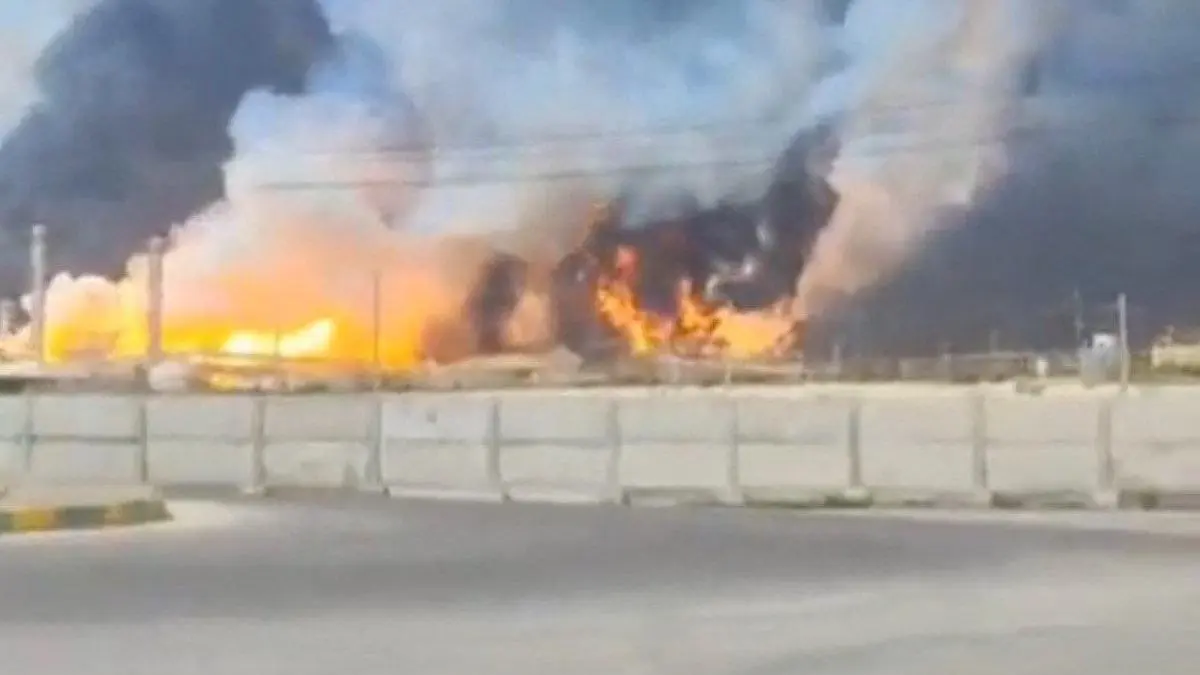
You probably don't think about the Levant Basin when you flip a light switch in London or Berlin. You should. Global energy markets are currently a giant, interconnected web of anxiety. When a drone or a rocket hits a gas platform in the Eastern Mediterranean or the Persian Gulf, it isn't just a regional skirmish. It’s a direct hit to your wallet. We've moved past the era where Middle East instability only meant "expensive oil." Today, the world runs on gas, and the supply chain is thinner than most politicians want to admit.
Middle East gas field attacks aren't just about broken pipes. They're about the sudden disappearance of "swing" supply. When Israeli fields like Tamar or Leviathan face security threats, or when Gulf infrastructure is targeted, the ripple effect moves at the speed of a trade execution. Europe, having cut itself off from Russian pipeline gas, is now hyper-dependent on Liquefied Natural Gas (LNG). If Middle Eastern gas stops flowing—or even if traders think it might stop—prices skyrocket globally.
Why the Eastern Med is the New Energy Frontline
For decades, the Eastern Mediterranean was a backwater for energy. That changed with massive discoveries like the Zohr field in Egypt and the Leviathan field off Israel’s coast. Suddenly, this region became a legitimate alternative to Russian energy. But there's a catch. These fields sit in some of the most contested waters on the planet.
When conflict flared in late 2023, Israel temporarily shut down the Tamar gas field. It was a safety move. But the impact was immediate. Egyptian gas imports dropped, which meant Egypt had less gas to liquefy and export to Europe. This is the "domino effect" in action. You lose one field in the Mediterranean, and a buyer in Spain suddenly has to bid against a buyer in Japan for a limited pool of American LNG. Prices go up for everyone. It’s a zero-sum game played with high-pressure pipelines.
The geography here is brutal. Most of these platforms are "sitting ducks" in the open sea. They rely on subsea pipelines that are notoriously difficult to defend. If a state actor or a well-funded proxy group decides to take out a manifold or a compression station, we aren't talking about a few days of downtime. We're talking months of repair in a war zone.
The Strait of Hormuz and the LNG Nightmare
While the Mediterranean is the new headache, the Persian Gulf remains the chronic migraine. Qatar is one of the world's largest LNG exporters. Almost all of that gas has to pass through the Strait of Hormuz. We often talk about the "oil chokepoint," but the "gas chokepoint" is arguably more dangerous now.
If an attack happens on Qatari infrastructure or if the Strait is blocked, the global economy hits a wall. Unlike oil, which can be stored in massive underground salt caverns or moved via different trucking routes in a pinch, LNG requires specialized terminals and ships. You can't just reroute a massive LNG carrier on a whim without massive costs.
In 2024 and 2025, we saw a massive increase in "gray zone" warfare—attacks that aren't quite full-scale war but are designed to create economic chaos. Sabotage, cyber-attacks on SCADA systems controlling gas flow, and "unidentified" drone strikes are the new tools of the trade. They're effective because they keep the market in a state of permanent "risk premium." You're paying extra for your gas right now just because traders are terrified of what might happen tomorrow.
How Market Psychology Overwhelms Physical Reality
Here is something the "experts" on cable news rarely explain. Prices don't just go up because gas stops flowing. They go up because people are scared it will stop. This is called the "risk premium."
Imagine a gas field in the Middle East provides only 2% of the global supply. If that field is attacked, you might think prices should only go up by 2%. Wrong. The market panics. Hedge funds and utility companies start buying futures contracts to lock in prices, fearing a bigger outage. This surge in buying drives the price up by 20% or 30% in a single afternoon.
We saw this during the initial reports of maritime drone activity in the Red Sea. Even though the gas was still technically there, the cost to ship it—and the insurance required to move it—doubled. The consumer always pays that insurance bill. It’s baked into the per-therm or per-kilowatt-hour rate on your monthly statement.
The Myth of Energy Independence
A common refrain is that the US or other domestic producers are shielded from this because they produce their own gas. That’s a total fantasy. Natural gas is a global commodity. If the price of gas in the Middle East spikes, American producers will naturally want to sell their gas to the highest bidder—which will be the desperate buyers in Europe or Asia.
To keep that gas at home, domestic prices have to rise to match the global market. Unless a country completely bans exports (which would be an economic disaster), they're tethered to the stability of Middle East gas fields. We're all in the same boat, and that boat is currently sailing through very choppy waters.
Breaking the Dependency Cycle
If you're waiting for the Middle East to become a boring, stable region, don't hold your breath. The tension is structural. The shift toward gas as a "bridge fuel" for the energy transition has actually made us more vulnerable in the short term. We've traded dependency on one set of volatile actors for another.
What actually works? Diversification is the only real shield. Countries that are building more regasification units (to take LNG from more sources) and those investing in long-duration battery storage are the ones that won't see their economies collapse when a drone hits a field in the Gulf.
Keep an eye on the "Basis Spread" between regional hubs like the Title Transfer Facility (TTF) in Europe and Henry Hub in the US. When that gap widens, it’s a signal that the market is pricing in Middle Eastern chaos. If you're managing a business or just trying to survive a winter, watch the news out of the Levant, not just for the politics, but for the pressure readings.
Start by auditing your own energy exposure. If you’re a business owner, look into fixed-rate energy contracts now, before the next "unforeseen" escalation. If you’re a homeowner, look at heat pump efficiency ratings. The goal isn't to predict the next attack—it’s to make sure you don't care as much when it happens.