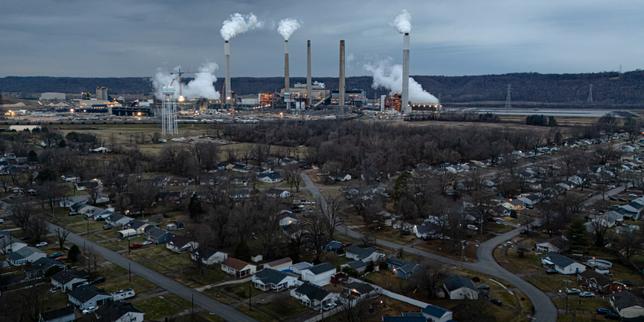
The federal government is injecting nearly $700 million into the American coal sector to build the first new coal-fired power plants in over a decade, revive shuttered facilities, and establish a West Coast export hub. President Donald Trump announced the sweeping initiative from the Oval Office, framing it as a vital move to stabilize the domestic power grid, reduce consumer electricity costs by an estimated $50 billion, and counter global economic competition. By invoking emergency powers under the Cold War-era Defense Production Act, the administration bypasses traditional legislative hurdles to fast-track fossil fuel infrastructure.
Behind the standard political theater of protecting mining jobs lies a far more modern economic driver. The aggressive push to resurrect coal is fundamentally tied to the insatiable energy demands of artificial intelligence and the massive data centers required to keep the United States ahead in the global technology race.
The Artificial Intelligence Power Crunch
The American electric grid is facing an unprecedented surge in demand. Over the past decade, utilities projected flat or minimal growth in electricity consumption as appliances became more efficient and heavy manufacturing moved abroad. The explosion of generative artificial intelligence changed everything completely. A single query processed by an advanced AI model consumes significantly more power than a traditional internet search, and the sprawling data centers housing these computational clusters require a continuous, uninterrupted stream of electricity.
Tech conglomerates have made public commitments to power their operations using wind, solar, and battery storage. The physical realities of the grid are complicating those promises. Renewable energy remains intermittent, fluctuating with weather conditions and daylight hours, while data centers require constant, baseload power twenty-four hours a day.
To bridge this gap, the administration is targeting specific geographic regions where tech infrastructure is expanding fastest. A key piece of the newly announced federal funding is a 1.6-gigawatt coal project proposed in West Virginia. This facility is specifically designed to provide power behind the meter directly to a massive, 1-gigawatt data center complex.
[Typical Data Center Power Consumption vs. Traditional Infrastructure]
By connecting the power plant directly to the technology facility, the developers avoid the transmission bottlenecks that currently plague the broader domestic grid. While the project website claims the site will feature an integrated carbon capture system to mitigate emissions, the underlying reality is clear. The digital frontier is running on old-school carbon.
The Cold War Tool for Modern Electricity
The mechanics of this $700 million capital infusion reveal how executive power can be wielded to reshape industrial policy. Rather than waiting for congressional appropriations, the administration is drawing from a $1 billion fund established under the Defense Production Act via previous legislative packages, alongside $185 million diverted from Department of Energy grants originally intended for carbon capture research under the 2021 bipartisan infrastructure law.
The Defense Production Act, originally enacted during the Korean War to prioritize steel production, allows the executive branch to direct domestic industrial capacity toward national security priorities. In this instance, the administration is treating grid reliability and artificial intelligence supremacy as national defense matters.
Where the Money Goes
The distribution of the $700 million pot splits across three distinct strategic pillars:
- Existing Asset Maintenance ($425 million): Disbursed via the Defense Production Act to support upgrades at 13 existing coal plants across 10 states, including West Virginia, Kentucky, Indiana, and North Carolina, effectively extending their operational lifespans.
- New Infrastructure and Restarts ($200 million): Department of Energy grants assigned to build two brand-new coal plants in West Virginia and Alaska—the first such construction since 2013—and to restart a 200-megawatt shuttered facility in Maryland.
- Export Expansion ($75 million): Allocated to the West Gateway export terminal in Oakland, California, providing a logistical pathway to ship up to 12 million tons of coal annually from landlocked western basins in Wyoming and Montana straight to energy markets in Asia.
Market Realities vs. Policy Interventions
The federal intervention highlights a widening chasm between political directives and market economics. For the past fifteen years, coal declined not because of federal regulations alone, but because it lost a brutal price war to domestic natural gas and utility-scale solar power. Coal accounted for roughly 45 percent of U.S. electricity generation in 2010; by 2024, that figure plummeted to 15 percent.
Utilities systematically scheduled coal units for retirement because running them was no longer profitable. The 200-megawatt Maryland plant slated for a restart under this new plan was shuttered precisely because market monitors deemed its operations extraordinarily uneconomic.
[U.S. Electricity Generation Mix Trends 2010 vs 2024]
By subsidizing these operations with public funds, the government alters the risk profile for private utilities like Duke Energy Corp., Hallador Energy Co., and American Electric Power Company Inc. The administration argues these subsidies protect consumers from skyrocketing costs during peak demand spikes. Critics, however, point out that the funding mechanisms essentially insulate energy firms from the financial penalties of operating obsolete, high-emission assets.
The Ratepayer Dilemma
The broader conflict centers on who should pay for the infrastructure required by the technology boom. In March, major tech companies signed a non-binding ratepayer protection pledge orchestrated by the White House, committing to fund the energy upgrades necessary for their data operations.
By utilizing general taxpayer funds via the Defense Production Act and restructured Department of Energy grants to build coal plants tied directly to tech facilities, the administration is effectively shifting those capital expenditures back to the public.
Former agency officials and energy consultants have raised immediate concerns regarding the legality of this approach. Siphoning money originally allocated by Congress for environmental remediation and emission reduction to instead build new fossil fuel infrastructure risks legal challenges from congressional committees. If courts find the funds were diverted outside their original statutory intent, the awards could face sudden rescission, leaving the incomplete projects stranded.
Environmental and Public Health Tradeoffs
The revival of coal infrastructure carries unavoidable consequences for local air quality and public health. Beyond carbon dioxide emissions, coal combustion releases sulfur dioxide, nitrogen oxides, and particulate matter that directly impact communities downwind of the generation stacks.
Environmental advocacy organizations like the Sierra Club argue that extending the lifespan of aging facilities reverses years of steady air quality improvements, particularly in the industrial Midwest and Appalachia. The administration counters that modern scrubbing technology and planned carbon capture systems minimize these localized impacts.
The immediate economic reality is that installing carbon capture technology at scale remains unproven at commercial volumes and adds immense capital costs to projects that are already financially fragile without ongoing government support.
The Geopolitical Chessboard
The push for domestic energy expansion is explicitly designed to counter international competitors, most notably China, which continues to build coal-fired generation capacity at a rapid pace to support its own industrial and computing infrastructure. Administration officials view the energy transition through a strictly competitive lens, arguing that hamstringing American computing capabilities with strict emission targets while foreign adversaries utilize all available fuel sources represents a long-term economic risk.
This logic underpins the inclusion of the Oakland export terminal funding. By ensuring western coal can reach Asian markets efficiently, the administration seeks to maintain an active, profitable domestic mining sector even if localized domestic utility demands shift in the coming decades.
The strategy assumes global demand for thermal coal will remain high enough to justify the infrastructure investments. It also relies on the premise that tech companies will quietly accept carbon-heavy electricity to satisfy their computational needs, despite their public corporate sustainability targets.
As data centers continue to pull massive amounts of power from regional grids, the tension between corporate public relations, economic survival, and state-directed industrial policy will intensify. The $700 million injection ensures that, for the foreseeable future, the infrastructure supporting the digital economy will remain anchored to the physical realities of the industrial past.