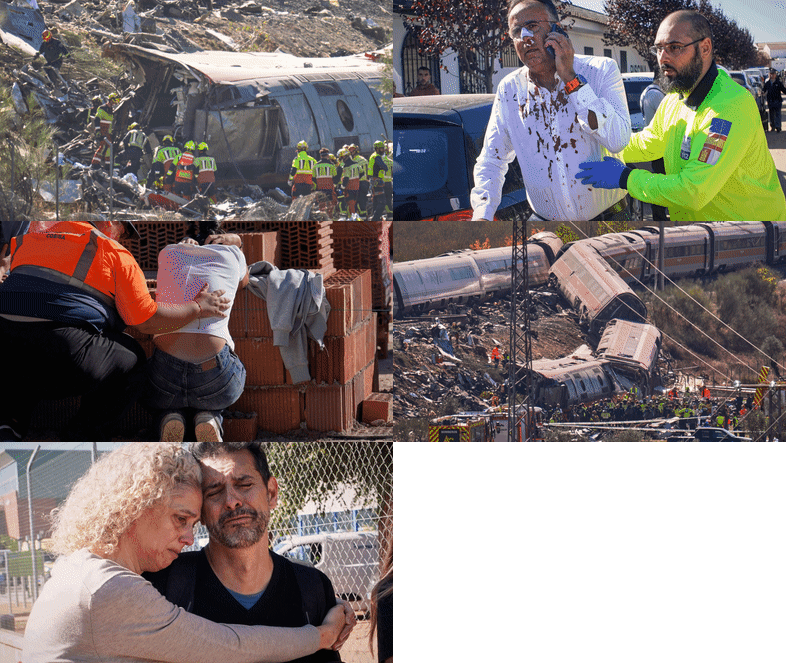
When news breaks of a catastrophic Spain train crash—like the breaking reports of dozens killed on a high-speed line and a nation plunged into mourning—the initial coverage always looks the same. Live blogs refresh every three minutes. Casualty numbers climb in grim increments. Prime ministers issue solemn statements about national grief while emergency crews cut through twisted steel under floodlights.
It's visceral, heartbreaking, and impossible to look away from.
Yet if you've ever followed rail safety investigations closely, you know that live-blog journalism misses almost everything that actually matters once the sirens fade. Breaking news captures the chaos of the first six hours, not the engineering realities, regulatory failures, or systemic safeguards that determine whether a tragedy becomes a turning point or a footnote. Understanding what really goes wrong on high-speed rail requires looking past the minute-by-minute ticker and examining how modern European rail networks operate under extreme pressure.
Why High-Speed Rail Disasters Shock Europe So Deeply
Rail travel across Spain isn't just transit; it's a point of fierce national pride. Over the past three decades, Spain built the longest high-speed rail network in Europe—exceeding 3,900 kilometers of track—second globally only to China. Operated primarily by state-owned Renfe alongside newer private competitors like Iryo and Ouigo, the AVE (Alta Velocidad Española) system earned a reputation for surgical punctuality and cutting-edge safety standards.
When something goes catastrophically wrong on tracks engineered for 300 kilometers per hour, the psychological shock hits harder than a highway pileup. People trust trains precisely because human error is supposed to be engineered out of the equation.
Consider the precedent that still haunts every Spanish rail engineer and transport minister: the July 2013 Santiago de Compostela derailment. An Alvia train traveling from Madrid to Ferrol entered the Angrois curve at nearly double the 80 km/h speed limit, killing 79 people and injuring more than 140. That disaster became a watershed moment not because the hardware failed, but because a dangerous transition zone lacked automated braking protection—leaving a single distracted driver as the sole barrier between normal operation and catastrophe.
Every time a new crash dominates headlines with rising death tolls, investigators immediately ask the same fundamental question. Did technology fail, or did human decision-making collide with a gap in the safety net?
The Anatomy of Modern Rail Safety Systems
Most travelers assume high-speed trains rely on a driver watching trackside signals through a windshield. At 300 km/h, that's physically impossible. A train moving at that velocity covers roughly 83 meters every single second—nearly the length of a football pitch before a human brain can even register a yellow light and move a hand toward a brake lever.
Instead, European high-speed corridors rely on ERTMS (European Rail Traffic Management System) and ETCS (European Train Control System). Think of ETCS as an invisible digital tether connecting the train's onboard computer directly to sensors embedded in the track bed.
Here is how that protection is supposed to work in practice:
- Continuous speed supervision calculates the train's exact braking curve based on weight, gradient, and distance to the next hazard.
- Automated intervention triggers emergency braking immediately if a driver ignores an auditory warning or exceeds the permitted velocity by even a few kilometers per hour.
- Cab signaling displays target speeds and movement authorities directly on the driver's console, eliminating visibility issues caused by fog, night, or heavy rain.
Spain also uses a legacy system called ASFA (Anuncio de Señales y Frenado Automático) on conventional lines and transitional segments. Unlike full Level 2 ETCS, older versions of ASFA relied on discrete trackside beacons rather than continuous monitoring. If a train accelerated after passing a beacon, the system didn't always catch the mistake until it was too late.
That distinction between continuous digital supervision and legacy beacon systems sits at the center of almost every major European rail inquiry. When high-speed trains leave dedicated high-speed corridors to share older infrastructure—or when signaling upgrades stall due to budget disputes—risk spikes dramatically.
What Breaking News Live Blogs Get Wrong in the First 24 Hours
If you are reading live updates as rescue teams pull survivors from wreckage, treat every early technical claim with heavy skepticism. Having analyzed dozens of transport accident timelines, I can tell you that the first 24 hours of reporting are notoriously unreliable on cause and culpability.
The Rush to Blame the Driver
Initial leaks from unnamed officials almost always focus on speed or human error. It's the easiest narrative to digest. A driver missed a signal, took a curve too fast, or misread a dispatch order.
In reality, modern transport safety science—championed by organizations like the European Union Agency for Railways (ERA)—rejects "human error" as a root cause. Humans make mistakes every day; engineers design systems assuming they will. If a single lapse in attention kills 68 or more people, the failure belongs to the system architecture that allowed an unmitigated error to become fatal.
Confusion Over Track Ownership and Operations
Spain's rail liberalization complicated public understanding of accountability. Today, multiple operators run passenger trains over infrastructure managed by Adif (Administrador de Infraestructuras Ferroviarias). When an accident occurs, reporters frequently conflate the train operator with the infrastructure manager.
They aren't the same entity. Adif maintains the rails, switches, overhead catenary wires, and signaling electronics. The operator—whether Renfe, Iryo, or Ouigo—maintains the rolling stock and employs the drivers. Determining whether a derailment stemmed from a fractured axle, a buckled rail, a switch malfunction, or an operational error requires dissecting the boundary between those two organizations.
Casualty Figures Fluctuate for Structural Reasons
Readers often get frustrated when official death tolls jump suddenly or shift between agencies. That isn't cover-up behavior. In high-speed collisions or derailments, carriages telescope into one another, requiring heavy hydraulic cutting gear and structural stabilization before forensic teams can safely enter every compartment. Regional emergency services, the Guardia Civil, and judicial magistrates each verify fatalities under strict legal protocols before updating official counts.
How Real Rail Investigations Actually Unfold
Once the Prime Minister concludes press briefings and national days of mourning begin, control of the crash site transfers from emergency responders to judicial investigators and Spain's CIAF (Comisión de Investigación de Accidentes Ferroviarios).
Their process is methodical, slow, and deliberately insulated from political pressure.
- Securing the Event Recorders. Every modern locomotive carries hardened crash-protected data loggers—the rail equivalent of aviation black boxes. These units record speed, throttle position, brake pipe pressure, horn activation, and every signaling telegram exchanged between track and train down to the millisecond.
- Mapping the Debris Field. Investigators laser-scan the exact resting positions of bogies, axles, and rail fasteners. The first wheel to leave the rail leaves unmistakable scoring marks on sleepers and steel, pinpointing the exact meter where normal physics gave way to disaster.
- Metallurgical and Infrastructure Testing. Track geometry cars and laboratory metallurgists examine broken rails or wheelsets under electron microscopes to distinguish pre-existing metal fatigue from impact fractures caused during the crash itself.
- Reviewing Dispatch Logs and Maintenance Records. Was there a temporary speed restriction issued for track maintenance? Did an automated hot-box detector flag an overheating axle bearing kilometers earlier? Did dispatchers override a faulty signal manually?
In Spain, the independence of the CIAF itself became a major legal battleground following the 2013 Santiago crash, when European regulators criticized the commission for lacking sufficient separation from the Ministry of Transport. Scrutiny over how investigations are conducted is now nearly as intense as scrutiny over the crashes themselves.
The Hidden Pressures Facing European Rail Networks
Look beyond any single incident, and a broader structural tension emerges across Europe's rail corridors. Passenger demand has surged to record highs as travelers ditch short-haul flights for cleaner, faster city-center-to-city-center rail links. Liberalization brought lower ticket prices and higher train frequencies, packing tight timetables onto shared corridors.
More trains mean narrower margins for maintenance windows. Track workers often get barely three or four hours in the dead of night to inspect switches, grind rails, and test signaling circuits before the first morning departures roll out at 6:00 AM.
Climate extremes add another layer of stress. Prolonged Iberian heatwaves push steel rail temperatures past 60 degrees Celsius, increasing the risk of thermal track buckling if ballast tension isn't meticulously maintained. Flash flooding, meanwhile, can undermine embankments beneath high-speed lines in hours.
None of this means high-speed rail has become unsafe. Statistically, traveling by train in the European Union remains orders of magnitude safer per passenger-kilometer than driving on any highway. Yet high-speed rail operates on a zero-tolerance social contract: because accidents are so rare, every single one must yield transparent, uncompromising structural reform.
How to Read Developing Rail Crash Coverage Critically
When a major rail tragedy dominates the news cycle, you don't have to passively consume speculative live blogs or sensationalized social media clips. Use a clear framework to separate verified facts from noise:
- Follow primary institutional bulletins directly. Check official updates from Adif, Renfe (or the specific operator involved), and Spain's Ministry of Transport and Sustainable Mobility rather than relying solely on secondhand aggregators.
- Distinguish infrastructure from rolling stock. Pay attention to whether investigators focus on a specific stretch of track (switches, curves, signaling beacons) or a specific train model, as that determines whether wider fleet inspections or route closures will follow.
- Ignore early single-cause theories. Wait until preliminary data from the onboard event recorders is released by judicial authorities before accepting claims about speed or equipment failure.
- Watch for safety directives, not just condolences. The true measure of institutional accountability isn't a politician's speech during a day of mourning—it's whether transport regulators issue immediate technical advisories modifying operating rules across similar corridors.
If you're traveling on Spanish or European rail networks following a major incident, check the operator's official service advisories for route diversions or bus bridges around affected corridors, as forensic inspections routinely close main lines for days or weeks. For those tracking the deeper policy fallout, watch the official reports published by the European Union Agency for Railways alongside Spain's CIAF—that is where the real lessons of every tragedy are written.


