Every January, municipal authorities and eco-charities wheel out the exact same feel-good narrative. Local residents are encouraged to haul their shedding, dead pine trees down to the coastline so volunteers can plant them in the sand. The pitch is simple, tidy, and broadcast everywhere from local news broadcasts to international wire services: discarded holiday firs are magically stopping coastal erosion, rebuilding ancient dunes, and saving seaside communities from rising tides.
It makes for a brilliant photo opportunity. It gives well-meaning citizens a comforting sense of active participation in climate stewardship.
It is also largely an exercise in performative conservation that mistakes a minor localized sediment trap for a scalable coastal defense strategy.
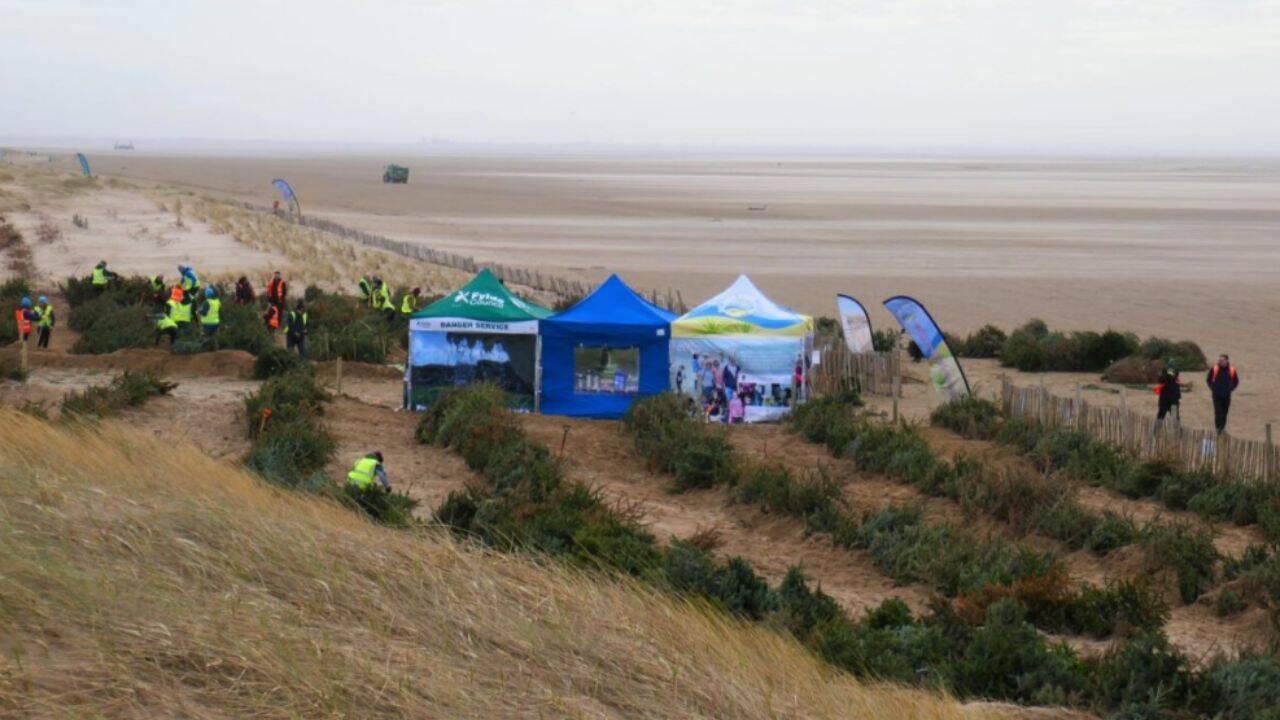
Let us look past the heartwarming imagery of volunteers in bobcaps planting conifer skeletons in the Lancashire wind. When you examine the actual engineering mechanics of coastal sediment transport and geomorphology, stacking thousands of discarded Christmas trees against a receding shoreline is akin to throwing wet paper towels at a structural flood.
The Physics of Sand Trapping vs. True Coastal Resilience
To understand why this widely praised initiative is fundamentally limited, you have to look at how coastal dunes actually form and survive. Dunes are dynamic, living systems driven by two primary inputs: an abundant, continuous supply of offshore sediment and high-energy aeolian transport. When wind blows across a dry beach, it picks up sand grains. Anything in the path of that wind—be it a fence, a rock, a clump of marram grass, or a dead spruce tree—causes a localized drop in wind velocity. The air drops its payload. Sand accumulates.
At a micro-scale, a pile of dead pine branches functions as an effective temporary baffle. Along England's Fylde Coast, projects like the Fylde Sand Dunes initiative have successfully utilized these trees to capture wind-blown sand, widening certain stretches of beach-head by dozens of meters over the past decade.
Here is what the glowing press releases omit: capturing blowing sand on a dry upper beach does not stop coastal erosion. It merely rearranges local sand distribution.
Erosion happens when rising sea levels, intense storm surges, and high-energy wave action strip sand away from the foreshore and drag it into the nearshore zone or out to sea. A row of buried Christmas trees does nothing to dissipate the hydraulic energy of a violent North Sea storm crashing against the coast. Once the winter storms hit, those brittle pine branches offer zero structural resistance against pounding waves. They snap, they rot, and within a few seasonal cycles, they mineralize or get buried entirely into nothingness.
The Conifer Decay Timeline
Proponents love to talk about how repurposing evergreens keeps them out of landfills where they would otherwise emit methane. This argument collapses under basic organic chemistry scrutiny.
Pinus and Picea species—ordinary Christmas trees like Sitka spruce and Nordmann fir—are packed with lignins and resins, but they decompose rapidly in sandy, saline, aerated environments. Once buried in a beach profile, needles drop within weeks. The soft wood degrades quickly through fungal and microbial activity, losing its structural integrity in less than two years.
Imagine a scenario where a municipality collects two thousand trees, hauls them using diesel-powered trucks, deploys dozens of volunteers to dig trenches, and anchors them into the sand. Within twenty-four months, the physical structure of those trees has largely oxidized or collapsed into organic dust. What remains behind is a thin layer of humus. If marram grass hasn't established deep, resilient root networks in that exact window of time, the trapped sand simply blows away during the next dry offshore gale.
The tree didn't build a dune. The wind built a dune, and the tree briefly acted as an expensive, biodegradable speed bump.
The Scale Mismatch
The real danger of the Christmas tree beach-restoration trope is that it acts as a corporate and municipal distraction. It lets agencies check an environmental box with minimal capital expenditure while avoiding the uncomfortable, expensive structural realities of genuine climate adaptation.
Look at the numbers. Over a decade of organized tree-planting efforts on certain UK coasts, projects report expanding dune systems by modest widths. Meanwhile, historical data shows that over eighty percent of natural dune networks in those same regions vanished over the past century and a half due to aggressive coastal urbanization and real estate development.
You cannot offset centuries of hard concrete sea-walls, poorly planned shoreline property development, and macro-scale sediment starvation by collecting dead holiday decorations once a year. It is the environmental equivalent of telling individuals to turn off their tap while a massive industrial pipe leaks millions of gallons unchecked.
Coastal geomorphologists know that true dune restoration requires massive sand replenishment programs, the removal of hard engineered barriers that block natural landward migration, and the aggressive restoration of native perennial dune grasses like Ammophila arenaria. Marram grass possesses extensive, deep rhizome systems that dynamically bind sand grains together through seasonal burial and growth cycles. A dead pine tree has zero biological feedback loops. It cannot grow, it cannot adapt to rising sea levels, and it cannot self-repair when battered by high tides.
What Actually Works
If you want to protect coastal communities from storm surges, stop relying on holiday recycling gimmicks.
First, implement managed realignment. Stop building hard, rigid defenses that reflect wave energy and scour away the base of the beach. Allow coastlines room to breathe and retreat naturally.
Second, fund large-scale sand bypassing and offshore nourishment projects that restore the actual sediment budget of the littoral cell. Dunes starve because groynes and breakwaters trap sand upstream, cutting off the natural conveyor belt of the sea.
Third, if you are going to use physical sand traps, deploy industrial geotextile fencing or engineered brushwood hurdles that last longer, maintain structural integrity through multiple storm seasons, and actually allow native vegetation time to colonize the substrate permanently.
Throwing your old fir tree into a dune trench isn't saving the planet. It is a feel-good ritual that makes people feel productive while the sea keeps rising against the door.
Stop treating coastal defense like a holiday craft project.