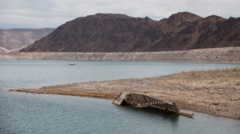
The shoreline at Lake Mead no longer marks where the water ends and the earth begins. Instead, a bleached white mineral bathtub ring scars the surrounding canyon walls, tracing a downward trajectory that has laid bare decades of forgotten history. When park visitors stumbled upon skeletal fragments, including a jawbone with teeth still intact, scattered across the baking silt of Boulder Beach, they did not just find evidence of a tragedy. They unearthing a stark physical manifestation of an ecological breakdown that goes far beyond local headlines.
As water levels at the nation's largest reservoir sink past historic thresholds, plunging beneath previous low-water marks, the shrinking basin is acting as a morbid archive. Yet, fixating purely on the macabre discoveries misses the underlying catastrophe. The receding tides of the American West are exposing systemic vulnerabilities in how millions of people manage an over-allocated, rapidly vanishing resource.
The Anatomy of a Man-Made Basin Collapse
To understand why human remains and sunken watercraft are surfacing across the Colorado River system, one must look closely at the rigid mathematics governing the American Southwest. Lake Mead was engineered to absorb the explosive growth of the desert metropolis nearby, functioning as a liquid savings account for seven states and parts of Mexico. For decades, withdrawals consistently outpaced replenishment.
Climate shifts have intensified the crisis, reducing the annual mountain snowpack that feeds the Colorado River system. Higher temperatures bake moisture straight out of the soil before snowmelt ever reaches the tributaries. When consumption patterns remain static while supply curves plummet downward, the baseline reality shifts. Reservoirs cease to function as stable bodies of water and begin to look more like evaporating puddles.
The mechanics of this decline are punishingly slow until they suddenly accelerate. As the surface area shrinks, shallower bays retreat entirely, turning underwater topography into dry land over the course of a single season. Skeletons, rusted barrels, and long-sunken boats emerge not because someone placed them near the surface, but because the water retreated vertically by over a hundred feet from its historical highs.
Beyond the Headlines of Old Secrets
Media coverage often leans heavily into sensationalism when bones appear in a dropping reservoir, frequently drawing direct lines to mid-century organized crime lore. This framing transforms a profound environmental warning sign into a true-crime television episode. Beneath the sensational veneer lies a much more mundane and widespread urban planning failure.
Every submerged artifact telling a story of past misfortune—whether a decades-old boating accident or a clandestine burial—is dwarfed by the modern infrastructure now hanging in the balance. Intake valves that once sat comfortably deep underwater now teeter closer to the surface, forcing water authorities to engineer expensive deep-straw pumping stations just to keep municipal taps flowing.
The exposure of ghost towns like St. Thomas, a Mormon settlement swallowed by the river in the 1930s during the construction of Hoover Dam, serves as a historical bookmark. It reminds observers that this landscape has always been dynamic. However, the current retreat is driven by chronic overuse and atmospheric warming rather than deliberate engineering choices.
The Brutal Economics of Scarcity
Water rights in the West operate on a strict priority system established a century ago, a framework that rewards the earliest claimants while leaving junior users high and dry during shortages. As total volume diminishes, the legal battles over every remaining acre-foot intensify. States along the upper and lower basins of the Colorado River routinely clash over mandatory conservation targets, locked in a high-stakes standoff where voluntary cutbacks have repeatedly proved insufficient.
Agriculture consumes the lion's share of this dwindling supply, irrigating crops in arid desert soils that would otherwise support only scrub brush. Alfalfa and feed corn grown in the desert are shipped overseas, effectively exporting millions of gallons of vanishing American river water in the form of livestock feed. When municipal water users face strict lawn-watering restrictions, industrial agricultural allocations often remain shielded by archaic legal protections.
This imbalance creates a profound cognitive dissonance. Tourists visit national recreation areas to snap photos of bathtub rings and exposed boat hulls, treating the shrinking lake as a natural wonder or a grim curiosity. Meanwhile, water managers crunch numbers that point toward dead pool status—the catastrophic threshold where water levels drop too low to pass through Hoover Dam's turbines or downstream outlet works.
Facing the Dry Horizon
The bones surfacing on Nevada's shores will eventually be identified through modern forensic testing, offering long-delayed closure to families of the missing. Yet the water will not return simply because an investigation concludes. The physical landscape of the American West is undergoing a permanent structural shift, and society's adaptation strategies are lagging far behind the speed of the crisis.
Ignoring the warning signs written across the shrinking mudflats guarantees a harsher reckoning when the basin reaches its absolute limit. The receding water is leaving behind an unvarnished record of past oversight, daring modern institutions to alter course before the taps run completely dry.