Mud smells like rot when it has been underwater for ten thousand years and suddenly hits the open air.
Walk out across what used to be the shoreline near Antelope Island in northern Utah and your boots sink with a wet, sucking pop. The wind comes off the water carrying that sharp, sulfurous tang—brine shrimp husks, alkali dust, old mineral soup baking under a high desert sky. For decades, people standing where you are standing right now could not have seen what sits in front of you. Because it was buried under waves.
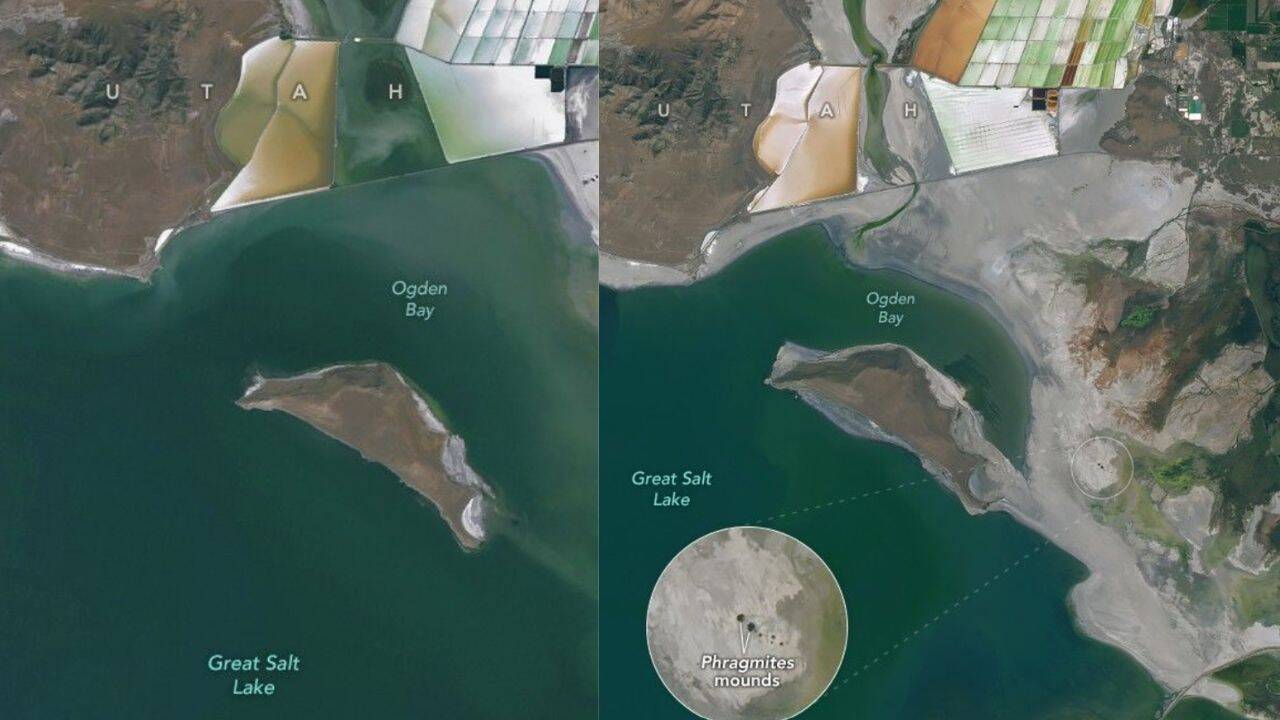
Now, stretching across the exposed lakebed in lumpy, rounded clusters, are hundreds of dome-shaped formations. Circular mounds. Some look like petrified loaves of bread; others resemble gray-brown coral heads stranded on a moonscape. At first glance, they look like alien eggs or ruins left behind by a forgotten civilization that built stone pillows along the tide line.
Exposed. Vulnerable. Dry.
When a lake as vast and storied as Utah's Great Salt Lake loses water on a historic scale, the shoreline doesn't just move back a few paces. It peels back time. And what emerges from beneath the retreating brine forces an uncomfortable question: are we looking at an ancient wonder finally revealed, or are we staring at the autopsy of a dying inland sea?
To be fair, even seasoned geologists pause when they first walk out onto newly dried flats and see these rounded structures jutting through the crust. The science can sound dense—calcium carbonate precipitation, cyanobacterial mats, benthic biofilms—and frankly, it is easy to feel lost in the jargon when all you see with your own eyes is a field of bumpy rocks sitting in gray mud.
The Stone Pillows That Breath
To understand what those circular mounds actually are, strip away the mystery and look closely at their texture. They aren't carved stones, and they aren't sand dunes blown into rings. They are microbialites—living, breathing rock formations built by communities of microscopic organisms, mostly cyanobacteria, working in slow motion over millennia.
Here is an analogy to make the invisible visible. Think of a coral reef in a tropical ocean, except scaled down to microbes and sped up through chemical precipitation in salty water. As microscopic algae and bacteria photosynthesize, they pull carbon dioxide out of the surrounding water. That shift in chemistry nudges calcium carbonate out of solution, locking minerals onto sticky microbial mats. Layer by microscopic layer, year after year, the colony builds a hard limestone or carbonate dome around itself.
The result is a rounded, cauliflower-like mound that can grow anywhere from a few inches across to several feet wide and tall. Because they grow upward toward sunlight and mineral-rich water, they take on distinct circular and domed shapes across the flats.
Let's be clear about what is a metaphor and what is plain physical reality here. Calling them "stone pillows" or "living rocks" is a metaphor to help picture how soft life hardens into mineral form. What is physically real is that these mounds were formed underwater, sustained by submergence, wave action, and the chemical balance of the lake.
I remember the first time I stood on a stretch of dried lakebed where the water had pulled back so far the distant mountains looked like cardboard cutouts pasted onto the horizon. The silence out there is heavy. No traffic, no rustling oak trees—just the hiss of wind dragging fine alkali silt across cracked clay. Touching one of those exposed mounds, the surface felt rough, gritty, and strangely brittle on the outside, yet solid beneath. You realize instantly that water isn't just background scenery out here. Water is the architect.
A Hypothetical Walk on the Flats
Because many readers have never set foot on the Great Salt Lake's exposed flats, let's trace a hypothetical scenario—a composite walk grounded in real conditions documented along the lake's shrinking margins.
Imagine Hannah, a middle-school science teacher from Salt Lake City who brings her students out to study local ecology. She isn't a hydrologist; she is someone who has watched the lake's water levels swing wildly over her lifetime and wants her kids to see what a shrinking terminal lake actually looks like up close.
Hannah steps carefully over salt-crusted ruts left by off-road vehicles and points to a cluster of circular mounds sitting completely out of the water. A student asks if people put them there to stop erosion. Another wonders if they're dinosaur eggs.
Hannah kneels down, careful not to crack the fragile crust, and explains how the lake works. Unlike most lakes that drain out through a river to the sea, the Great Salt Lake is a terminal lake. Water flows in from mountain snowpack and rivers like the Bear, Weber, and Jordan—and the only way out is evaporation. When water evaporates, salts and minerals stay behind.
For thousands of years, those mounds sat submerged, bathed in mineral-rich water. Now, sitting exposed in the dry air, their story shifts from quiet growth to precarious survival.
Here is why Hannah's field trip matters beyond a single science lesson. When water levels drop and expose microbialites for extended periods, drying, wind erosion, and lack of submergence threaten the delicate living communities clinging to their surfaces and alter the habitat structure they provide in the shallow water. Worse still, exposed lakebed sediments can dry into fine dust that blows into nearby populated valleys when strong winds sweep across the basin.
That is the hidden trap of a shrinking lake. The water disappears, and the consequences don't stay neatly inside the old shoreline.
Why the Water Keeps Dropping
Why has a body of water that once covered thousands of square miles—and whose ancient predecessor, Lake Bonneville, once spanned much of modern Utah during the Ice Age—reached alarming lows in recent years?
There is no single villain in this story, which makes fixing it far harder than blaming one dam or one dry winter. It is a math problem where withdrawals and evaporation have repeatedly outpaced inflows during dry stretches.
Consider what happens next when upstream water is diverted for agriculture, municipal lawns, industrial uses, and reservoirs before it ever reaches the lake. Every gallon taken out upstream is a gallon that never tops off the basin. Add years of drought, higher temperatures that speed up evaporation, and infrastructure like causeways that divide the lake into separate arms with different water levels and salinities, and the system strains from every direction.
Historians and water managers have seen this pattern play out in closed basins around the world—from the Aral Sea in Central Asia to Owens Lake in California. Closed lakes act like bank accounts with no overdraft protection. When deposits shrink and withdrawals stay high, the balance drops fast.
But the real problem lies elsewhere than just a number on a water gauge.
When a lake shrinks, salinity can climb in remaining shallow pools, making survival harder for brine shrimp and brine flies. Those tiny creatures might sound insignificant until you remember that millions of migratory birds—avocets, phalaropes, gulls, grebes—stop at the Great Salt Lake to refuel along major flyways. No brine flies and brine shrimp means far less food for migrating birds. No water means exposed mudflats and dust storms. No healthy lake means economic and environmental shocks rippling across northern Utah.
It is easy to feel overwhelmed by all of that at once. Even experts who study hydrology and ecology for a living admit that predicting exact ecological tipping points in a complex, changing lake system carries real uncertainty. A wet winter can bring welcome relief and push water levels up temporarily, giving people hope and breathing room. Yet a single good snowpack doesn't automatically erase decades of cumulative water deficits or rewrite the underlying balance of supply and demand.
That tension—between brief rebounds and long-term depletion—is where public attention often gets whiplash. One season brings headlines of rising water; another brings reminders of how low the baseline has sunk.
What Those Circular Mounds Are Trying to Tell Us
Look back at those circular mounds sitting stranded on the mud. They don't shout. They don't send text alerts or hold press conferences.
They just sit there, round and heavy, marking where the water used to be.
For years, many people barely knew microbialites existed beneath the surface of the Great Salt Lake. They were out of sight, and therefore out of mind. People knew the lake for sailboats, sunsets behind Antelope Island, brine shrimp harvests, or a quick dip in water so buoyant you float like a cork. Few stopped to think about ancient microbial communities quietly building carbonate domes in the dark shallows.
Now that falling water levels have pushed them into view, those mounds serve as an unmistakable visual gauge of change. Every ring and dome sitting high and dry is a receipt from the past, stamped into mineral stone.
Can we turn this moment around? Yes—if we treat water conservation not as a temporary sacrifice during emergencies, but as a permanent operating rule for a dry climate. That means smarter agricultural irrigation, outdoor water efficiency in cities, protecting instream flows so rivers actually reach the lake, and listening to scientists who track both water volume and ecosystem health.
Progress rarely looks dramatic on day one. It looks like a farmer upgrading drip lines, a city replacing thirsty turf, a water right leased to keep river water flowing into the basin, and neighbors agreeing that a healthy lake is worth protecting.
Slowly. Deliberately. Inch by inch.
Stand back from the shoreline as dusk settles over the flats. The sulfurous mud cools, the wind dies down, and the circular mounds catch the last pale orange light before turning dark against the gray clay.
Water remembers where it belongs, even when we forget.