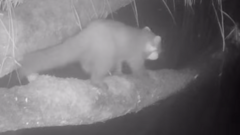
The grain of a grainy trail-camera image has sparked a conservation firestorm in the West Country. After decades of official absence, the pine marten—a lithe, cat-sized member of the weasel family—is back in Cornwall. This is not just a feel-good story for nature lovers. It is a biological disruption that challenges how we manage the British countryside and who gets to decide which species belong in our modern, fragmented woods.
While sightings in the north of England and Scotland have become more frequent, Cornwall remained a final frontier. The discovery of a lone individual in a remote stretch of Cornish woodland confirms that the species is moving south, likely aided by unofficial releases or a natural expansion that outpaces government monitoring. For the local ecosystem, the marten is a surgical tool. It targets the invasive grey squirrel, a species that has decimated British broadleaf forests and pushed the native red squirrel to the brink of extinction.
The Ghost in the Canopy
Pine martens were effectively wiped out across most of England by the early 20th century. Habitat loss did part of the damage, but the heavy lifting was done by Victorian gamekeepers who viewed anything with teeth and claws as a threat to pheasant shoots. They were right to be nervous. Martens are extraordinary hunters, capable of chasing prey through the highest branches with a speed that makes a squirrel look sluggish.
The recent Cornish sighting changes the math for regional biodiversity. We aren't just looking at a single animal wandering through the brush. We are looking at the potential return of an apex predator that fills a vacant niche. This matters because Cornwall’s woodlands are currently out of balance. Overpopulated by grey squirrels and deer, the forest floor is often stripped bare, preventing new oak and beech trees from taking root. The marten changes the behavior of everything below it on the food chain.
The Squirrel Dynamics
The relationship between the pine marten and the grey squirrel is one of the most compelling arguments for their return. Grey squirrels are heavier and spend more time on the ground than the native reds. This makes them easy pickings for a marten. In areas of Ireland and Scotland where martens have rebounded, grey squirrel populations have plummeted. Interestingly, the smaller, more agile red squirrels often survive these encounters because they can retreat to thinner branches where the marten cannot follow.
In Cornwall, where the red squirrel is a distant memory, the marten’s primary role will be pest control. Every grey squirrel removed from the ecosystem allows the forest to breathe. It reduces the need for expensive and often unpopular culling programs involving traps and air rifles. However, this biological solution comes with its own set of complications for those who make their living from the land.
A Conflict of Interest in the Undergrowth
Conservationists might cheer, but the arrival of a predator is rarely met with universal acclaim. Farmers and poultry keepers in the Southwest are already expressing quiet concern. A pine marten does not distinguish between a wild squirrel and a high-value racing pigeon or a backyard chicken. They are opportunistic. If a coop isn't secured like a fortress, a marten will find its way in.
There is also the matter of the law. Once a pine marten establishes itself in a woodland, that area gains a new level of legal protection. This can complicate life for developers and timber harvesters. You cannot simply clear a stand of trees if it contains a known marten den, or "natal den." This creates a friction point between economic progress and environmental restoration that many local councils are unprepared to navigate.
The Problem of Genetic Isolation
One sighting does not make a population. The individual seen in Cornwall is likely a "scout" or a survivor of an unsanctioned release. For a species to truly return, it needs a "ghost corridor"—a path of connected woodland that allows it to travel from Exmoor down into the depths of the Cornish peninsula without being hit by a car or trapped in a suburban garden.
Cornwall’s landscape is famously hemmed in by the sea. This creates a genetic bottleneck. If we do not actively manage the migration of martens, the small local population could become inbred and vulnerable to disease. The question then becomes one of human intervention. Should we leave it to chance, or should we intentionally reintroduce more individuals to ensure a healthy, diverse gene pool from the start?
The Invisible Battle for Land Use
Behind the grainy photo of a furry face lies a bigger conflict. Landowners in Cornwall are split. Some see the marten as a natural ally against the grey squirrel’s damage to young saplings. Others see it as another layer of bureaucracy that will restrict their ability to manage their estates as they see fit. This is not just about a marten. It's about a fundamental shift in how we value British landscapes.
In the 1950s, the priority was production—timber, meat, and grain. Today, the focus is shifting toward "natural capital." A woodland with a breeding pair of pine martens is seen as more valuable by many stakeholders than a sterilized plantation. This shift is not without its casualties. Smallholders and poultry farmers are often the ones who pay the price when a predator moves back into the neighborhood.
Redefining the Cornish Countryside
The Cornish sighting should not be treated as a one-off curiosity. It is a sign of a wider trend that is reshaping the British landscape. From the return of beavers in Devon to the expansion of martens in the north, the "rewilding" movement is moving from an academic theory to a lived reality. This is not always a comfortable process.
We must move beyond the binary of "good" or "bad" when discussing these predators. A marten is a master of its craft. It will kill, it will move through the night, and it will change the behavior of every animal it encounters. This is precisely what Cornwall’s depleted woodlands need to find a new equilibrium. The presence of this predator is a litmus test for our tolerance of a nature that is truly wild and unpredictable.
The next few years will determine if this sighting was a fluke or a foundation. If we want a landscape that can actually sustain itself, we have to accept the teeth and claws that come with it. The pine marten is back in Cornwall, and it doesn't care about our property lines or our rural nostalgia. It is simply looking for its next meal in a forest that has forgotten how to be a forest.