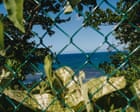
The sand changes color when it belongs to someone else.
On the northern coast of Jamaica, where the Caribbean Sea shifts from a bruised purple to an impossible, brilliant turquoise, the transition isn't marked by nature. It is marked by concrete. It is marked by chain-link fences, razor wire, and men with stern faces holding clipboards. For generations, a walk down the beach was a continuous, unbroken rhythm of salt-crusted skin and wet soles. Today, that walk stops abruptly at a wall.
To understand what is happening to the Jamaican coastline, you have to look past the glossy travel brochures advertising pristine, empty sanctuaries of relaxation. Those brochures are real, but they tell a highly selective truth. They show the beach as a product. What they leave out is the cost of the packaging.
Consider a hypothetical fisherman named Devon. He isn't a statistic, but he represents thousands of real people living along the parish lines of St. Ann and Trelawny. For forty years, Devon’s morning routine was identical: wake up before the sun, walk down a dirt path cut through the sea-grape bushes, drag his wooden canoe into the surf, and head out to the reef.
One Tuesday morning last year, Devon found a gate. The path was gone, replaced by a paved driveway leading to an incoming luxury resort. A sign informed him that this was now private property. To get to the water, Devon now has to walk three miles down a dusty highway, carrying his nets on his shoulders, to an overcrowded, rocky slip of land that hasn't been claimed yet.
Devon did not lose his job that day. He lost his heritage.
The Invisible Fences
Jamaica has over two hundred miles of coastline, but for the people who call the island home, the ocean is becoming a distant rumor.
A standard corporate report on this issue would tell you about the Beach Control Act of 1956. It would dryly explain that while the Crown—and now the government—holds the rights to the foreshore, the land leading to that water is almost entirely up for grabs. If a developer buys the land adjacent to the sea, they effectively own the sea itself, because they can block anyone from crossing their dirt to touch the water.
But dry law doesn’t capture the sting of being a stranger in your own birthplace.
The reality is a slow, creeping enclosure. It begins with a security guard suggesting you move along because the guests feel uncomfortable. It graduates to a temporary plywood barrier during a hotel renovation. Finally, it becomes a permanent structure, complete with CCTV cameras and "Keep Out" signs written in languages the local children are only just learning in school.
This is privatization by osmosis. It absorbs public space so quietly that by the time you notice it's gone, the concrete has already cured.
The argument from the boardrooms is predictable and, on paper, logically compelling. Tourism is the engine of the economy. It builds roads, it funds infrastructure, it provides thousands of hospitality jobs. A multi-million-dollar resort requires security and exclusivity; high-net-worth travelers pay for privacy. If you allow the public to wander through the property, the investment model collapses.
It is a calculation of spreadsheets. But spreadsheets don't have memories.
The Battle of Bob Marley Beach
The tension has finally boiled over from the sand to the courtroom. A coalition of activists, fishermen, and everyday citizens under the banner of beach access campaigns have filed lawsuits to challenge the systematic locking away of the coast. They are fighting for places like Bob Marley Beach in St. Andrew, a stretch of black sand woven deeply into the cultural fabric of the island.
The legal battle isn't just about swimming. It is a fundamental argument about sovereignty and identity.
What the campaigners are up against is a formidable alliance of historical oversight and modern capital. The 1956 Act is an archaic piece of colonial-era legislation that never envisioned an island completely ringed by mega-resorts. It was written in a time when access was assumed because the coast was vast and development was sparse.
Now, activists are relying on a legal doctrine known as "implied dedication" or prescriptive rights. The argument is simple: if the public has used a path to access the sea without interruption for decades, that path becomes a public right of way that cannot be legally stripped away by a new title deed.
But proving a tradition in a court of law is an expensive, exhausting uphill climb.
Imagine standing in a wood-paneled courtroom in Kingston, trying to translate the sensory experience of a community into legal jargon. How do you quantify the value of a Sunday afternoon family cookout under the almond trees? How do you submit the feeling of a child catching their first wave into evidence?
The developers bring high-priced attorneys, land surveys, and economic impact projections. The locals bring their memories and the calluses on their hands.
The Myth of the Giving Ocean
There is a profound irony at the heart of this conflict. The global tourism industry markets Jamaica by leveraging the warmth of its people, the vitality of its music, and the freedom of its natural beauty. Yet, the very people who created that culture are systematically excluded from the spaces that inspired it.
Reggae music didn't grow out of air-conditioned conference rooms. It grew out of the beaches, the street corners, and the communal spaces where people gathered to talk, wash away the heat of the day, and exist without a price tag attached to their presence.
When you restrict access to the ocean, you aren't just limiting recreation. You are disrupting a vital psychological safety valve.
Life on the island, for many, is a beautiful but grueling hustle. The economy can be unforgiving. The sun is hot. The work is hard. Historically, the sea was the one equalizer. It didn't care about your bank account, your last name, or your social standing. The salt water washed everyone clean just the same.
Take that away, and you create a distinct, simmering resentment. You create a psychological border wall within a nation.
Consider what happens next when a society is entirely separated from its natural environment. Children grow up next to the Caribbean Sea but never learn to swim because they have nowhere to touch the water safely. A generation develops a fear of the ocean rather than a kinship with it. The relationship between a people and their ecosystem becomes completely transactional. You go to the water to serve someone else a drink, not to feel the tide pull at your own ankles.
Reclaiming the Horizon
The solution being pushed by campaigners isn't the expulsion of hotels or the destruction of the tourism industry. No one is arguing for economic suicide. Instead, they are demanding a modern legislative framework—a New Beach Act that explicitly guarantees public access points at regular intervals along the coast.
It is a model that exists elsewhere. In Barbados, the principle that the beach belongs to the public is fiercely protected by law. No matter how luxurious the hotel, the sand up to the high-water mark remains open to everyone. The guest from New York and the schoolchild from Bridgetown share the same footprint in the sand.
It requires a shift in how we value progress.
If economic growth requires a population to sign away its right to look at the horizon, then that growth is a wolf in sheep's clothing. True development should expand a people's world, not shrink it down to the narrow corridors between private property lines.
The court cases will drag on. Judges will pore over ancient maps, deeds, and transcripts. The lawyers will argue over definitions of words like "foreshore" and "easement."
But out on the coast, the stakes remain beautifully, tragically clear.
As the sun begins to drop into the water, casting a long, amber light across the contested shores of St. Ann, an old woman sits on a overturned plastic bucket just a few feet outside a resort's perimeter fence. She isn't swimming. She isn't fishing. She is just watching the waves tumble over themselves, listening to the oldest rhythm the world has to offer.
A security guard walks toward the edge of the property line, his boots crunching loudly on the manicured gravel pathway. He stops at the boundary, watching her. She doesn't look back. She keeps her eyes fixed firmly on the open, shifting blue, claiming the only part of the island that cannot be fenced in.