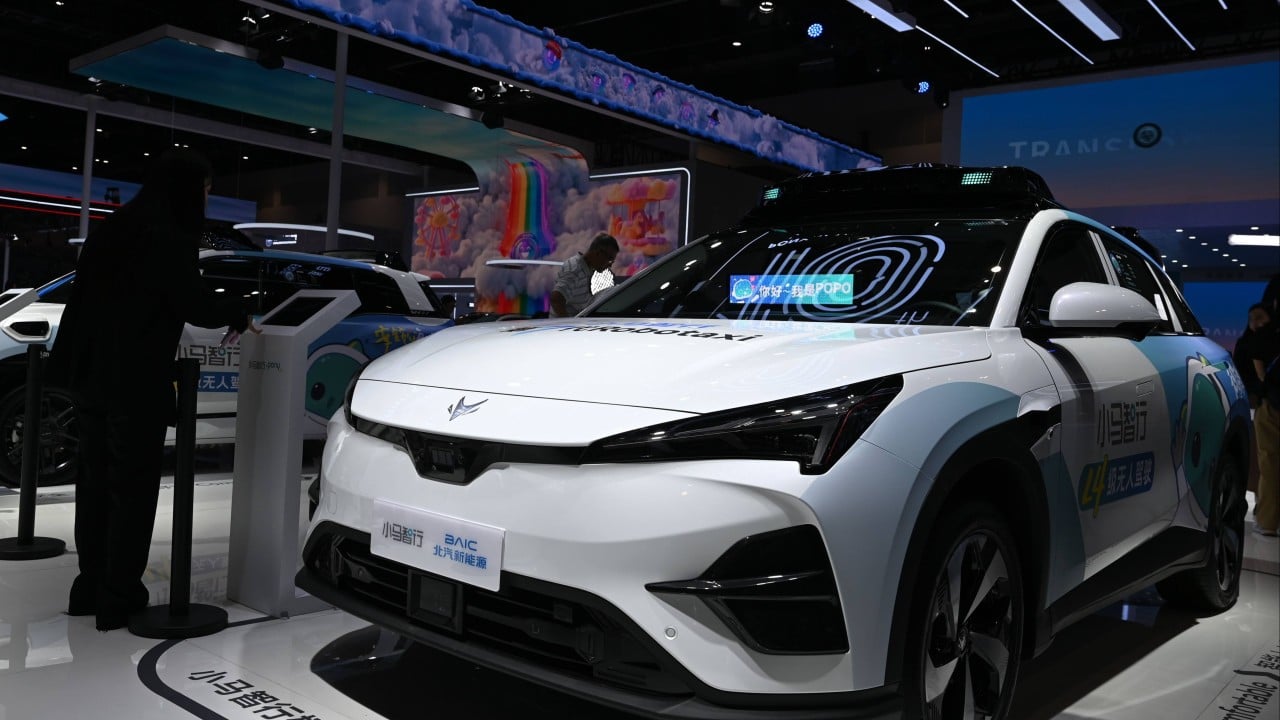
The narrative currently taking hold in industry circles suggests that Chinese robotaxi operators are simply winning because their technology is faster, better, and cheaper. This is a profound misreading of the situation. While firms like Pony.ai and Baidu have indeed made significant strides in their home market, their expansion into Europe is not a story of technological superiority. It is a calculated arbitrage of the continent’s regulatory disarray.
European automakers are currently trapped in a slow-motion collapse of their own making. By focusing on premium, high-margin consumer vehicles and resisting the rapid, iterative testing models preferred by their eastern rivals, they have created a vacuum. Chinese firms are filling that void not by overcoming technical hurdles that others cannot solve, but by moving into a fragmented market where the rules of engagement are still being written. Building on this topic, you can find more in: Stop Calling the Fiat Topolino a Golf Cart and Wake Up to the Micromobility Revolution.
The core issue is not that European technology is inferior. It is that the European Union operates as a patchwork of competing national interests. In Germany, a startup might gain approval for a trial in one city only to find that the data-sharing protocols or insurance requirements change entirely upon crossing into a neighboring member state. This is an environment where progress goes to die. Chinese firms, meanwhile, are accustomed to operating under centralized mandates where pilot programs are treated as national priorities rather than administrative headaches. They have built the agility to pivot their software and deployment models in weeks, whereas a traditional European automotive giant often requires months just to navigate a committee meeting.
Consider the infrastructure gap. This is where the narrative of Chinese dominance usually focuses on smart roads and vehicle-to-everything communication. In reality, this is a distraction. The Chinese government has spent billions turning cities into high-tech testbeds with dedicated lanes and hyper-connected grids. European cities, with their medieval layouts and protective heritage laws, were never going to mirror that. The Chinese firms arriving in Europe are currently betting that they can bypass this physical infrastructure deficit by deploying more aggressive, perception-heavy software stacks. They are optimizing for the environment they want, rather than the one that exists. Analysts at Bloomberg have provided expertise on this situation.
There is also the matter of data sovereignty. The expansion of these fleets is raising questions that regulators are woefully unprepared to answer. When a robotaxi travels through a city, it is essentially a high-definition surveillance node on wheels. European authorities are preoccupied with GDPR compliance and consumer privacy, while the real risk sits elsewhere. It is the integration of these vehicles into a broader digital ecosystem where the control loops often terminate in a headquarters halfway across the world. In a hypothetical scenario, a localized software update could theoretically change the behavior of an entire fleet instantly. European regulators are currently acting as if they are judging a standard automotive safety audit, failing to recognize that they are actually dealing with an internet-of-things security crisis.
The competitive advantage of the Chinese entrant is not just the car. It is the partnership model. We see this with recent ventures where a foreign company provides the autonomous software and operational expertise, while a local proxy handles the public-facing brand and regulatory interface. This creates a convenient layer of deniability. If an accident occurs or a data breach is uncovered, the responsibility chain is intentionally blurred. This strategy has already been deployed effectively in regions outside of China, and it is the primary vector for their European entry.
European manufacturers are responding with the only weapon they have: inertia. They have lobbied for tighter safety certifications and more rigorous testing requirements, effectively trying to regulate their competitors out of the market. This is a dangerous gamble. If they succeed, they might protect their domestic market for another few years. If they fail, they will have spent their remaining capital on legal fees instead of actual product development.
The real challenge for Europe is not how to stop the arrival of these fleets. It is how to move past the obsession with perfect, centralized regulation that treats every street as a laboratory. The current system relies on the assumption that a vehicle can be certified safe before it touches the road. In the era of machine learning and constant over-the-air updates, that concept is obsolete. A vehicle that is safe on Monday can be modified by a patch on Tuesday.
Instead of fighting the tide, some smaller European firms are beginning to copy the Chinese blueprint. They are forming cross-border alliances to bypass the national regulatory silos and creating private testing grounds that operate under a unified, experimental set of rules. This is not a perfect solution. It invites a lack of transparency and creates parallel systems that the public may never fully trust. However, it is the only way to generate the data density required to compete at scale.
We are watching a fundamental shift in how transport systems evolve. The era of the manufacturer that builds a car, sells it, and disappears is over. The future is an ongoing, high-stakes negotiation between developers, cities, and national governments. Those who understand that the regulation is the product are the ones who will own the market. Those who believe that better engineering will eventually win the day are already looking at the rearview mirror.
The pace of deployment is not accelerating because the technology is ready. It is accelerating because the pressure on the European status quo has reached a breaking point. We are about to find out if the European automotive industry still has the capacity to build a new foundation, or if it will simply be absorbed by a model that prioritizes raw, relentless momentum over established design. The shift is already underway. It is not waiting for permission.