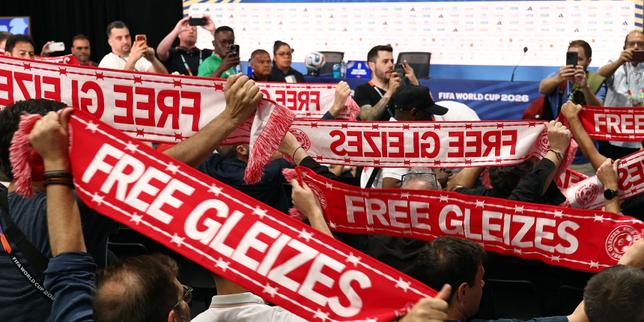
A plastic chair. A gray, windowless room somewhere inside the administrative labyrinth of Algiers. On one side of the table sits a French diplomat, brief-case heavy with official protocols and carefully worded demarches. On the other side sits Christophe Gleizes.
If you looked at him without knowing the context, you might mistake him for a man who simply went on a very long, very exhausting journey. But the reality is far more stark. He has been in Algeria for over two years, cut off from his family, his friends, and the newsrooms of Paris.
On July 7, 2026, the door of that room opened for only the second time in months. A second consular visit. To the outside world, it is a line in a government press release—a sterile update on "consular protection" and "ongoing assistance". But to those watching the clock tick in Paris and Tizi Ouzou, those few minutes of human contact are the only fragile thread tying a sports journalist back to the life he used to own.
How does a man who went to write about football end up facing seven years in an Algerian prison?
To understand the absurdity of the situation, you have to look at what Christophe Gleizes actually does. He is not a deep-cover political operative. He does not write grand geopolitical treatises on state borders or international espionage. He is a writer for So Foot and Society. He is a storyteller who chases the beautiful game into the corners of the world where football is more than a sport—where it is identity, survival, and culture.
In May 2024, Gleizes traveled to Kabylie. His goal was simple: write a profile on the Jeunesse Sportive de Kabylie (JSK), the legendary Berber football club that has long served as a beating heart of regional pride. It is a club with a history so rich and politically charged that you cannot talk about its midfield without talking about its cultural significance.
But in Algeria, sports and politics are not merely parallel lines; they are combustible elements.
The prosecution focused on interviews Gleizes had conducted years prior—conversations from 2015 and 2018 with individuals associated with the club. The problem, according to Algerian authorities, was that some of these contacts were also linked to the Mouvement pour l'autodétermination de la Kabylie (MAK), a group officially classified by Algiers as a terrorist organization in 2021.
Imagine talking to a local community leader for a sports piece, only to find out years later that the conversation has been retroactively cataloged as "apology for terrorism".
That is the logical leap that landed Gleizes a seven-year prison sentence. No weapons. No plots. Just notebook pages, digital transcripts, and a journalist doing the fundamental work of his trade: asking questions to people who live the story.
The French government expressed its "deep regret" when the appeal court confirmed the sentence in December 2025. But regret does not open prison doors.
Behind the dry legal rulings lies a cold diplomatic chessboard. The relationship between Paris and Algiers has never been a straightforward affair; it is a volatile cycle of sudden warmth and bitter freezes. When political winds shift, individuals on the ground become currency.
To many observers, Gleizes is not being punished for what he wrote, but for who he is—a French national holding a notebook in a highly sensitive region at a time when relations between the two nations are fraying at the edges. He is the human collateral of a larger, invisible friction.
The strategy has now shifted from the courtroom to the quiet, agonizing hope of executive clemency. In March, Gleizes withdrew his final appeal in cassation, a deliberate tactical move to clear any legal hurdles that might prevent Algerian President Abdelmadjid Tebboune from granting a presidential pardon.
It is a high-stakes gamble. It means accepting the finality of the sentence on paper in exchange for a plea of mercy.
Now, his family waits. His mother, Sylvie Godard, and his step-father, Francis Godard, spoke on French television just a day before the consular visit. They spoke of a son who is suffering, whose life has been paused in its prime. They point to Spain, to Germany, to any diplomatic backchannel that might carry a message to Algiers. After all, Germany successfully interceded in late 2025 for the release of the Franco-Algerian writer Boualem Sansal. If it worked for a novelist, why not for a sports reporter?
But diplomacy moves at its own agonizing pace, entirely indifferent to the sleepless nights of parents waiting for a phone call.
When the consular team left the prison on July 7, the heavy doors closed behind them once more. The official updates will continue to speak of "constructive discussions" and "active mobilization". But for Christophe Gleizes, the reality remains a small cell, the quiet passage of Algerian summer heat, and the memory of a green football pitch somewhere far beyond the walls.