The dust of the Balkans never truly settles. It hangs in the olive groves, settles on the corrugated tin roofs of Prishtina, and coats the memory of anyone who stood in the crossfire of the late twentieth century. History books like to clean things up. They draw neat lines across maps, assign tidy blame to factions, and use dry legal terminology like sovereignty and jurisdiction to make the bleeding look manageable.
Real life is messier. Real life smells like woodsmoke and copper. Don't forget to check out our recent post on this related article.
Consider the silence of a mountain road just outside Gjakova. Twenty-five years ago, this path was measured not in kilometers, but in survival. People packed their entire lives into the trunks of battered Zastava cars or walked until their boot soles wore through to the stony earth. They were running from men who wore uniforms stamped with authority, men who believed that the purity of a state justified the erasure of a neighbor.
When we talk about the Kosovo Liberation Army, the acronym KLA, we are talking about a paradox born in that exact mud. To the world watching from comfortable living rooms in London or Washington in the late 1990s, they were underdogs. They were the scrappy insurgents fighting back against a brutal state apparatus led by Slobodan Milošević, a regime that had stripped Kosovo of its autonomy and unleashed ethnic cleansing across the valleys. The images on the nightly news were stark: displaced families trudging through snow, burning barns, the hollow eyes of children clutching blankets. To read more about the background of this, BBC News offers an informative breakdown.
The insurgency filled a desperate vacuum. When peaceful resistance led by figures like Ibrahim Rugova failed to stop the tanks, young men picked up rifles. They became the shield for communities that had nowhere else to turn.
Yet war is an acid. It eats away at the righteous justifications of those who wage it until nothing is left but the raw, jagged edges of survival.
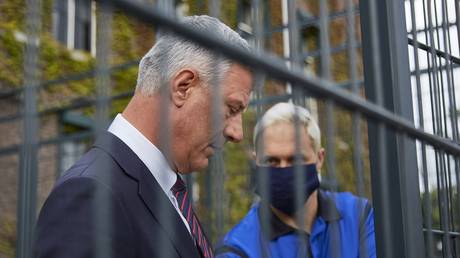
Recent legal reckonings—specifically the proceedings at the Kosovo Specialist Chambers in The Hague—have forced a brutal reckoning with that acid. Figures once hailed as foundational architects of independence, such as former guerrilla commanders and political leaders like Hashim Thaçi, find themselves answering for crimes committed not just against occupying forces, but against political rivals, minorities, and fellow Albanians deemed insufficiently loyal.
To understand why this stings so deeply for people who lived through the conflict, you have to step away from the courtroom transcripts and into a kitchen in Prizren.
Imagine an elderly woman sitting by a window, pouring Turkish coffee from a long-handled copper ibrik. Her hands shake slightly, not entirely from age, but from the weight of names she no longer speaks aloud. Her brother disappeared in the spring of 1999. For decades, official reports pointed fingers exclusively in one direction—at the departing Serbian police and paramilitary units. That was the clean narrative. That was the story that allowed the community to bind its wounds together under a single banner of shared martyrdom.
When evidence emerged suggesting that some KLA commanders operated clandestine detention sites and targeted internal dissenters, the foundation of that shared narrative cracked.
It is a terrifying thing to realize that the shield you trusted might also have left scars.
This is the psychological labyrinth of post-conflict justice. How do you process accountability when the man who protected your village from expulsion is simultaneously accused of ordering the abduction of a neighbor? How do you separate the legitimate, desperate defense of a persecuted population from the opportunistic violence that inevitably festers in the lawless vacuum of an insurgency?
International tribunals like the Special Court, based in the Netherlands precisely to insulate judges from local intimidation, operate on cold legal definitions. They deal in command responsibility, unlawful detention, and war crimes. They look at documents, intercepted radio communications, and forensic excavation reports from mass graves.
These tools are necessary. Without them, impunity wins, and the victims are buried twice—first in the earth, and second in the collective amnesia of the state.
But courts cannot mend a torn social fabric. When indictments drop against wartime heroes, the reaction in the streets of Pristina is rarely simple relief. It is a complex cocktail of defiance, betrayal, and exhaustion. Banners reading Freedom Has a Name line the boulevards, a visceral reminder that for many, prosecuting the leaders of the independence movement feels perilously close to putting the very idea of liberation on trial.
This is where the paradox deepens. A society cannot build a sustainable future on a foundation of unaddressed historical trauma and selective memory. True sovereignty requires the courage to look into the darkest corners of one's own revolution. If the KLA’s struggle was fundamentally about securing human rights, dignity, and self-determination against an oppressive regime, then upholding those exact values must extend to reckoning with abuses committed by its own ranks.
To pretend otherwise is to adopt the moral logic of the very oppressors the guerrillas fought to drive out.
Yet, acknowledging this truth does not require erasing the context of why the insurgency arose in the first place. History is not a zero-sum game where one side's atrocities cancel out another's. The mass expulsion of nearly a million ethnic Albanians by Serbian forces remains a documented historical catastrophe of staggering proportions. NATO’s 1999 intervention, controversial as its legal framework was at the time, stopped an ongoing humanitarian disaster.
Two things can be true simultaneously: a population was subjected to ethnic cleansing and systemic terror, and elements within the resistance movement committed grave violations of international humanitarian law against civilians and political opponents.
Accepting that dual reality is the heavy tax of peace.
Walking through the streets of Pristina today, you see a young, vibrant city pulsing with the energy of a population where the median age is under thirty. Cafés spill out onto sidewalks. Neon signs hum against the dusk. The generation building this modern state has no personal memory of the air raid sirens or the panic of the mountain flights. They want jobs, visa-free travel, economic stability, and a government that answers to the rule of law rather than the lingering prestige of wartime credentials.
For them, the ongoing trials in The Hague are a generational threshold. Every verdict, every piece of testimony read into the public record, is a chisel blow chipping away at the mythology of the past to make room for a more honest, if painful, reality.
Memory is a fragile vessel. We tend to polish the rough edges of our origin stories until they shine like monuments, safe from the corrosive effects of nuance. But nations are not built on monuments alone. They are forged in the quiet, agonizing work of telling the whole truth—especially the parts that hurt to look at.
The sun dips below the rugged ridges of the Accursed Mountains, casting long, bruised shadows across the valley. Down in the town square, the chatter of children playing blends with the distant hum of traffic. The past is never really behind us here; it is the soil under our feet, rich with both the fertilizer of sacrifice and the bitter roots of unpunished grief. The trials will eventually end, the legal briefs will gather dust in archives, and the politicians will pass into history. But the work of living together with the truth, in all its fractured complexity, belongs to those who remain.
The coffee grows cold in the cup. The old woman looks out the window, watching the last sliver of daylight fade from the hills, carrying the weight of a quiet, unyielding grace.