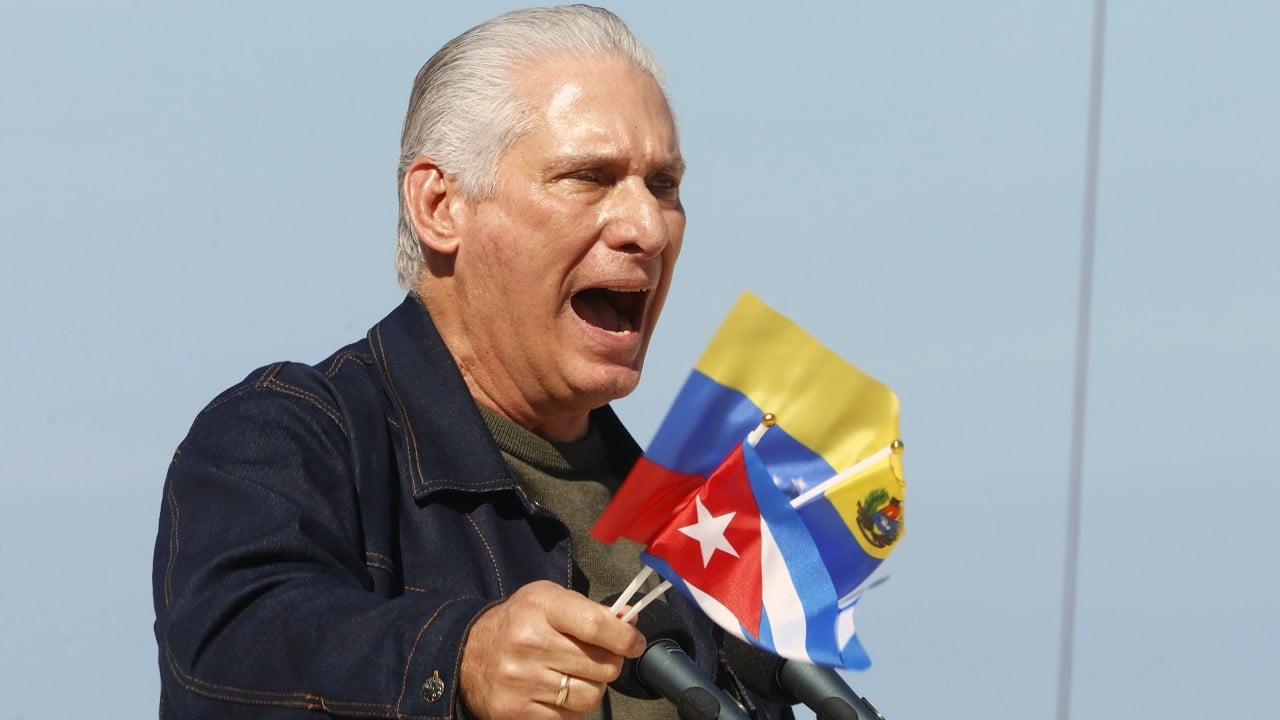
The recent warnings from Havana regarding American intervention represent more than a routine diplomatic spat. They are the calculated echoes of a revolutionary playbook that has remained unchanged since 1959. Cuban President Miguel Díaz-Canel’s recent assertions that the United States is actively plotting to depose his government serve a dual purpose. First, they aim to consolidate domestic loyalty during a period of unprecedented economic hardship. Second, they attempt to frame internal dissent as a purely foreign product. For those watching the Caribbean, this is not just rhetoric; it is a survival mechanism for a regime facing its most significant domestic pressure since the Special Period of the 1990s.
The Mechanics of Defensive Rhetoric
Governments under pressure often look outward to find a villain. In the case of Cuba, the "Yankee" threat is a historical constant that provides the ruling Communist Party with a convenient shield. When food shortages lead to protests in Santiago or Matanzas, the official narrative rarely pivots to failed agricultural policies or a lack of market reform. Instead, the focus shifts to the decades-old embargo and the supposed "clandestine operations" of the CIA.
This strategy works because it taps into a genuine historical trauma. The memory of the Bay of Pigs and the numerous verified attempts on Fidel Castro’s life during the Cold War provide a grain of truth that the state expands into a mountain of propaganda. By framing every protest as an act of treason orchestrated by Washington, the Cuban state justifies the use of its security apparatus to silence local voices. It effectively turns a policy failure into a national security emergency.
The current administration in Havana is navigating a precarious transition. The original revolutionaries—the "historic generation"—are largely gone or retired. Díaz-Canel lacks the cult of personality that sustained Fidel or the military pedigree of Raúl Castro. He is a bureaucrat in a system designed for a commander-in-chief. Consequently, his warnings about US aggression are an attempt to wrap himself in the flag and borrow the legitimacy of his predecessors. He needs a threat to justify his authority.
Economic Paralyzation and the Search for a Scapegoat
The Cuban economy is currently a series of cascading failures. The power grid is prone to frequent collapses, leading to blackouts that last for days. Basic rations of bread, rice, and fuel are increasingly scarce. While the US embargo undeniably complicates international trade, it is the internal structural rigidities that are doing the most damage.
The government’s refusal to fully embrace private property or allow small businesses to scale without heavy state interference has throttled the island's potential. Despite these internal causes, the Cuban leadership finds it far more useful to point to the American "blockade." By claiming the US is trying to starve the population into submission, the regime can ask for further sacrifices from its citizens. It is a request for endurance under the guise of patriotism.
The Failure of the Dual Currency System
A significant portion of the current unrest stems from the botched unification of the Cuban Peso. For years, the island operated with a complex two-currency system that created a massive divide between those with access to foreign currency and those without. When the government attempted to rectify this, it sparked hyperinflation. Prices for basic goods skyrocketed, while state wages remained stagnant.
Instead of admitting that the central planning department miscalculated the timing and execution of these reforms, the state-run media outlets focused on "foreign-funded agitators" who were supposedly taking advantage of the confusion. This diversionary tactic is essential for maintaining the party’s image as an infallible vanguard. To admit a mistake in economic planning is to admit a failure in the ideology itself.
The Role of the Diaspora and Digital Connectivity
The game has changed because of the internet. For sixty years, the Cuban government held a monopoly on information. That ended with the introduction of mobile data and the expansion of Wi-Fi hotspots across the island. Now, a teenager in Havana can see the reality of life outside the island in real-time. They can communicate with the diaspora in Miami, Madrid, and Mexico City.
This digital bridge is what the Cuban government fears most. It is why, during the protests of July 11, 2021, the first thing the state did was cut the internet. They understand that connectivity allows for spontaneous organization that the traditional police state cannot easily track. When Díaz-Canel warns of US attempts to depose him, he is often referring to the digital influence of Cuban-Americans who use social media to document the reality of the island's decay.
Washington’s role in this is nuanced. While the US government does fund programs aimed at promoting democracy, the scale of these programs is often dwarfed by the organic anger of the Cuban people. The regime’s attempt to equate a Facebook post with a paramilitary invasion is a desperate stretch. It is an acknowledgment that they are losing the battle for the hearts and minds of the younger generation.
Geopolitical Alliances as a Counterweight
To offset the pressure from the North, Havana has aggressively courted Moscow and Beijing. We are seeing a resurgence of Cold War-era dynamics, albeit with different economic stakes. Russia has recently provided shipments of oil and wheat, while China has assisted with telecommunications infrastructure—the very infrastructure used to monitor and restrict dissent.
These alliances give the Cuban government a sense of security. If they can secure enough credit and resources from anti-Western powers, they can ignore the demands for reform from their own people. The warnings against the US are, in part, a signal to these allies. By positioning Cuba as the "first line of defense" against American imperialism in the Western Hemisphere, Havana secures its status as a client state deserving of support.
The Security Apparatus and the Architecture of Control
The actual threat of a US military invasion is virtually non-existent in the current political climate. Washington has shown no appetite for a kinetic conflict in the Caribbean. The real "war" being fought is internal. The Cuban military, through a conglomerate known as GAESA, controls a massive portion of the island’s economy, particularly the tourism sector.
This means the generals have a direct financial stake in the status quo. Any move toward liberalization or a rapprochement with the US that involves opening the market would threaten their monopoly. Therefore, the military leadership is the most vocal proponent of the "US threat" narrative. They need the population to believe that a change in government would mean a return to pre-1959 exploitation, rather than a path toward modern prosperity.
Total control requires a constant enemy.
If the threat of an American invasion were to disappear tomorrow, the Cuban government would have to invent a new one. Without the "Empire" to blame, the focus would land squarely on the crumbling buildings of Old Havana, the empty shelves of the grocery stores, and the lack of basic freedoms. The warning issued by Díaz-Canel isn't a defensive posture against a foreign military; it is a desperate plea for his own political relevance.
The situation remains a stalemate. The US is unlikely to lift the embargo without significant human rights concessions, and the Cuban government is unlikely to grant those concessions because doing so would jeopardize their hold on power. In the middle of this geopolitical chess match are eleven million people who are tired of rhetoric and hungry for a life that isn't defined by the grievances of their grandparents' generation.
The rhetoric will continue to escalate because the regime has no other tools left in its kit. They cannot fix the power grid, they cannot stabilize the currency, and they cannot produce enough food. All they can do is warn of a ghost that has haunted the Florida Straits for over six decades. They are betting that fear of a foreign takeover is still stronger than the desire for a domestic change. It is a bet that gets riskier every time the lights go out in Havana.
The silence that follows these official warnings is often more telling than the speeches themselves. It is the silence of a population that has heard it all before and is simply waiting for the next blackout to end. The regime is talking to a crowd that is increasingly looking at their phones rather than the podium. They are watching a world that has moved on, while their leaders remain trapped in a 1960s fever dream of bayonets and blockades.
The real danger to the Cuban presidency isn't a fleet of ships from Key West. It is the slow, grinding realization among the Cuban people that the revolution has become the very thing it once sought to overthrow—an elite, out-of-touch bureaucracy more interested in its own survival than the welfare of the nation. Until the structural issues of the island are addressed, no amount of finger-pointing at Washington will stop the inevitable slide toward a breaking point. The walls of the fortress are cracking from the inside.