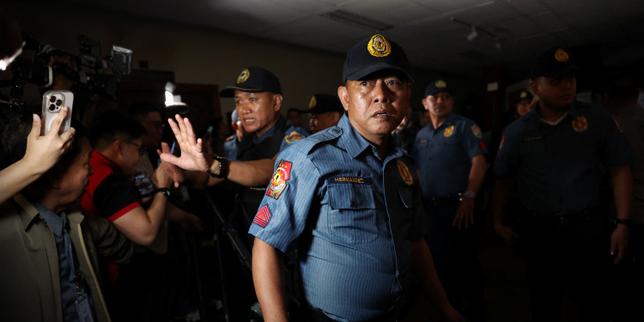
The cracks in the Philippine democratic facade finally shattered this week. When gunfire echoed through the halls of the Senate in Pasay City, it wasn't just a security breach; it was the violent intersection of a domestic power struggle and an international pursuit of justice. At the center of this storm is Ronald "Bato" dela Rosa, the former national police chief and current senator who has transformed the legislative building into a personal fortress against the International Criminal Court (ICC).
The situation is unprecedented. A sitting lawmaker, wanted for crimes against humanity, is currently utilizing parliamentary immunity and a phalanx of loyalist security forces to defy a global arrest warrant. This is no longer about a "War on Drugs." It is about a state divided against itself, where the rule of law has become a secondary concern to the survival of a political dynasty.
A Sanctuary Under Siege
The gunfire reported near the Senate grounds signals a dangerous escalation in the standoff between the Marcos administration and the remnants of the Duterte loyalists. For months, Dela Rosa has remained within the Senate complex, rarely venturing outside for fear of being whisked away by ICC-authorized agents or a Philippine government suddenly willing to cooperate with The Hague.
This isn't a simple case of a fugitive on the run. Dela Rosa represents a significant faction of the security apparatus. His presence in the Senate creates a legal and physical stalemate. While the Senate President has technically granted him sanctuary based on the "sanctity" of the chamber, the practical reality is a tense, armed standoff. The shots fired outside are a warning. They serve as a reminder that the transition of power from Rodrigo Duterte to Ferdinand Marcos Jr. was never a clean handoff; it was a temporary truce that has now expired.
The ICC Shadow and the Broken Alliance
To understand why the Senate has become a combat zone, you have to look at the crumbling "UniTeam" alliance. When Marcos Jr. took office, the understanding was that he would protect the Duterte family and their associates from international prosecution. That deal is dead. As Marcos leans further toward Western diplomatic norms and seeks to repair the Philippines' global reputation, the ICC's investigation into the extrajudicial killings of the previous decade has become a convenient tool for political leverage.
Dela Rosa knows this. He was the architect of "Oplan Tokhang," the police operation that left thousands of Filipinos dead in the streets. He isn't just a senator; he is the personification of the previous administration’s most controversial policies. By holing up in the Senate, he is forcing the current government to make a choice: invade the legislature and risk a full-scale mutiny within the police force, or continue to look weak on the international stage while a wanted man mocks the judiciary from a mahogany desk.
The Mechanics of Defiance
The logistics of this "refuge" are telling. Reliable sources within the Senate security detail suggest that the armed presence surrounding Dela Rosa isn't just the official Senate Sergeant-at-Arms. There are reports of plainclothes officers and "volunteers" from the Davao region who have filtered into the capital.
The strategy is simple:
- Physical Deterrence: Maintaining a high-enough level of armed protection to make any arrest attempt a bloody affair.
- Legal Obfuscation: Utilizing the ambiguity of Philippine law regarding the ICC's jurisdiction now that the country has officially withdrawn from the Rome Statute.
- Political Theater: Framing the ICC pursuit as a violation of national sovereignty to drum up populist support.
This isn't a legal defense. It is a siege mentality.
The Fragility of the Philippine Police Force
Perhaps the most overlooked factor in this crisis is the state of the Philippine National Police (PNP). The gunfire at the Senate highlights a terrifying reality: the police are not a monolith. Dela Rosa still commands immense loyalty among the rank and file who carried out his orders during the drug war. If the Marcos administration orders the PNP to arrest their former chief, the risk of a split within the force is high.
We are seeing the consequences of years of institutional erosion. When the police are told for six years that the law is whatever the leadership says it is, they do not easily revert to being neutral enforcers of a new administration's will. The shots heard in Pasay were likely a message from one faction of the security state to another. It was a signal that any attempt to breach the Senate’s perimeter would be met with kinetic resistance.
The International Stakes
The ICC does not have a police force of its own. It relies on state cooperation. In the past, the Philippine government has been vocal about its refusal to allow ICC investigators into the country. However, the tone has shifted. Subtly, the Department of Justice has begun to suggest that while they won't "invite" the ICC, they might not stand in the way if a warrant is served via Interpol.
This "middle ground" is what triggered the current panic. Dela Rosa and his backers recognize that the wind is shifting. The Philippines is trying to secure maritime defense deals with the United States and Japan. In those circles, harboring a man accused of mass murder is a significant diplomatic liability. Marcos Jr. is a pragmatist. If sacrificing Dela Rosa buys him the international legitimacy he craves, he will do it. The gunfire was the sound of the Duterte faction realizing they are being traded away for geopolitical capital.
Sovereignty as a Shield
The counter-argument often presented by the Senate loyalists is one of sovereignty. They argue that the ICC has no right to interfere in domestic affairs. This argument is hollow. It ignores the fact that the crimes in question occurred while the Philippines was a full member of the ICC. More importantly, it ignores the domestic failure to prosecute these cases. If the Philippine court system had shown any genuine appetite for holding the architects of the drug war accountable, the ICC would have no standing.
The current standoff is the direct result of a judicial system that has been paralyzed by political patronage. When the local courts fail, the international community steps in. When the local politicians refuse to yield to the international community, you get gunshots in the Senate.
The Cost of Parliamentary Immunity
The Senate of the Philippines was modeled after the American system, intended to be a "deliberative body" of the nation's most elder statesmen. Today, it is being used as a safe house. This abuse of parliamentary immunity sets a precedent that will haunt the country for decades. If a senator can avoid an international arrest warrant by simply refusing to leave the building, then the building itself ceases to be a house of law. It becomes a hideout.
The internal tension within the Senate is palpable. Other senators are privately fuming that their workplace has been turned into a garrison. The Senate President is in an impossible position: uphold the traditions of the chamber by protecting a colleague, or uphold the law of the land by allowing the service of a warrant. Every hour that Dela Rosa remains in the building, the credibility of the Philippine Senate withers.
Beyond the Gunfire
The immediate concern is the safety of the civilians and staff within the Senate complex, but the long-term concern is the survival of the Philippine state. This isn't just about one man. It is about whether the country can move past an era of impunity.
The "War on Drugs" was sold as a way to bring order to the streets. Instead, it brought a culture of violence that has now reached the very top of the government. The chickens have come home to roost in the most literal sense possible. The gunfire in Pasay is the logical conclusion of a policy that valued "results" over the process of law.
Marcos Jr. has a decision to make. He can continue to play both sides, hoping the problem disappears, or he can assert the authority of the executive and ensure that no individual—regardless of their title—is above the law. If he chooses the former, the shots fired at the Senate will only be the beginning of a much larger, more violent fragmentation of the Philippine government.
The standoff is a test of whether the Philippines is a constitutional republic or a collection of fiefdoms. As of tonight, the fiefdoms are winning. The man wanted by the world is sleeping in a government office, guarded by men with government guns, while the rest of the country waits to see who will blink first.
The era of the "strongman" was supposed to bring stability. Instead, it has left the nation's capital listening for the sound of bullets in the halls of power. There is no easy way out of this. If the government moves in, there is blood. If they don't, the law is a joke.
Move the police units back. Open the gates. Let the process work. Or watch as the institution of the Senate becomes nothing more than a high-end prison for those too powerful to be caught.