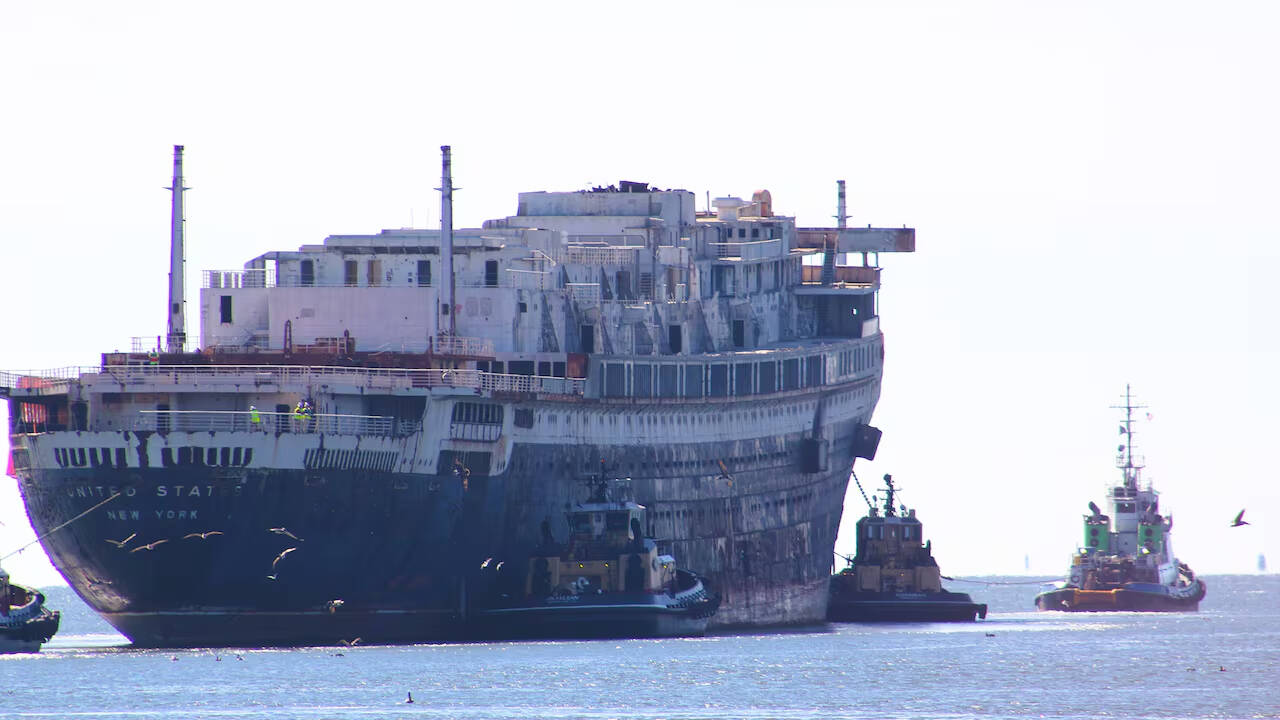
Everybody is cheering the death of a masterpiece.
Local politicians in Okaloosa County, Florida, are popping champagne over a $10 million deal to buy, strip, and scuttle the SS United States off the coast of Destin-Fort Walton Beach. Mainstream travel outlets are framing this as a triumphant second act—turning America’s fastest ocean liner into the "world’s largest artificial reef."
It is a convenient fairytale. It is also an admission of total economic and civic failure.
When a municipality lacks the vision to turn an irreplaceable industrial icon into a profitable waterfront asset, they punch holes in the hull and call it environmentalism. We saw the exact same playbook executed with the USS Oriskany off Pensacola in 2006. The pattern never changes: slap a "marine habitat" label on a multi-million-dollar disposal strategy, collect the press clippings, and let the ocean swallow a piece of engineering history you were too unimaginative to monetize.
The Artificial Reef Mirage
Let’s look at the math that tourism boards quietly sweep under the rug.
Advocates claim sinking a 990-foot vessel creates an instant economic engine for dive charters, hotels, and restaurants. On paper, the projections always look thrilling. In reality, deep-water wreck diving is an exceptionally narrow niche market.
To keep a ship the size of the SS United States safely below shipping lanes—and clear of hurricane surge zones that can shift massive steel structures—it has to be sunk deep. We are not talking about a casual 40-foot reef where honeymooners in rental masks can float above the promenade deck. The ship's top structures will sit well below standard recreational limits, pushing prime exploration into technical diving territory.
Think about the actual customer base for a 130-to-180-foot technical dive.
- Certified open-water divers make up the vast majority of the recreational market, and they are legally and physically restricted to 60 feet (or 130 feet with advanced training).
- Technical divers require specialized gas mixes, redundant gear, and decompression training—representing a tiny fraction of traveling tourists.
- Strong Gulf currents and seasonal visibility drops regularly cancel charters, making dive revenue notoriously volatile.
I have watched coastal counties pour millions into sinking massive hulls—from naval carriers to decommissioned tankers—only to realize five years later that three local dive shops cannot generate enough hotel bed taxes to justify the bond payments. Meanwhile, a stationary floating museum, hotel, and mixed-use commercial hub attracts millions of non-swimmers, families, school groups, and corporate events 365 days a year.
You do not need a PADI certification to buy a $25 ticket, eat dinner on a historic deck, or book a wedding overlooking a harbor. By sinking the SS United States, Florida is trading millions of accessible, high-margin foot-traffic customers for a few thousand specialized divers.
What Everyone Gets Wrong About "Marine Habitat"
The environmental argument is the ultimate shield against criticism. Nobody wants to be the person arguing against fish.
Here is the nuance the press releases leave out: steel ships are not natural coral reefs, and turning them into artificial reefs is a heavily sanitized, chemical-intensive process.
Before a vessel from 1952 can touch the seafloor, environmental remediation teams have to strip out miles of asbestos insulation, tons of polychlorinated biphenyls (PCBs) in old wiring, lead paint, and residual hydrocarbons. Even after years of gutting and power-washing, a massive steel hull introduces an unnatural concentration of iron into a sandy-bottom ecosystem.
Marine biologists, including researchers at institutions like the Florida Fish and Wildlife Conservation Commission and university marine labs, have long debated the "attraction versus production" problem. Does an artificial reef actually generate new marine biomass, or does it simply act as a magnet—pulling existing fish away from natural reefs and concentrating them in one spot where commercial and recreational fishermen can wipe them out faster?
For top predators like red snapper and grouper, giant wrecks often function less like nurseries and more like high-efficiency aggregation devices. Calling a scuttled ocean liner an ecological triumph is like bulldozing a historic downtown theater to build a parking lot and celebrating the fact that pigeons now have somewhere to perch.
The Engineering Marvel Nobody Bothered to Understand
To grasp the sheer scale of what is being thrown away, you have to understand what William Francis Gibbs actually built in 1952.
The SS United States is not just an old boat. It is the peak of mid-century American naval architecture. Subsidized by the U.S. government during the Cold War, the ship was designed with a dual purpose: luxury transatlantic travel by day, and a high-speed troop transport capable of carrying 15,000 soldiers without refueling by night.
Gibbs was obsessed with fire safety to a degree that bordered on paranoia. Aside from the grand piano in the ballroom—which was made of fire-resistant mahogany—and the butcher blocks in the galley, there was virtually no wood anywhere on the ship. The bulkheads were aluminum and Marinite. The deck chairs were custom-cast aluminum. The art was painted on fiberglass and spun glass.
And then there was the propulsion system. Classified by the Navy for decades, its four Westinghouse steam turbines generated over 240,000 shaft horsepower. On her maiden voyage in July 1952, she crossed the Atlantic in three days, ten hours, and forty minutes, averaging 35.59 knots (nearly 41 miles per hour) and obliterating the Blue Riband speed record. No conventional passenger liner has beaten that record in the seventy-plus years since.
When you sink this ship, you are not retiring a ferry. You are erasing the last physical proof of an era when American shipyards built the fastest, safest, most technologically advanced vessels on the planet.
Why Preservation Actually Failed (And It Wasn't the Ship's Fault)
If the ship is so historic, why did it sit rusting at Pier 82 in Philadelphia for nearly three decades?
Lazy commentators blame the ship itself. They say it was too big, too stripped-out, and too expensive to restore. That is only half the truth. The real culprit was decades of fragmented ownership, speculative real estate delusions, and a complete refusal to embrace adaptive reuse.
Look at how successful historic ship conversions actually work:
- The Queen Mary (Long Beach, California): Built in 1936, permanently moored in 1967. Despite well-documented municipal mismanagement and deferred maintenance headaches, the ship remains a massive landmark, operating as a 347-room hotel, event venue, and tourist attraction that anchors the Long Beach waterfront.
- The SS Rotterdam (Rotterdam, Netherlands): Completed in 1959, faced asbestos issues and scrapping threats in the early 2000s, and was rescued through a disciplined public-private partnership. Today, it operates profitably as a 254-room hotel, museum, and restaurant complex.
- The Intrepid Sea, Air & Space Museum (New York City): A World War II aircraft carrier transformed into one of Manhattan’s premier cultural institutions, drawing over a million visitors annually.
Every single one of these projects required two things the SS United States never got simultaneously: a guaranteed, low-cost municipal berth and a developer willing to treat the hull as real estate rather than a charity case.
Instead, the SS United States bounced between private speculators—from Richard Hadley to Norwegian Cruise Line to RXR Realty—while bleeding $60,000 a month just in dockage fees in Philadelphia. When Penn Warehousing doubled the rent and a federal judge ordered the ship evicted in 2024, the clock simply ran out.
Okaloosa County did not rescue the ship from the scrapyard. They simply outbid the scrapyard by offering a slightly more palatable burial.
The Uncomfortable Truth About the Contrarian Case
To be completely intellectually honest, keeping the SS United States afloat was never going to be cheap or easy.
Anyone arguing for preservation has to admit the brutal realities of dry-docking a 990-foot hull. Because the ship’s interior was completely gutted during an asbestos abatement in Ukraine in the 1990s, restoring her meant building an entire interior from scratch inside an aging steel shell. Estimates for a full waterfront redevelopment routinely climbed past $500 million.
Furthermore, a floating museum faces permanent, relentless maintenance costs. Saltwater eats steel every second of the day. Without an endowment or massive commercial revenue streams—like high-end retail, residential condos, or a flagship hotel—a preserved ship quickly becomes a financial albatross that bankrupts its caretakers.
Sinking the ship solves the maintenance problem permanently. Once it hits the sand in the Gulf of Mexico, nobody ever has to paint the hull, pay pier rent, or insure the superstructure again. It is the ultimate risk-off move for local officials who want a ribbon-cutting photo op without a 50-year balance sheet liability.
How Cities Should Actually Monetize Industrial Icons
If another city finds itself holding the keys to a massive, decommissioned industrial asset—whether it is a historic ship, a defunct power plant, or an abandoned steel mill—copying Florida’s reef strategy is the worst possible move.
If you want to turn heavy iron into high-margin revenue, you have to stop treating history like a fragile museum piece and start treating it like an anchor tenant.
- Separate the Heritage from the Cash Flow: Museums rarely pay their own bills. Successful waterfront redevelopments use 20% of the footprint for historical interpretation and 80% for high-yield commercial real estate—luxury hospitality, culinary halls, coworking spaces, and nightlife.
- Lock In the Land Before the Asset: Never buy a historic vessel without securing a long-term, waterfront lease first. Pier fees will bleed a project dry faster than structural repairs ever will.
- Embrace Brutal Modernism: Stop trying to recreate 1952 interiors down to the silverware. Look at London’s Tate Modern (a former oil-fired power station) or Bethlehem’s SteelStacks in Pennsylvania. Preserve the raw, massive industrial skeleton and insert sleek, modern steel-and-glass commercial spaces inside it.
- Sell Experiences, Not Nostalgia: Baby boomers remember the SS United States; Gen Z does not. You cannot market a monument based on your grandparents' memories. You market it based on exclusivity, architecture, and the sheer spectacle of standing inside a machine that broke the sound barrier of the Atlantic.
The Final Verdict on Pier 82
When the tugboats pull the SS United States down the Delaware River and out into the Atlantic for the final time, pay attention to the language used by the people celebrating on the shore.
They will call it a "new beginning." They will call it a "win for marine life." They will talk about "honoring her legacy."
Do not buy a word of it.
Great civilizations preserve their monuments and build thriving economies around them. Declining ones sink them to the bottom of the ocean because it is cheaper than figuring out what to do with them. The SS United States survived Cold War espionage, North Atlantic gales, and decades of neglect—only to be defeated by a lack of imagination.