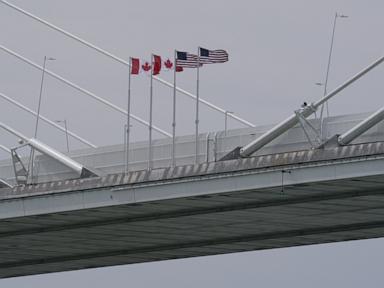
The air on the Detroit River tastes like salt, diesel, and centuries of heavy industry. If you stand on the banks in southwest Detroit, looking across the chopping gray water toward Windsor, Ontario, the first thing you notice is the sound. It is a relentless, rhythmic thudding. It is the sound of thousands of eighteen-wheelers pounding across the aging Ambassador Bridge, carrying a quarter of all trade between the United States and Canada.
For decades, this single, privately owned suspension bridge has been the fragile throat of North American commerce. If it chokes, assembly lines in Ohio grind to a halt within hours. Grocery shelves in Toronto empty out. Don't forget to check out our previous article on this related article.
But look just a few miles downriver. A new silhouette cuts through the low-hanging Midwestern clouds. Two massive, wishbone-shaped towers soar into the sky, staying up through a web of high-strength steel cables. This is the Gordie Howe International Bridge. It is a six-billion-dollar monument to sheer political willpower, engineered to withstand the fiercest winds of the Great Lakes—and the even more volatile storms of international politics.
It is finally opening. Yet, its completion was never a guarantee. If you want more about the context of this, NPR provides an informative breakdown.
The Man with the Monopoly
To understand why this new bridge matters so deeply to the truck drivers, factory workers, and everyday consumers who keep the continent running, you have to understand the strange reality of the man who tried to stop it.
Imagine a single family owning the only highway connecting two economic superpowers. That was not a hypothetical scenario; it was the reality for nearly a century. The Ambassador Bridge, built in 1929, belonged to a billionaire named Manuel "Matty" Moroun. He ran the crossing like a private fiefdom. It was a wildly lucrative monopoly that generated hundreds of millions of dollars in tolls and duty-free gas sales every year.
For a long time, if you wanted to move auto parts from a plant in Ontario to an assembly line in Michigan, you paid Matty Moroun.
The consequences of this monopoly hit home for people like Marcus, a fictional composite of the thousands of long-haul truckers who have spent their lives idling on these banks. For drivers like Marcus, the old bridge was a daily exercise in frustration. The approach on the American side plunged heavy trucks straight onto narrow city streets, forcing them to navigate stoplights, pedestrian crossings, and tight corners.
Gridlock was a certainty. Diesel exhaust choked the neighborhood of Delray. The shipping delays cost logistics companies millions.
Canada wanted a new bridge. Washington wanted a new bridge. The auto industry begged for a new bridge. But Moroun fought back with every weapon a billionaire could buy. He launched a barrage of lawsuits. He bought prime-time television ads. He even funded a ballot initiative in Michigan to try to alter the state constitution to block any competing span.
The battle dragged on for more than a decade. It was a classic David-and-Goliath story, except in this version, David was the combined government of Canada, and Goliath was an elderly billionaire determined to protect his toll booth.
The Art of the Threat
Canada eventually took matters into its own hands. In an unprecedented move, Ottawa agreed to foot the entire bill for the construction of the new crossing, including the massive customs plaza on the American side. They named it after Gordie Howe, the legendary hockey player who grew up in Saskatchewan but became an icon playing for the Detroit Red Wings. It was a perfect symbol of cross-border unity.
Then, the political landscape fractured.
In 2016, Donald Trump was elected president on a platform of intense economic nationalism. Suddenly, a massive infrastructure project funded by a foreign government right on the U.S. border became a prime target. Trump threatened to rip up the North American Free Trade Agreement (NAFTA). He slapped tariffs on Canadian steel and aluminum, declaring America’s closest ally a "national security threat."
Behind closed doors, the future of the Gordie Howe International Bridge hung in the balance. Trump openly questioned why the U.S. was letting Canada build a bridge into Detroit. Moroun’s family saw an opening, aggressively lobbying the Trump administration to revoke the presidential permit for the project.
Think about the sheer anxiety of that moment. Hundreds of workers had already been hired. Engineers had already poured years of calculations into the foundations. Yet, a single stroke of a pen in Washington could have reduced the entire project to an expensive, half-finished pier rotting in the river mud.
Canada had to play a delicate game of diplomatic chess. Government officials quietly reminded the White House that the bridge was being built with American steel and by American union labor. They pointed out that a disruption to the automotive supply chain would devastate Trump's own base of working-class voters in Michigan and Ohio.
The strategy worked. The permit held. The construction crews kept digging.
Gravity Always Wins
Building a bridge of this scale is a masterclass in defying nature. The Gordie Howe International Bridge is a cable-stayed design, featuring the longest main span of its kind in North America.
Consider what happens when you stretch a piece of rope tightly between two points. The tension is immense. Now, imagine that rope is a six-lane highway made of concrete and steel, suspended hundreds of feet above a busy international shipping lane, without a single supporting pier in the water.
Every millimetre of the structure is under constant, agonizing pressure. The towers hold the weight of the entire world.
During the peak of construction, workers faced biting winter winds that swept off Lake Erie, freezing their equipment and numbing their fingers. They worked through a global pandemic that threatened to paralyze supply chains worldwide. As the two sides of the bridge slowly crept out from opposite shores, meeting in the middle required a level of mathematical precision that boggles the mind. A mistake of just a few inches would mean the two halves would fail to connect, resulting in a multi-million-dollar disaster.
But the real engineering triumph wasn’t just overcoming gravity. It was overcoming the cynicism of an era that says big things can no longer get built in the West.
The First Crossing
When the final steel girder was bolted into place, connecting the United States and Canada in mid-air, the workers from both sides walked out to the center of the span. They shook hands. They swapped flags.
It was a moment of profound catharsis. For the people living in southwest Detroit, the opening of this bridge is not a mere footnote in a business journal. It is a literal lifesaver. The new design funnels truck traffic directly off the highway and into a state-of-the-art inspection plaza, bypassing the neighborhood streets entirely. The constant hum of idling engines that has plagued local children with asthma for generations will finally begin to dissipate.
For the global economy, it represents a massive injection of resilience. If a cyberattack, a natural disaster, or a protest shuts down one crossing, the continent’s economic heartbeat will no longer skip a beat.
The Gordie Howe International Bridge stands as a physical manifestation of a simple truth we often forget in an age of digital borders and political polarization: we are still bound to each other by geography, by trade, and by shared human effort.
The trucks are about to start rolling. The concrete is cured. The cables are taut. A project that survived corporate monopolies, hostile presidential administrations, and the fury of Great Lakes winters now stretches proudly from shore to shore, waiting for the first headlights to break the dawn.


:max_bytes(150000):strip_icc():focal(665x0:667x2)/gettyimages-50733149-2000-8b129a2475974982a915418ce92a73d8.jpg)