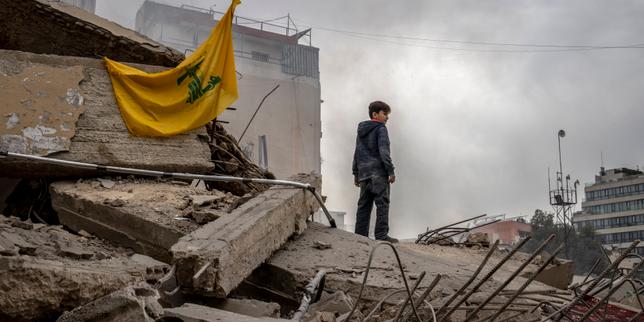
The sound of a tea kettle whistling in a quiet kitchen used to be a comfort. Now, in the neighborhoods of South Beirut, any high-pitched whine from the sky sends a physical jolt through the marrow of your bones. It is a biological rewrite. The brain, once tuned to the rhythms of Mediterranean tides and the scent of roasting coffee, now specializes in the acoustics of incoming steel.
When the news tickers flash that over 1,000 people have died in Lebanon since the escalation began, the number sits on the screen like a cold, unfeeling stone. It is a statistic designed to be processed, filed away, and eventually forgotten. But numbers don't have faces. Numbers don't have unfinished dinners or half-written text messages or the smell of jasmine clinging to their clothes. To understand what is happening between the borders of Israel, Lebanon, and the fiery reach of Iran, you have to look past the spreadsheets of the dead and into the eyes of those waiting for the next whistle.
Consider a man named Elias. He is a hypothetical composite of the thousands currently living in the shadow of the Litani River. Elias doesn't care about the geopolitical nuances of "strategic depth" or the "axis of resistance" when the floorboards of his home begin to dance. To him, the conflict isn't a chess match. It’s the vibration in his water glass. It’s the way his seven-year-old daughter has stopped speaking and started wetting the bed again.
The political reality is a triangulation of terror. On one side, the relentless precision of Israeli airstrikes aimed at dismantling Hezbollah’s infrastructure. On the other, the dark, arched backs of Iranian missiles crossing the night sky, launched from a thousand miles away to claim a stake in a war of shadows. In the middle is the Lebanese civilian, a person whose sovereignty has been traded for a seat at a table they were never invited to join.
The Geography of Anxiety
Modern warfare is often described in terms of "theaters." It’s a theatrical word for a place where people bleed. In this specific theater, the stage has expanded. What started as a localized exchange of fire has metastasized into a regional fever. When Iran launched its recent barrage of missiles toward Tel Aviv and Jerusalem, it wasn't just a military maneuver; it was a signal that the old rules of engagement had been shredded and fed to the wind.
The "Red Line" is a phrase diplomats love to use. They speak of it as if it’s a physical barrier, a wall of glass that shouldn't be broken. But for those on the ground, the red line is the blood on the sidewalk after a strike in Dahieh. It is the dust that settles over a school-turned-shelter. We often think of war as a series of explosions, but the true weight of it is the silence that follows. The silence of a neighborhood that has been emptied. The silence of a phone that rings and rings because the person on the other end is no longer there to answer.
Why does this matter to someone sitting in a coffee shop in London or a suburb in Ohio? Because the Middle East is the world’s most sensitive nervous system. When Lebanon destabilizes, the ripples are felt in global oil markets, in European migration patterns, and in the very fabric of international law. More importantly, it matters because we are witnessing the normalization of the unthinkable. We are watching a country that was once the "Paris of the Middle East" be ground down into a launchpad and a target.
The Architecture of the Strike
There is a terrifying logic to the way these conflicts unfold. The military strategist looks at a map and sees nodes. A bridge is a supply line. A residential basement is a weapon cache. A telecommunications tower is a command center. But when you apply that logic to a densely populated city, the map becomes a minefield of human tragedy.
When a missile hits a building, the physics are indifferent to the inhabitants. The pressure wave travels at supersonic speeds, shattering glass into a billion microscopic daggers. The heat can melt steel. But the most devastating part isn't the fire; it’s the "pancaking" of the floors. Imagine a stack of books falling flat. Everything between those pages—the family photos, the heirlooms, the people—is compressed into nothingness.
Hezbollah claims to be the shield of the oppressed, yet their presence in these civilian hubs turns every living room into a potential battlefield. Israel claims to be surgical, yet a "surgical" strike on a high-rise still leaves a scar on the soul of a city. Iran claims to be the defender of the faith, yet their missiles fly over the heads of the very people they say they are protecting.
Everyone has a justification. No one has a solution that involves less blood.
The Invisible Stakes
We talk about the 1,000 dead, but we rarely talk about the 100,000 displaced. These are the ghosts of the conflict. They aren't dead, but their lives have been killed. They are the teachers who now sleep on gym mats. They are the grandmothers carrying their life’s savings in a plastic bag. Displacement is a slow-motion trauma. It strips a human being of their context. Without your home, your garden, your specific view of the street, who are you?
The stakes aren't just territorial. They are existential. We are seeing the erosion of the idea that a civilian's life has an inherent, unnegotiable value. In the language of modern conflict, civilians have become "variables." They are factored into the cost-benefit analysis of a strike.
- If the target is high-value enough, is fifty lives an acceptable price?
- If the missile launch saves a city elsewhere, is the destruction of a village here a net win?
These are the questions being asked in darkened command rooms. They are questions that Elias, holding his daughter in a cold basement, cannot afford to answer.
The Long Shadow of Tehran
The recent missile strikes from Iran marked a shift from proxy war to direct confrontation. It was a moment of terrifying clarity. For years, the conflict was fought through intermediaries—men in the hills of southern Lebanon using Iranian equipment. Now, the mask is off.
When those missiles streaked across the sky, they carried with them the weight of decades of ideological struggle. They weren't just explosives; they were messages written in fire. The message to Israel was: "We can reach you." The message to the West was: "We are not afraid." But the message to the people of Lebanon was the loudest of all, even if it was unspoken. It was: "You are the frontline, whether you like it or not."
The sheer scale of the Iranian arsenal is difficult to grasp. These are not the crude rockets of the past. These are sophisticated machines with GPS guidance and multi-stage engines. They are designed to overwhelm air defense systems like the Iron Dome. When you see the videos of dozens of lights raining down over an Israeli city, you are seeing the result of billions of dollars in investment—money that could have been spent on hospitals, schools, or infrastructure, but was instead diverted into the machinery of annihilation.
The Anatomy of the Aftermath
What happens after the sirens stop? The world’s attention span is short. We watch the flares on social media, we read the headlines for a few days, and then we move on to the next crisis. But for the people in the impact zone, the war never really ends. It just changes shape.
It becomes the struggle to find clean water. It becomes the effort to explain to a child why they can't go back to their bedroom. It becomes the permanent flinch at the sound of a slamming door.
We must resist the urge to see this as a "cycle of violence." That phrase is a trap. It implies a natural phenomenon, like the weather or the tides, something that simply happens and cannot be stopped. It isn't. It is a series of choices made by men in suits and men in uniforms. It is the result of a specific brand of political math that prizes "deterrence" over human breath.
The truth is that we are all connected to that water glass on Elias’s table. The instability of the Middle East is not a localized infection; it is a systemic fever. When the international community fails to find a path toward de-escalation, it isn't just failing Lebanon or Israel. It is failing the very idea of a global order built on something other than might.
The 1,000 deaths reported this week are not just a tally. They are a warning. Each one represents a hole in the world that cannot be filled. A father who won't teach his son to drive. A doctor who won't save a patient. A poet who will never finish the verse.
As the sun sets over the Mediterranean, the sky takes on a bruised, purple hue. In any other time, it would be beautiful. Today, it is a reminder of the darkness that is gathering. The people of Beirut look up, not with wonder, but with a silent, desperate prayer that the stars stay still, and the horizon remains empty of fire.
The whistle hasn't started yet. But the air is thin, and the world is holding its breath.