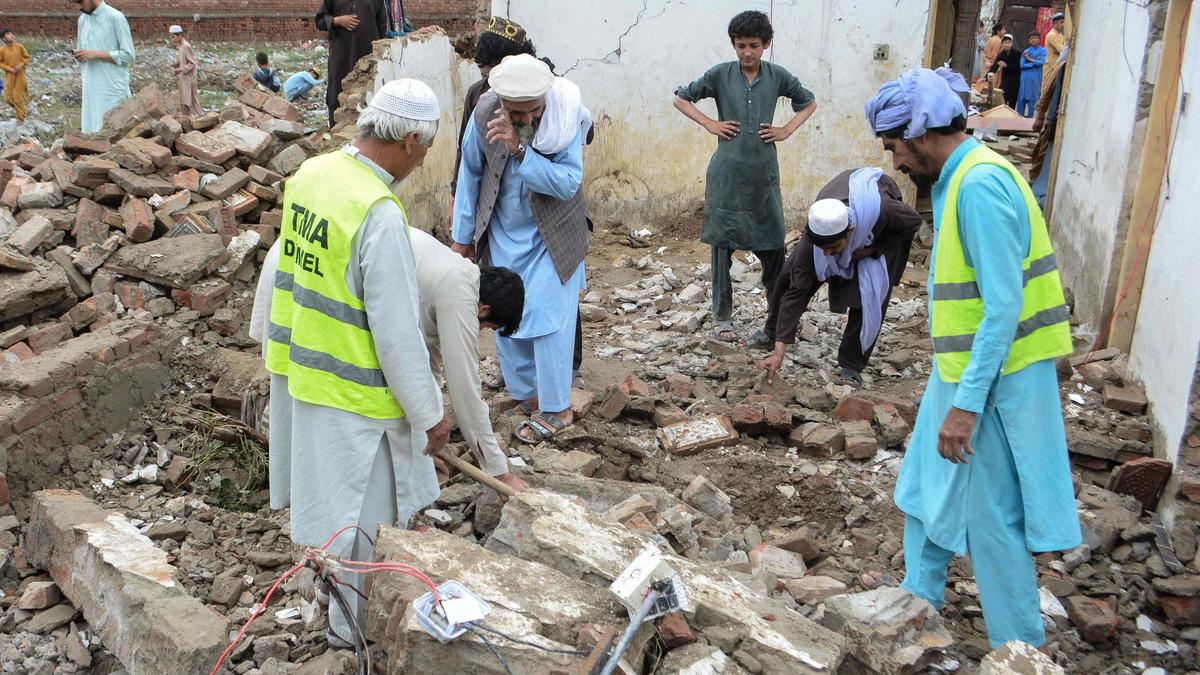
The afternoon sun in the Tirah Valley usually signals a quiet rhythm. In this rugged stretch of Khyber Pakhtunkhwa, near the border where Pakistan meets Afghanistan, the mountains are both a fortress and a prison. On a Tuesday like any other, the air carried the scent of woodsmoke and the sharp, dry dust of the northwest. Children were likely playing in the dirt tracks between mud-brick houses. Women were tending to the evening meal. Then, the sky tore open.
It wasn't thunder. It was the whistle—a thin, high-pitched scream that lasts only a second but feels like a lifetime to those who recognize it. A mortar shell, heavy and indifferent, plummeted into a civilian neighborhood.
Silence followed the blast. Not a peaceful silence, but the suffocating, ringing void that occurs when the world is rearranged by high explosives. When the dust finally settled, six lives had vanished. Thirteen others were left broken, their bodies mapped with shrapnel.
The Geometry of a Random Death
A mortar is a blunt instrument. Unlike a sniper’s bullet, which seeks a specific heart, or a guided missile, which targets a coordinate, a mortar shell is an arc of probability. It is fired from a tube, lofted into the clouds, and pulled back to earth by gravity. It does not care if it lands on a militant outpost or a kitchen table.
In the Tirah Valley, the probability turned cruel.
The victims weren't soldiers. They weren't combatants in the long, grinding friction that has defined this region for decades. They were people whose only crime was being home. Consider the immediate aftermath: the frantic digging with bare hands, the shouting of names that will never again be answered, and the sight of everyday objects—a plastic shoe, a tea cup, a school notebook—twisted into the wreckage.
Six people dead. The number is small enough to be a statistic in a morning briefing, yet large enough to destroy a community’s sense of gravity. In a village where everyone is a cousin, a neighbor, or a lifelong friend, six deaths mean six gaping holes in the social fabric that can never be stitched back together.
The Invisible Stakes of the Borderlands
Why does this keep happening? To understand the tragedy in Khyber Pakhtunkhwa, you have to look at the geography of instability. For years, the Pakistani military has been engaged in a complex, often bloody "whack-a-mole" campaign against various militant factions, including the Tehreek-e-Taliban Pakistan (TTP). These groups use the jagged terrain of the former Tribal Areas as a hideout, a staging ground, and a shield.
But the shield is made of people.
When the shells fly, the "collateral damage"—a sterile, haunting phrase—is almost always the local population. These families live in a permanent state of hyper-vigilance. They have learned to sleep lightly. They have learned that a sudden loud noise might be a tire blowing out, or it might be the end of their lineage.
The thirteen injured in this specific strike face a different kind of horror. In the northwest, medical facilities are often miles away over treacherous, unpaved roads. A shrapnel wound to the leg isn't just a medical emergency; it is a financial catastrophe. It is a slow trek in the back of a bouncing pickup truck, praying the bleeding stops before the clinic appears on the horizon. For those who survive, the trauma becomes a permanent resident. Every time a door slams or a storm rolls in from the mountains, the heart hammers against the ribs.
The Weight of the Unseen
We often view these conflicts through the lens of geopolitics. We talk about border security, counter-terrorism budgets, and regional stability. We analyze the movements of battalions. But the real story is found in the smaller, quieter details.
Imagine a father who had just returned from work, his pockets perhaps holding a small sweet for his daughter. Imagine a grandmother who was telling a story she had told a hundred times before. The mortar shell doesn't just kill the person; it kills the story. It erases the future of the children who were supposed to grow up and become doctors, farmers, or teachers.
The instability in northwest Pakistan is not a "game-changer" or a "paradigm shift." It is a slow, agonizing erosion of human dignity.
The local authorities have launched investigations, as they always do. There will be tallies of the damage and perhaps a small amount of compensation offered to the grieving families. But money cannot replace a mother. It cannot quiet the ringing in the ears of a child who watched their house collapse.
The Tirah Valley remains. The mountains remain. But for the families of the six who died, the world has become significantly heavier.
Consider what happens when the cameras leave and the news cycle moves on to the next crisis. The survivors are left to pick up the pieces of a life that no longer fits together. They will rebuild the walls. They will sweep away the glass. But they will always look at the sky with a new, justified suspicion.
The tragedy in Khyber Pakhtunkhwa is a reminder that in the theater of war, the audience is often forced onto the stage. The mortar shell didn't just hit a civilian area; it hit the very idea that a home should be a sanctuary.
There is a specific kind of grief that comes from a death delivered from the clouds—unseen, unprovoked, and utterly final. As the sun sets over the Tirah Valley tonight, there are six fewer lamps burning. There are thirteen people grappling with the reality of their own shattered bodies. And there is a silence that no amount of political rhetoric can ever truly fill.
The mountains are tall, but they offer no protection from the indifference of a falling shell.