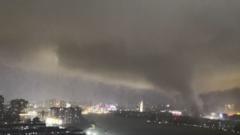
The air in Henan had been heavy for days, the kind of thick, wet heat that settles over central China in the high summer like a damp wool blanket. In the city of Zhumadian, the old men had stopped playing xiangqi under the chinaberry trees. It was simply too hot to breathe, let alone think. Traffic moved with a sluggish, liquid weight. People slipped into air-conditioned convenience stores just to stand near the open drink coolers, staring blankly at green tea bottles while the humidity outside baked the concrete.
Nothing about the afternoon signaled history. Central China is a land of massive agriculture and sprawling, industrializing hubs, a landscape carved by the yellow silt of the ancient river, not the volatile atmospheric collisions that haunt the American Great Plains. Tornadoes here are ghosts. They belong to folklore, or to faraway news broadcasts from places with names like Oklahoma or Kansas.
Then, the sky changed color.
It did not turn gray, or even the deep charcoal of a standard summer thunderstorm. It turned an unsettling, bruised shade of yellowish-green.
Imagine standing on a balcony in a high-rise apartment complex, looking out over a sea of identical gray rooftops, when the wind suddenly dies completely. A total, suffocating vacuum. The leaves on the poplars stop trembling. The ambient hum of a city of millions drops into a terrifying, unnatural silence.
And then comes the sound.
It starts as a low, bass-heavy rumble, the kind you feel in your shinbones before you hear it with your ears. It sounds like a freight train running tracks that do not exist, moving across the sky at ninety miles an hour.
The Day the Horizon Bent
For centuries, the communities along the plains of central China have feared the waters. The Yellow River, known historically as China’s Sorrow, was the monster that came from the side, bursting dikes and swallowing villages. But on this afternoon, the danger fell directly from above.
A massive, multi-vortex tornado—an atmospheric anomaly so rare in this part of the world that local weather bureaus initially struggled to categorize it—dropped out of the green clouds. It did not touch down gently. It slammed into the earth with the force of a kinetic weapon, instantly tearing through the outer fringes of the city before grinding its way into the dense urban core.
To understand the sheer terror of an urban tornado, you have to look past the wide-angle drone footage that eventually populates the evening news. You have to look at the glass.
Modern Chinese cities are built upward. They are monuments to concrete, steel, and massive sheets of reinforced window pane. When a tornadic vortex enters a canyon of twenty-story apartment blocks, those windows do not merely break; they weaponize. The pressure drop alone causes glass to explode outward in a synchronized, deafening volley. Millions of razor-sharp shards join the debris field, spinning at speeds exceeding two hundred kilometers per hour.
Consider a hypothetical resident named Zhou, a retired rail worker living on the twelfth floor of a mid-rise complex near the city center. When the warning sirens finally pierced the air, there was no cellar to run to. There are no storm shelters under the concrete foundations of modern high-rises. Zhou did what thousands of others did: he retreated to the only windowless room in his home, a cramped bathroom, hugging the porcelain base of the sink while the walls around him began to groan.
The human mind is ill-equipped for the sheer volume of a tornado. It is not a whistle or a roar. It is an all-consuming, physical assault on the senses. The air pressure drops so fast your ears pop as if you are in a diving airplane. The smell of ripped earth, pulverized concrete, and snapped electrical wires fills the back of your throat. For three minutes, Zhou’s world was reduced to the dark, vibrating tiles of his bathroom floor and the certainty that the ceiling was about to collapse.
The Mechanics of an Anomaly
Why did this happen here?
Meteorologists point to a perfect, catastrophic alignment of variables. A weak cold front pushing down from the northern mountains collided head-on with a massive, hyper-moist low-pressure system moving up from the South China Sea. The flat, heavily urbanized plains acted as an oven, heating the lower atmosphere while the upper air remained freezing cold.
The technical term is severe convective instability. The layman's terms are much simpler: a powder keg waiting for a match.
When the updraft began, it didn't just rise; it started to spin, fed by shifting wind directions at different altitudes. This wind shear created a rotating supercell, the engine of the modern tornado. In a country where building codes are designed to withstand earthquakes and typhoons—forces that push horizontally or shake laterally—the vertical lifting force of a tornado is a structural nightmare. It tears roofs upward, exposing the hollow interiors of buildings to the elements, leaving them vulnerable to total structural failure.
The footage captured by survivors on their smartphones, later broadcast across global networks, reveals a scene that looks less like a weather event and more like a zone of active combat. Cars are lifted effortlessly, tossed across six-lane highways like discarded toys. Corrugated iron roofing from industrial parks miles away spins through the air like lethal, oversized playing cards.
But the most haunting videos are the quiet ones. The clips shot from inside apartments after the vortex had passed, showing living rooms completely gutted, the outer walls entirely missing, leaving a sofa and a television set sitting perfectly intact on the edge of a precipice, looking out over a ruined city.
The Anatomy of the Aftermath
When the wind finally dies down, the silence returns, but it is a completely different kind of quiet. It is the stunned, breathless hush of a community trying to comprehend a brand-new reality.
The immediate aftermath of a natural disaster is often depicted as a scene of chaotic shouting, but the reality on the ground is far more internal. People wander out of their buildings into a landscape they no longer recognize. Landmarks are gone. The familiar convenience store on the corner is now a pile of shattered cinderblocks. The ancient trees that lined the avenue have been snapped in half, their white interiors exposed like broken bones.
The true weight of the event settles in during the hours that follow.
In the immediate wake of the storm, the city’s infrastructure is completely severed. Power lines lay tangled in the flooded streets like giant black snakes. The cellular networks are overloaded or destroyed, leaving thousands of people unable to call their families to say two simple words: I’m safe.
This is where the true human element of the disaster emerges. Long before the heavy machinery arrives, before the provincial government can deploy emergency response teams or military units, the citizens become each other's lifelines.
You see restaurant owners using their gas burners to cook massive pots of noodles for people who have lost their homes. You see teenagers climbing through the rubble of a collapsed storefront to pull out an elderly neighbor who was trapped behind a fallen display case. There is no blueprint for this kind of survival; it is an instinctual, collective response to shared trauma.
The Invisible Stakes
The tornado in central China is not just a freak weather event to be watched on a loop on social media. It is a harbinger.
For decades, the global conversation about climate volatility has focused on the margins—rising sea levels on coastal islands, melting glaciers in the far north, droughts in already arid deserts. We have conditioned ourselves to look outward, toward the edges of the map, for the signs of a changing planet.
But the real crisis is moving inward, into the heartlands, into places that believed their geography shielded them from the worst of nature's fury. The warming of the global atmosphere means there is more energy trapped in the system than ever before. More heat means more moisture; more moisture means more volatile updrafts. The borders of Tornado Alley are no longer confined to the American Midwest. They are expanding, shifting, and appearing in the densely populated agricultural and industrial valleys of Asia.
The stakes are incredibly high. When a tornado hits a rural field, it is a tragedy for the farmer who loses his crop. When a tornado hits a central Chinese metropolis, where twenty million people live stacked on top of each other in vertical concrete communities, it is a potential catastrophe on an unprecedented scale.
Our architecture is built on the assumption that the future will look like the past. We build structures based on fifty-year flood plains and a century of recorded wind speeds. But the old data is crumbling. The sky is rewriting the rules of engagement, and the cities of the interior are utterly unprepared for the new vocabulary of the atmosphere.
The Weight of the Sky
As dusk fell over the damaged districts, the rain returned—not the violent torrent of the supercell, but a soft, persistent drizzle that washed the grey dust from the ruins.
Volunteers in bright orange vests moved through the debris with flashlights, their beams cutting through the dark as the city remained without power. The flashlights illuminated strange, surreal tableaus: a child’s backpack caught in the branches of a fallen telephone pole; a calendar from a wall kitchen floating in a puddle, its pages torn to July; a single high-heeled shoe sitting on top of a crushed sedan.
The sirens of ambulances echoed in the distance, a reminder that the work of counting the cost was only just beginning. Hospitals were already filling up with those cut by flying glass or struck by falling masonry. For the families waiting in those crowded corridors, the abstract concepts of meteorology, atmospheric pressure, and climate shifts had ceased to be academic debates. They had become matters of life and death, written in blood and broken bone.
The city will rebuild. Concrete can be poured again, glass can be replaced, and the shattered roofs will eventually be covered with new tiles. The government will issue reports, and engineers will study the structural failures to design stronger joints and more resilient walls.
But for the people who stood in the path of the green sky, something fundamental has changed. The illusion of absolute permanence has evaporated. They now know that the air above them, the very air they breathe to survive, can turn violent in the span of a single afternoon, transforming the familiar streets of home into an alien, perilous terrain.
Zhou eventually stepped out of his apartment building into the cool night air, his hands still shaking slightly from the adrenaline. He looked up at the sky. The stars were starting to peek through the breaking clouds, distant and calm, as if nothing had happened. But he knew, and everyone else in the quieted city knew, that the sky was no longer just a backdrop. It was a ceiling that could fall at any moment.