The rain in Belfast doesn’t just fall. It hangs. It sticks to the red brick of the terrace houses, slicking the tarmac of streets that have seen too many centuries of argument. On a Tuesday evening in August, that damp air carried something else entirely. It wasn’t the familiar tang of turf smoke or petrol exhaust. It was the sharp, warm bloom of tempering mustard seeds, ginger, and turmeric.
Inside a modest kitchen, Jaswinder stood over a pot large enough to bathe a child in. Her knuckles were stained yellow. Her eyes smarted, not from the onions she had spent three hours dicing, but from the exhaustion that settles deep in the marrow when a city decides to tear itself apart outside your window.
A week earlier, the streets of Belfast had erupted. What started as anti-immigration protests swiftly degenerated into targeted violence. Windows were smashed. A local supermarket owned by a Middle Eastern family was gutted by fire. For the city’s minority communities, the message was loud, clear, and terrifying: You do not belong here.
Fear has a specific weight. It makes people shrink. It closes curtains, locks deadbolts, and empties cupboards. In the days following the riots, many immigrant families, international students, and healthcare workers from South Asia and Africa simply stopped leaving their homes. The grocery shops were closed or destroyed. The streets felt hostile.
Jaswinder knew that fear. She had arrived in Northern Ireland two decades ago, a young bride adjusting to a grey climate and a accent that sounded like a completely different language. She had built a life here. Her children spoke with that distinct, beautiful Belfast lilt. But when the bricks started flying, the old isolation rushed back.
She had two choices. She could double-lock her front door and wait for the madness to pass. Or she could cook.
She chose the stove.
The Anatomy of an Empty Street
To understand the stakes of a plate of food, you have to understand what happens to a neighborhood when trust evaporates. Belfast is a city carved up by "peace walls"—physical barriers of concrete and steel that have separated Catholic and Protestant enclaves for decades. The city knows how to divide itself. It is an expert in lines.
When the recent violence flared, it wasn't the old sectarian lines that were targeted, but the new ones. The diverse, vibrant, multicultural spaces that had quietly grown in the gaps between the old hatreds became the battlegrounds.
Consider a young nurse from Kerala, India, recruited to work in one of Belfast’s understaffed hospitals. She works a twelve-hour shift, caring for elderly local residents, only to walk out of the hospital gates into a city where people who look like her are being hunted through the dark. She returns to a cramped flat. The fridge is empty. She is too terrified to walk to the corner shop. She drinks water and goes to sleep, wondering if she made the biggest mistake of her life by moving across the world.
This isn't a hypothetical victim. This was the exact reality for dozens of people residing in the South and East of the city.
Jaswinder’s phone began to buzz with messages from a WhatsApp group for the local Indian diaspora. Is it safe to go out? Has anyone seen the crowd on Sandy Row? My windows were rattled. The anxiety was infectious. It threatened to paralyze everyone.
"When people are scared, they forget who they are," Jaswinder says, her voice quiet but steady as she stirs a massive vat of dal. "They feel invisible. I wanted to show them that they are seen. And more than that, that they are fed."
The Currency of the Kitchen
Food is often romanticized as a bridge between cultures. We talk about it in airy, abstract terms at food festivals and cultural exchange galas. But on the ground, in a neighborhood where police Land Rovers are idling at the corner, food is something much more primal. It is security. It is proof of life.
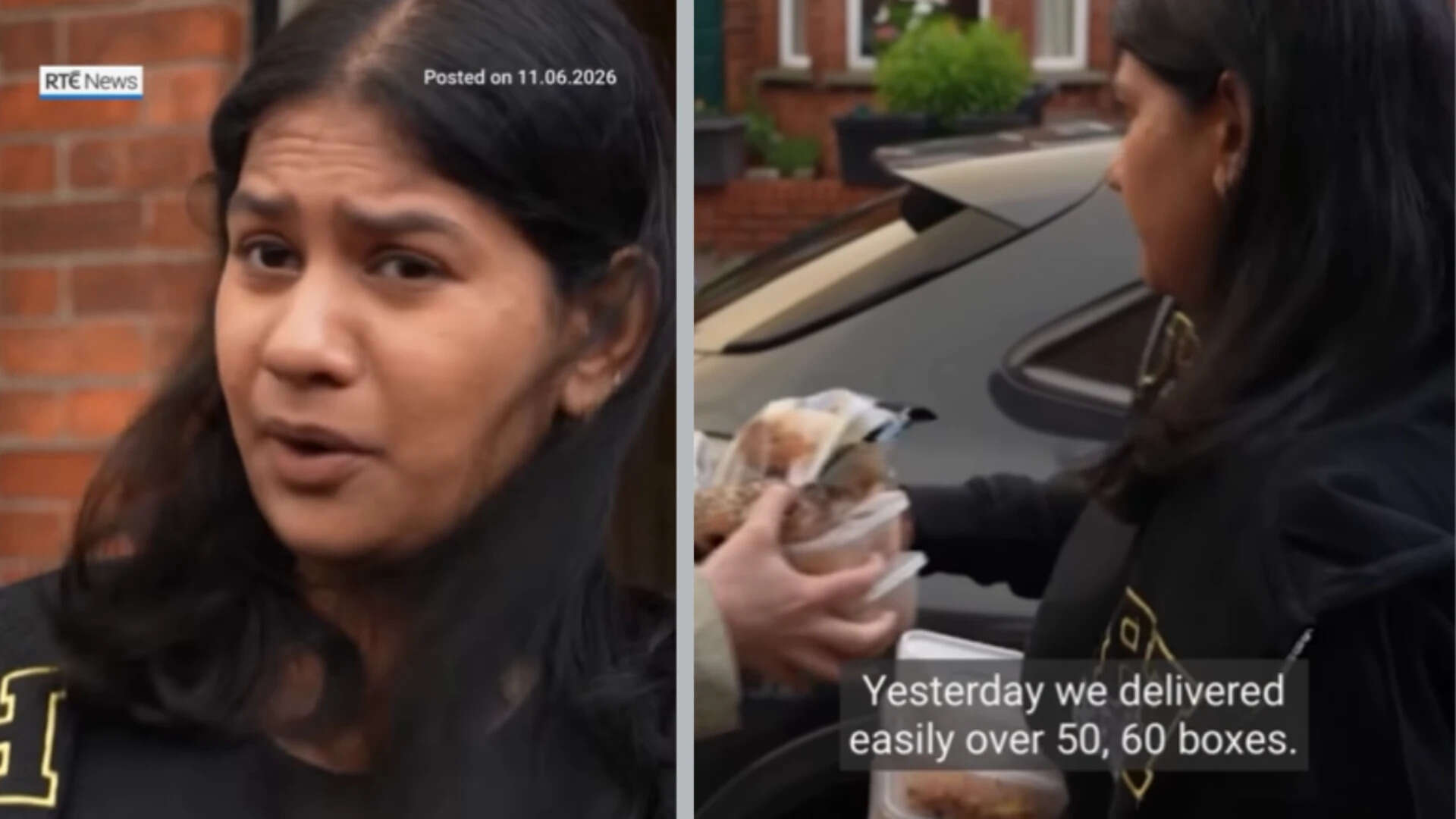
Jaswinder started small, aiming to feed twenty people she knew were trapped in their homes. She used her own money, buying sacks of rice and lentils from the few wholesalers still willing to deliver.
The logistics were a nightmare. Northern Ireland’s history means that a crowd gathering on a street corner can be interpreted as a threat or a provocation. Delivering food to terrified people meant driving through volatile areas with a car boot full of steaming tinfoil containers, hoping the smell of coriander would somehow act as a shield.
On the first night of her initiative, she pulled up outside a house where three international students were hiding. They had turned off all the lights in their flat to make it appear unoccupied. When Jaswinder knocked, there was silence. She knocked again, calling out in Punjabi and English.
When the door finally opened a crack, the face looking out was pale, eyes darting to the street behind her. Jaswinder didn’t offer a speech. She didn’t offer political commentary. She just handed over three containers of warm, home-cooked food.
The student looked at the container, then at her. He didn't say thank you. He just started to cry.
The Weight of a Single Plate
By day three, twenty plates had become fifty. By day five, it was over a hundred.
Local businesses, moved by the sight of one woman fighting a riot with a ladle, began slipping donations under her door. A butcher who had lived through the worst of the Troubles dropped off crates of vegetables. A bakery provided loaves of bread.
The kitchen became a makeshift assembly line. Steam rose to the ceiling, condensing and running down the windowpanes like tears. The menu was simple: comforting, nutrient-dense, and deeply traditional. Khichdi, a gentle rice and lentil porridge that is the universal Indian antidote to sickness and distress. Chana masala, rich and spicy. Soft rotis wrapped in foil to keep the heat trapped inside.
Think about the sheer physical labor of this. Lifting pots that weigh forty pounds. Standing on concrete floors until your ankles swell. Chop. Stir. Pack. Deliver. Repeat.
But the physical toll was nothing compared to the emotional weight of what those deliveries revealed. Jaswinder wasn't just encountering frightened immigrants; she was encountering lonely elderly locals who had been cut off from their usual support networks by the chaos.
One afternoon, she knocked on the door of an elderly man named Arthur. He had lived on the same street for seventy years and had seen the city burn more times than he cared to count. He hadn't been able to get to the chemist or the grocery store for four days because of the protests at the end of his road.
When Jaswinder handed him a container of chickpea curry, he looked at it skeptically.
"Is it hot, love?" he asked.
"It will warm you up, Arthur," she replied.
He took a bite right there on the threshold, using a plastic spoon. He chewed slowly. "Tastes like someone cared enough to stand over a hot stove for me," he said. "That’ll do."
In that moment, the narrative that the rioters were trying to write—a narrative of clean divisions, of "us" versus "them"—crumbled. The real division wasn’t between the people born in Belfast and the people who moved there. It was between those who wanted to burn things down and those who wanted to keep people fed.
The Invisible Infrastructure of Survival
Governments have protocols for riots. They deploy riot police. They issue statements of condemnation. They promise investigations and funding for rebuilding.
All of that is necessary, but it is slow. It operates at the macro-level, far above the immediate, agonizing reality of a human being sitting in a dark room with an empty stomach, listening to sirens echo off the brickwork.
The real resilience of a city doesn't live in the stormont parliament buildings. It lives in the grassroots, invisible infrastructure created by ordinary people who refuse to succumb to the script of hatred. It is found in a woman who sees her neighbors as her responsibility, regardless of where their passports were issued.
As the week wore on, the violence began to wane. The crowds dispersed, replaced by rain and the uneasy quiet of a city hungover from its own anger. The boarded-up windows remained, a jagged reminder of how fragile peace can be.
But something had shifted in Jaswinder’s neighborhood. The deliveries didn't stop immediately, but the atmosphere around them changed. People began coming out to her car instead of waiting for her to knock. They stood on the wet pavement, holding their warm containers, talking to each other.
A small crowd of people from India, Somalia, and the local estate stood together in the drizzle, eating curry from tinfoil bowls. They were talking about the weather. They were complaining about the bus schedules. They were doing the most radical thing you can do in a divided city: they were being normal together.
The Long Memory of the Hearth
Belfast is a city with a terrifyingly long memory. People here can tell you what side of a street someone's grandfather walked on in 1972. Every wall painting, every curbstone painted red, white, and blue or green, white, and orange is a monument to past grievances.
But memory can also be a tool for preservation.
The children who watched Jaswinder cook during those dark days will remember something else. They will remember the sound of the heavy metal spoon scraping the bottom of the pot. They will remember the smell of cumin rising to meet the damp Northern Irish air, defying the smoke of the bonfires.
They will remember that when the city outside grew cold and terrifying, there was one place where the fire was kept lit for everyone.
The pots are clean now, stacked neatly against the kitchen wall, gleaming under the fluorescent light. The streets are open again. But the grease on the stove and the faint, persistent scent of spices in the curtains remain. A quiet testament to the week a kitchen held a neighborhood together, one plate at a time.


