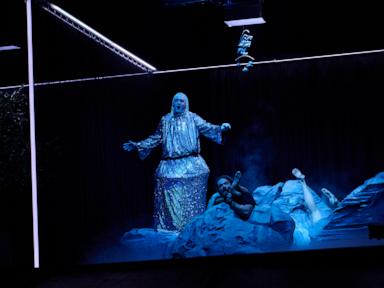
The sirens do not wait for the curtain call. Down in Kyiv, beneath concrete ribs that once stored industrial weight, the warning wails like a raw nerve exposed to salt. Above us, the sky is a bruised violet, heavy with the quiet dread of what drones might carry tonight. But inside the theater, the air smells of old wool, stale coffee, and rosin.
Dust motes dance in the amber sweep of a single spotlight.
A man walks onto the bare wooden boards. He wears no armor, yet every line of his posture screams of a ten-year siege. He is Odysseus, yes, but he is also a soldier from Bakhmut who has forgotten what bread tastes like without the tang of cordite. When he speaks, his voice does not boom with classical theatricality. It scrapes. It is the dry rattle of gravel sliding down a trench wall.
We have gathered here because art refuses to die in a blackout.
The Long Way Home
For centuries, Homer’s epic has been taught as a museum piece. We read it in high school classrooms under the fluorescent hum of flickering bulbs, reducing a visceral, blood-soaked survival story into a sequence of vocabulary words: lotus-eaters, sirens, Ithaca. We treated the sea as a metaphor. We treated the monsters as ink on parchment.
That luxury died two years ago.
When modern artillery re-mapped the geography of Europe, ancient myths stopped being dusty relics. They became documentary accounts. Consider what happens when a theater company in a besieged capital decides to stage the Odyssey today: the sea monsters are not mythical beasts with many heads; they are the endless, indiscriminate screech of incoming cruise missiles. The island of the lotus-eaters is not a tropical beach of sleepy oblivion; it is the numbing exhaustion of scrolling through casualty reports until your own pulse feels like a stranger’s.
I sat in the tenth row last week, listening to an actress play Penelope. She was weaving a shroud—not of white linen, but of olive-drab netting, the kind volunteers tie in school basements by the thousand to hide artillery positions from thermal drones. Every knot she tied was a day of waiting. Every thread was a son, a brother, a husband gone into the gray haze of the eastern front.
When she spoke of holding the line against suitors who wanted to carve up her home, the audience did not clap. They stopped breathing. The silence in that room was heavy enough to touch.
The Geography of Grief
Theater in wartime is not an escape. It is a mirror held up to a furnace.
Before the invasion, performance spaces in Ukraine buzzed with experimental set designs and glossy imported scripts. Now, stripped of electricity, budget, and safety, artists have returned to the bare bones of human expression: a voice, a body, a witness. They rehearse in bomb shelters. They time their monologues between curfews.
(Note: When I speak of the actors' daily routines, I draw directly from interviews with the troupe currently staging this adaptation, whose members split their hours between humanitarian supply runs and rehearsal spaces.)
Let me tell you about Dmytro. He plays Telemachus. Last month, a mortar strike took the roof off his apartment building in Saltivka. He lost his childhood piano, his library, and his neighbor's cat. Yet every afternoon, he walks three miles across a city scarred by blast craters to stand on a stage and search for a father who might never come home.
"When I scream at the gods in the third act," Dmytro told me backstage, smelling faintly of cold iron and cheap tobacco, "I am not acting. I am asking the ceiling why my friend Sasha is under a wooden cross in Kharkiv while I get to say these ancient lines."
This is the friction at the heart of the production. The ancient Greeks understood that trauma fractures time. They knew that a man returning from war brings the war back inside his skull, transforming his own living room into a battlefield. By mapping Odysseus's twenty-year wandering onto the current Ukrainian diaspora—millions scattered across strange European capitals, speaking foreign tongues, longing for a kitchen table that no longer exists—the play bridges a three-thousand-year chasm.
The Weight of the Oar
In the final movement of the epic, Tiresias tells Odysseus to take an oar and walk inland until he reaches a people who know nothing of the sea, a people who ask him why he carries a winnowing fan on his shoulder. Only there, where the salt of the ocean is utterly foreign, may he plant his oar and make peace.
That image haunts the stages of Kyiv now.
Because what happens when the war ends, and these actors, these soldiers, these mothers with woven nets of camouflage step back into a world that has moved on? How do you plant an oar in soil that has been poisoned by heavy metals and shrapnel? How do you explain the sound of a whistle in the dark to someone who has never had to duck?
The theater does not answer these questions. It does something harder. It sits with them in the dark.
As the house lights flickered back on—powered by a wheezing, diesel-guzzling generator parked in the alleyway—the audience did not rush for the exits. They stood there in the dust and the chill, looking at one another, recognizing the dark rings under each other's eyes, the shared posture of survival. The actors took their bow not with triumphant grins, but with the quiet, bone-deep dignity of people who have crossed an abyss and simply refuse to let the darkness have the last word.
Outside, the air raid sirens began to wail again. Nobody ran. They pulled their coats tighter, zipped their collars against the coming night, and stepped out into the smoke.