The political discourse surrounding the Anglo-American alliance frequently relies on the emotive framing of a "Special Relationship." This terminology obscures the reality of the arrangement. The partnership between the United States and the United Kingdom functions not through diplomatic sentiment or personal affinity between heads of state, but through a deeply entrenched, multi-layered institutional architecture. Leaders may modulate the tone of the rhetoric to satisfy domestic political constituencies, but the underlying mechanisms of the alliance remain static and resistant to change.
To understand the durability of this relationship, one must deconstruct it into three distinct operational domains: intelligence, defense, and capital flow.
The Institutional Baseline of Intelligence Sharing
The Five Eyes alliance serves as the primary structural anchor. Formed from the wreckage of World War II, this signals intelligence pact creates a persistent data-sharing loop between the US, UK, Canada, Australia, and New Zealand. This is not a voluntary, discretionary agreement; it is a system of integrated technological infrastructure.
The mechanism relies on a division of labor where the UK’s GCHQ (Government Communications Headquarters) and the US National Security Agency (NSA) perform functionally redundant but geographically dispersed surveillance. The strategic value here is risk mitigation. The US cannot physically monitor every quadrant of the globe; the UK provides essential geographic coverage and historical linguistic/cultural expertise in former colonial territories. This integration is so absolute that the two nations effectively operate a single, shared intelligence apparatus. When a US president welcomes a British monarch or prime minister, the public spectacle masks the reality that these individuals are simply public-facing figureshead components of a massive, perpetual bureaucratic engine.
Defense Integration and Nuclear Dependency
The second pillar rests on the Mutual Defence Agreement of 1958. Unlike most international defense treaties, which are based on promises of mutual aid, this agreement involves the literal transfer of hardware, fissile materials, and technology.
The UK’s nuclear deterrent, the Trident program, is operationally dependent on US technology. The missiles are leased from the US, maintained at US facilities, and rely on US-supplied guidance systems. This creates a state of technological lock-in. A British government cannot unilaterally alter its strategic defense posture without severe friction, nor can a US administration easily dismantle the partnership without compromising its own strategic depth. The "friendship" is effectively a byproduct of this defense entanglement. The cost of decoupling is prohibitively high for both parties, resulting in a systemic inertia that survives regardless of whether the US president acts with transactional disregard or the UK monarch seeks traditional statecraft.
Capital Markets and Economic Gravity
The economic dimension of this relationship is defined by capital markets rather than trade volume. While trade negotiations often dominate the headlines, they are statistically secondary to the flow of financial services.
The City of London functions as the primary European gateway for American capital, while Wall Street acts as the principal destination for British investment. This is a circular financial dependency. American institutional investors hold substantial positions in the FTSE 100, and British pension funds are heavily indexed to the S&P 500.
The regulatory alignment between the Financial Conduct Authority (FCA) in the UK and the Securities and Exchange Commission (SEC) in the US dictates the terms of global finance. When these two entities harmonize their standards, they set the de facto rules for international trade. This creates a regulatory moat. Neither the US nor the UK has an incentive to drift toward Chinese or European Union regulatory standards, as doing so would invite capital flight and reduce the efficiency of their existing market integration.
The Variable of Political Personalities
Political theater often obscures these structural realities. During diplomatic meetings, optics serve a specific tactical purpose. For a US president, positioning the UK as a "closest friend" signals reliability to a domestic base that values traditional alliances. For the UK, maintaining this perception is essential for national security, as it signals to global adversaries that the UK retains a tier-one security guarantee.
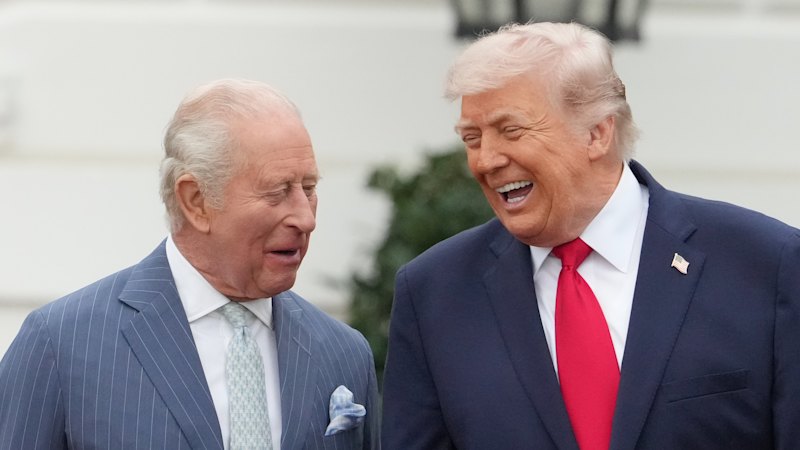
The interaction between figures such as Donald Trump and King Charles III illustrates the limits of personality-driven politics. Media narratives often focus on the friction between populist rhetoric and monarchical tradition. An analytical view, however, reveals that these interactions are inconsequential to the strategic vector of the relationship. The bureaucracy at the State Department, the Pentagon, and the intelligence community operates on a five-to-ten-year horizon, while presidential terms operate on a four-year cycle. The bureaucratic apparatus absorbs the volatility of individual leaders.
Analyzing the Limitations of the Relationship
The alliance faces acute pressures that threaten its historical equilibrium. The primary risk is the divergence of domestic economic priorities. The US has moved toward an industrial policy characterized by protectionism and the reshoring of manufacturing. The UK, post-Brexit, faces a mandate to cultivate trade relationships outside of the European sphere while simultaneously grappling with stagnant domestic productivity.
If the US continues to prioritize isolationist economic policies, the UK will eventually reach a point of diminishing returns in its reliance on the American market. The strategic recommendation is not to assume the relationship will persist in its current form by default. Rather, the UK must diversify its security dependencies. Dependence on the US for nuclear maintenance is a rigid constraint, but reliance on the US for economic growth is a strategic vulnerability.
The "Special Relationship" survives not because of shared history, but because the cost of exit for both nations exceeds the benefit of independent action. The strategic play for stakeholders is to ignore the performative aspects of diplomatic visits and monitor the unglamorous data points: the renewal cycles of intelligence sharing agreements, the technical specifications of defense hardware updates, and the flow of capital between the New York and London stock exchanges. These metrics define the trajectory of the alliance, irrespective of who holds the office of the presidency or sits on the British throne.
The definitive trend is toward continued, albeit potentially strained, institutional integration. The US requires a forward-deployed intelligence and military node in Europe; the UK requires a nuclear deterrent and a liquidity anchor. As long as these needs remain unmet by other global powers, the structural architecture of the US-UK relationship will remain immovable.