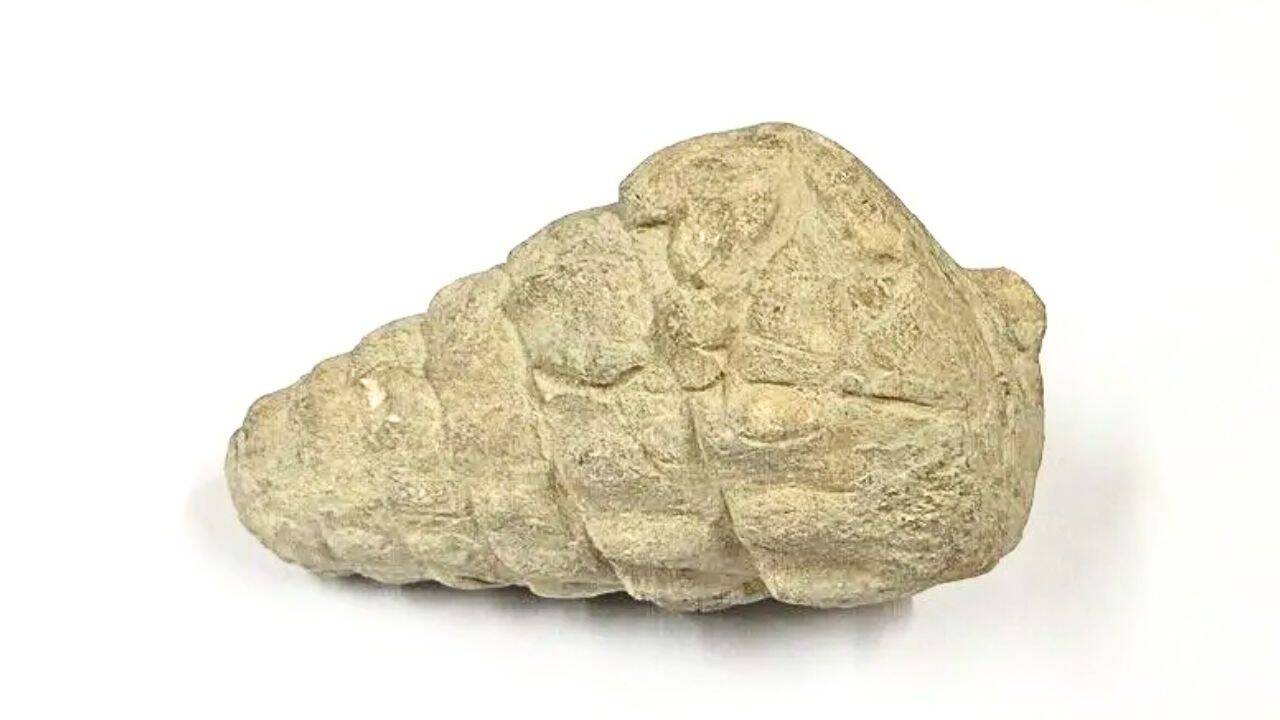
Dirt does not forget. It merely waits for someone patient enough to listen to the silence it keeps.
Imagine kneeling in the dry earth of an ancient Anatolian settlement, five thousand years removed from the hands that last disturbed the soil. The sun beats down on the excavation site, baking the clay into a stubborn armor. Dust clings to sweat, settling into the lines of your face. You are looking for broken pottery, charred seeds, the ordinary debris of a Bronze Age life. Instead, your trowel hits something smooth. It does not chip like flint. It does not snap like bone. It yields with a heavy, stubborn grace, a coiled spiral of polished calcium carbonate that has no business resting beneath the floorboards of a mudbrick hut built millennia after its own creation.
You brush away the grime. You trace the whorls.
Sixty-six million years.
Pause for a second and let the sheer, violent absurdity of that gap wash over you. When this shell was a living creature—pulsing in a shallow, warm prehistoric sea—dinosaurs still ruled the earth. Entire continents drifted across an alien globe. An asteroid had not yet fallen to wipe the skies clean. And yet, deep in the heart of modern-day Ankara, at a site pulsating with the mundane hustle of human antiquity, someone picked up this ancient fossil. They carried it home. They kept it.
Why?
The Archaeology of the Unspoken
We are obsessed with the utility of the past. We want to know what they ate, how they buried their dead, what taxes they paid, and how sharp their bronze blades were. We reduce history to a ledger of survival.
Yet people have always been inexplicably, beautifully strange.
Picture a woman sitting in the dim interior of a dwelling in Bronze Age Ankara. Outside, goats bleat, children chase dust devils, and the steady, grinding rhythm of stone against grain echoes through the settlement. She is tired. Her shoulders ache from hauling water. She sweeps the packed dirt floor of her home, and her hand brushes against an anomaly.
It is a gastropod fossil, eroded free from the surrounding limestone hills by wind and rain centuries before she was born. It is heavy in her palm. It is impossibly old, even to her. It has no practical value. It cannot be melted down into a spearhead. It cannot be ground into flour. It will not hold water.
And yet, she does not throw it into the refuse heap. She brings it inside. She places it on a shelf, or holds it in her palm on a quiet evening, turning it over and over until the surface catches the firelight.
When archaeologists uncovered this artifact, the standard protocol took over. Measurements were taken. GPS coordinates logged. Material analysis performed. The specimen was identified as a fossilized marine snail from the Cretaceous period, completely alien to the geological strata of the immediate inland settlement. It had traveled. Either carried by the ancient inhabitants across miles of rugged terrain, or collected from local sedimentary exposures where geological upheavals had exposed the prehistoric seabed to the open air.
The data is clean. The science is absolute. But the data misses the ghost in the room.
The Long Thread of Wonder
We like to think of ourselves as modern creatures, insulated by our technology and our refined understanding of deep time. We know about the Cretaceous. We can rattle off extinction events and plate tectonics. We view ancient peoples as primitives stumbling blindly through a terrifying wilderness, motivated solely by hunger, fear, and superstition.
How arrogant of us.
That Bronze Age inhabitant possessed eyes just as sharp as yours. They looked at the same horizon, felt the same ache in their joints, and experienced the exact same jolt of existential vertigo when encountering something that outlived its own era.
Consider what happens when a mind capable of abstract thought collides with deep time. You do not need to understand paleontology to recognize an artifact of eternity. You just need to hold something that was old when the world was young.
The fossil found in Ankara is a bridge built across sixty-six million years of silence, anchored on one side by an extinct mollusk and on the other by a human being who refused to let it go unnoticed. Between them lies an unquantifiable ocean of evolutionary change, climate shifts, rising mountain ranges, and the birth and death of empires.
We walk through our lives surrounded by relics we no longer see. We rush to work, scroll through glowing rectangles, and complain about the weather, entirely disconnected from the monstrous, beautiful depth of the earth beneath our sneakers. We treat history as a series of textbooks dates, neatly bound and easily forgotten.
Then a trowel strikes a snail shell in the dirt of Ankara.
And for a fleeting, terrifying moment, the walls of the present crack wide open. You realize that you are just a temporary tenant in a very old house, clutching things you do not fully understand, trying to leave a mark before the dust settles over your own hands.
The shell remains. The hands that held it are dust. But the wonder, sharp and quiet and utterly human, survives every single thing that tried to bury it.