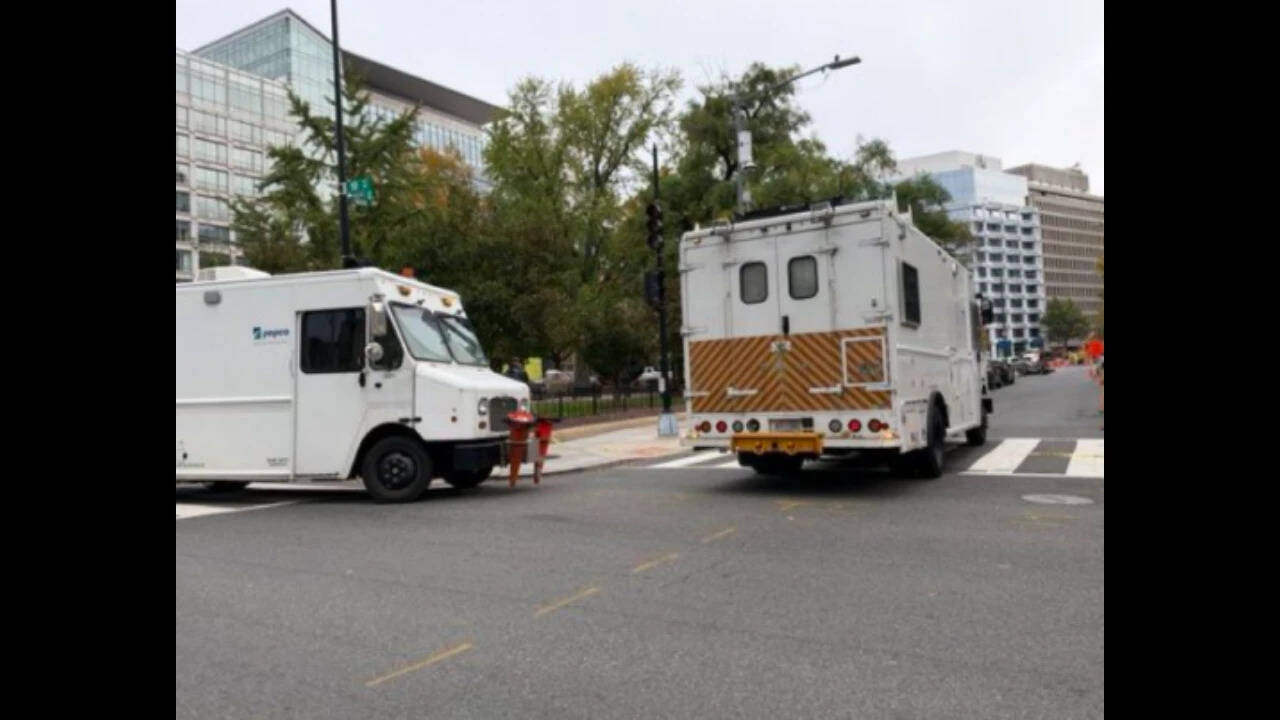
Eleven hundred customers in Foggy Bottom lose power, and right on cue, the local news cycle turns into a predictable theater of outrage. The headline writes itself. A utility company fails. Residents sit in the dark. Comment sections fill up with demands to fine Pepco, nationalize the grid, or blame corporate greed for an aging transformer blowing out three blocks from the State Department.
That narrative is lazy, comforting, and completely wrong.
If you actually understand how urban distribution networks operate beneath the streets of Washington, D.C., a localized outage affecting 1,100 meters isn't evidence of a broken system. It is evidence of a system doing the exact job it was engineered to do under impossible physical constraints. The real story isn't that the power went out in Foggy Bottom. The real story is that the lights stay on 99.9% of the time in a neighborhood built on a literal swamp, choked with legacy ductwork, and asked to support power densities its original architects could never have conceived.
The Myth of the Fragile Grid
Every time an underground feeder trips in Northwest D.C., local coverage treats it like a freak accident or a moral failing by Potomac Electric Power Company. Reporters quote frustrated residents. They paste screenshots of the Pepco outage map. They mention the estimated restoration time. And then they move on, leaving the public with the distinct impression that electrical infrastructure is supposed to be infallible, and any deviation is proof of incompetence.
I have spent years sitting in utility war rooms and reviewing post-mortem engineering reports for Northeast distribution grids. I have watched municipalities blow tens of millions of dollars on "grid hardening" initiatives that sounded brilliant in a city council hearing and did almost nothing to stop localized feeder trips.
Here is what nobody in local media wants to tell you: zero outages is a thermodynamic and economic fantasy.
To appreciate why Foggy Bottom goes dark, you have to understand the specific architecture underneath it. Unlike suburban neighborhoods where power lines hang from wooden poles and a squirrel or a falling oak branch takes out a single street, downtown D.C. runs on an underground secondary network grid. This is the same high-density topology used in Manhattan and downtown Chicago.
In a standard radial system, power flows one way from a substation to your house. If a line breaks, everyone downstream loses power until a crew splices the wire. In an underground secondary network—like the ones serving Foggy Bottom, George Washington University, and the surrounding federal corridors—multiple primary feeders supply a shared web of secondary cables through specialized devices called network protectors.
When one primary feeder faults, the network protectors are supposed to open instantly, isolating the bad line while the remaining feeders pick up the slack without the customer ever seeing a flicker. It is a brilliant piece of mid-twentieth-century engineering.
Until it isn't.
When a cascading fault occurs—often triggered by water intrusion, thermal overload during sudden weather swings, or a third-party contractor hitting a duct bank—the system has to sacrifice a localized pocket to prevent a catastrophic substation failure. Losing 1,100 customers in Foggy Bottom is not a grid collapse. It is a circuit breaker tripping to save the rest of the District from going dark.
Why Foggy Bottom Is an Engineering Nightmare
Location matters. Foggy Bottom earned its name for a reason. Before it was home to diplomats, university dorms, and high-end condos, it was a low-lying, marshy floodplain along the Potomac River.
Underground electrical cables hate two things above all else: heat and water. Foggy Bottom provides an endless supply of both.
- The Water Table Problem: High groundwater levels mean underground vaults and manholes are constantly battling moisture. Even with modern cross-linked polyethylene (XLPE) insulation replacing older paper-insulated lead-covered (PILC) cables, splices remain vulnerable. When brackish or mineral-heavy water penetrates a compromised joint, it creates electrical tracking. Eventually, the insulation fails, an arc flashes inside a confined concrete vault, and a feeder trips offline.
- Thermal Bottlenecks: Underground cables cannot shed heat into the open air like overhead wires. They rely on the surrounding soil to act as a heat sink. During late-season temperature spikes or sudden cold snaps when electric heat pumps kick on simultaneously, the soil around tightly packed duct banks dries out and loses its thermal conductivity. The cables cook in their own heat.
- The Excavation Gauntlet: Washington, D.C. is in a perpetual state of digging itself up. Fiber-optic expansions, water main replacements, steam tunnel repairs, and commercial construction happen daily in tight right-of-ways. A backhoe nicking a conduit doesn't always cause an immediate explosion. Sometimes it merely cracks a protective casing, letting water seep in over six months until a random Tuesday evening when 1,100 customers suddenly lose their Wi-Fi.
Blaming Pepco's customer service or executive compensation for groundwater physics and legacy civil engineering is like blaming an airline pilot for headwinds over the Atlantic.
The Unspoken Trade-Off Nobody Wants to Pay For
Whenever an outage hits a prominent D.C. neighborhood, the immediate political reflex is to demand total undergrounding and triple redundancy. The District has already spent hundreds of millions of dollars on the DC PLUG (District of Columbia Power Line Undergrounding) initiative to bury overhead feeders in other wards, yet Foggy Bottom—already largely underground—still experiences disruptions.
Why? Because redundancy has a brutal cost curve.
Engineers measure grid performance using metrics established by the Institute of Electrical and Electronics Engineers (IEEE), primarily SAIDI (System Average Interruption Duration Index) and SAIFI (System Average Interruption Frequency Index). Over the past decade, following aggressive capital investments under Exelon's ownership, Pepco has actually driven its outage frequency down significantly compared to its dismal performance in the early 2010s.
You can push reliability from 99.9% to 99.99%. It just requires quadrupling the capital expenditure per mile of feeder, tearing up Pennsylvania Avenue and 23rd Street for five consecutive years, and passing every cent of that rate base directly onto the monthly bills of D.C. residents and small businesses.
Let's be honest about the downside of the "accept minor outages" stance: if you are a biotech lab at GW University with temperature-sensitive samples, or a restaurant on I Street watching $4,000 worth of inventory warm up in a walk-in cooler, an engineering lecture about IEEE reliability indices does nothing for your bottom line. Outages cost real money. For medically vulnerable residents relying on powered oxygen concentrators or dialysis machines at home, a four-hour blackout isn't an inconvenience; it is a life-safety emergency.
But pretending the utility can engineer away every single localized failure without turning D.C. electric rates into San Diego electric rates is pure fantasy.
What You Should Actually Be Asking
When the power goes out in Foggy Bottom, the local news articles always try to answer the same surface-level questions. Let's look at the actual questions people ask—and dismantle the flawed assumptions baked into them.
"Why does it take Pepco hours to fix a simple outage?"
Because underground faults are invisible. On an overhead line, a lineman drives down the street with a spotlight, spots a blown fuse or a tree branch on a wire, and fixes it in forty minutes. Underground, crews have to isolate the faulted section, pump flooded manholes, test air quality for toxic gases like carbon monoxide or methane before anyone can descend a ladder, locate the exact failed splice among miles of buried cable, cut it out, and rebuild the joint by hand. Splicing a high-voltage underground cable is surgical work. Rushing it gets people killed.
"Is the D.C. grid failing because of electric vehicles and data centers?"
Not yet—at least not in Foggy Bottom. While massive data center clusters in Northern Virginia (Loudoun County's "Data Center Alley") are straining regional transmission capacity across the PJM Interconnection grid, a localized 1,100-customer outage in D.C. is almost always a distribution-level equipment failure, not a bulk generation shortage. The power exists; the last-mile delivery pipe just clogged.
"Should Washington, D.C. municipalize Pepco?"
People love floating public power as a magic bullet whenever a private utility stumbles. Look at public utilities across the country—from the Los Angeles Department of Water and Power to smaller municipal co-ops—and you will find the exact same aging transformers, the exact same supply-chain backlogs for switchgear, and the exact same physics. Changing the name on the letterhead doesn't lower the water table in Foggy Bottom. It just shifts the political blame from a corporate boardroom to the D.C. Council.
How to Actually Bulletproof Your Life Against Urban Outages
Stop waiting for regulators, mayors, or utility executives to guarantee uninterrupted power. They can't. Even the best-maintained urban grids in Tokyo, London, and New York suffer localized feeder trips. If your livelihood, health, or sanity depends on continuous electricity, resilience is your responsibility.
Forget the breathless panic buying of flashlights and candles every time a storm rolls up the Potomac. Take three concrete steps instead:
- Deploy Lithium Iron Phosphate (LiFePO4) Battery Backups, Not Lead-Acid UPS Units: Most home office battery backups use cheap sealed lead-acid batteries that die after two years and barely run a router for twenty minutes. Modern LiFePO4 power stations (from manufacturers like EcoFlow, Anker, or Bluetti) hold a charge for months, handle thousands of cycles, and can silently keep a modem, laptop, and refrigerator running for hours inside a Foggy Bottom apartment where gas generators are illegal and lethal.
- Decouple Your Internet from Your Neighborhood Grid: When Pepco drops a feeder, your building's Wi-Fi dies instantly, even if your laptop has 80% battery. Worse, local cell towers often rely on battery backups that deplete within two to four hours during widespread events, turning 5G speeds into a crawl as thousands of neighbors jump onto cellular data simultaneously. Keep your router and fiber ONT plugged into a dedicated mini-UPS. Even when the block goes dark, the central fiber hub miles away usually stays powered, keeping your internet alive.
- Audit Your Building's Transfer Switch Reality: If you live or operate a business in a multi-story D.C. building, ask management one specific question: What is actually wired to the building's emergency diesel generator? In almost every high-rise, code only requires emergency power for stairwell lighting, fire pumps, and one elevator. Your outlets, HVAC, and server closets are completely exposed unless you install local point-of-use storage.
The Real Takeaway
The next time a headline flashes across your screen announcing that 1,100 customers in Foggy Bottom are sitting in the dark, skip the outrage theater.
The grid didn't fail. A single underground component reached the end of its thermal or mechanical life in one of the most hostile subterranean environments on the East Coast, and the network sacrificed a small fraction of a percent of its customer base to keep the rest of the capital running.
Demand transparency on maintenance schedules. Hold regulators accountable for how rate hikes are spent. Buy a battery for your router. Just stop pretending that electricity in a swamp is supposed to be magic.


