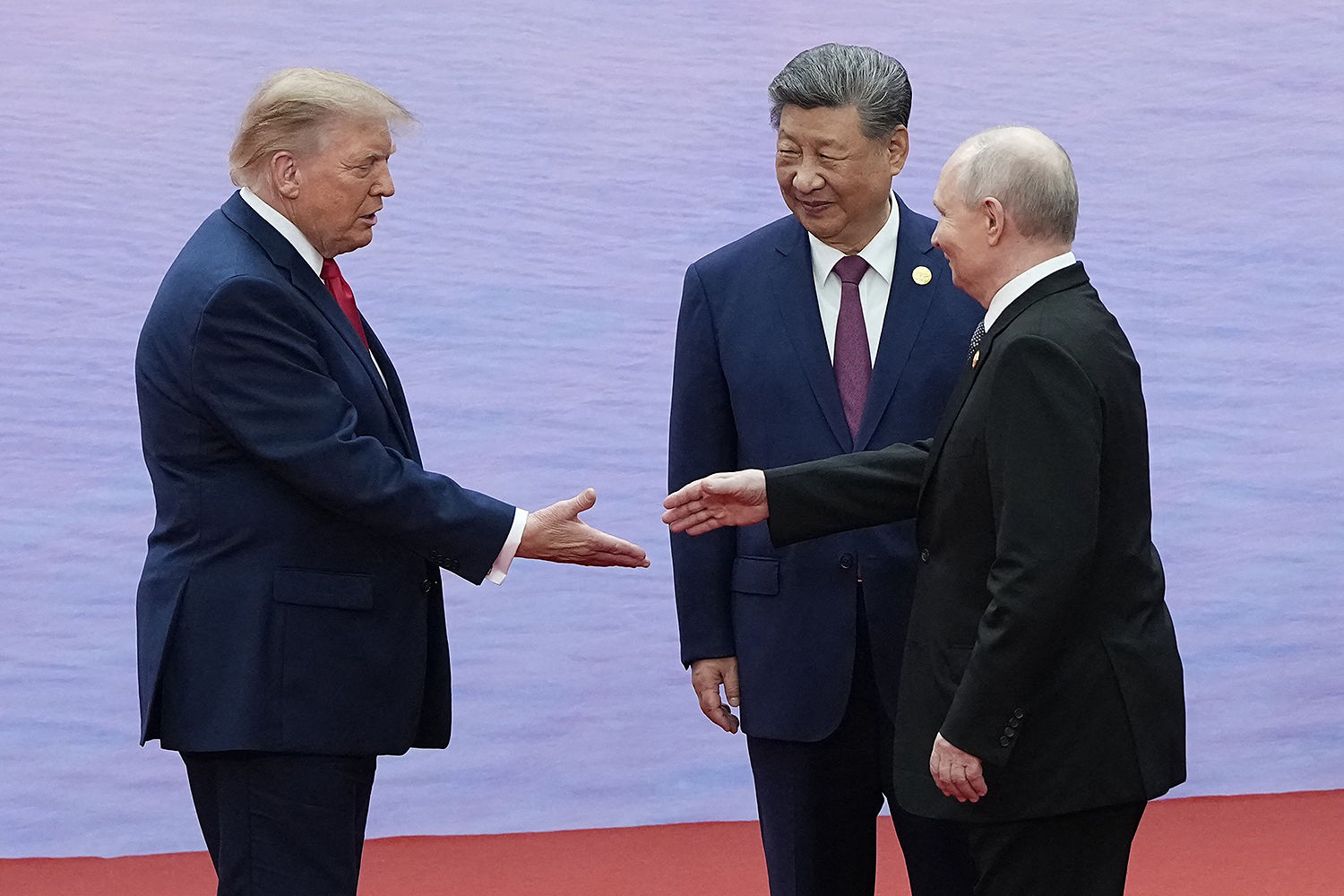
Every time Xi Jinping steps off an Air China Boeing 747 in a foreign capital, shakes a hand, and signs a vague memorandum of understanding, the Western press corps swoons. They call it a "remarkable diplomatic moment." They fret over Washington losing its grip on the Global South. They wring their hands about Beijing filling the vacuum.
They are looking at the theater and missing the fire backstage.
The mainstream commentary surrounding Xi’s high-profile diplomatic engagements operates on a lazy, outdated consensus. Pundits assume that a busy travel schedule equals geopolitical strength. They treat state banquets and BRICS expansion summits as proof that China is effortlessly assembling a new world order while the United States stumbles. That framing is backwards. When you strip away the red carpets and state-media choreography, Xi’s hyperactive diplomacy is not a victory lap. It is a containment breach. Beijing is exporting political capital at a frantic pace because its domestic economic engine is sputtering, its demographic floor is collapsing, and its traditional export markets are slamming the doors shut.
If you want to understand modern geopolitics, stop counting how many summits Xi attends. Start looking at why he cannot afford to stay home.
The Illusion of the Diplomatic Victory Lap
The standard narrative goes like this: Washington is distracted, Europe is divided, and Beijing is swooping in as the adult in the room, brokering peace deals, hosting regional leaders, and projecting stability. Analysts point to the expansion of BRICS, the endless stream of heads of state visiting the Great Hall of the People, and Beijing’s mediation efforts in the Middle East as evidence of an unstoppable ascent.
This analysis mistakes photo opportunities for binding alliances.
I have sat across the table from sovereign wealth fund managers in the Gulf and trade ministers in Southeast Asia for over a decade. When they fly to Beijing and praise Xi’s "Global Development Initiative," they are not signing up to join an anti-Western bloc. They are price-shopping. They are hedging. They want cheap infrastructure loans, discounted solar panels, and access to Chinese buyers, while keeping their security guarantees firmly anchored in Washington and their capital parked in New York and London.
Real geopolitical power is measured by what allies will sacrifice for you when things get ugly. Look at the ledger. When Russia invaded Ukraine, Beijing offered rhetorical cover and bought discounted oil, yet Chinese state banks quietly complied with secondary Western sanctions to avoid being cut off from the US dollar clearing system. When Middle Eastern tensions flared and Red Sea shipping lanes came under attack, the self-proclaimed regional peacemaker in Beijing did not send a single naval destroyer to protect global commerce. They let the US Navy absorb the cost and the risk while Chinese cargo ships coasted through under the cover of American radar.
That is not the behavior of a rising hegemon replacing the global order. That is free-riding dressed up as statesmanship.
The Domestic Dumpster Fire Driving Foreign Policy
To see the real driver behind Xi’s diplomatic offensive, you have to look at China’s balance sheet. Foreign policy does not exist in a vacuum; it is an extension of domestic political survival.
For thirty years, the Chinese Communist Party’s legitimacy rested on an unspoken social contract: we deliver relentless economic growth, rising living standards, and booming property values, and you stay out of politics. That contract is broken.
- The Property Meltdown: Real estate once accounted for roughly a quarter to a third of China’s gross domestic product and held up to 70 percent of household wealth. Today, giants like Evergrande and Countrywide are symbols of historic corporate ruin. Unfinished apartment towers scar the edges of tier-two and tier-three cities. Local governments, which relied on land sales for nearly half their revenue, are drowning in trillions of dollars of hidden debt held by Local Government Financing Vehicles.
- Deflationary Drag: While the rest of the world fought inflation, China slipped into persistent deflationary pressure. Producer prices have spent months in negative territory. Consumers, watching their housing equity evaporate and youth unemployment spike so high Beijing briefly stopped publishing the data, are hoarding cash instead of spending it.
- Capital Flight and Distrust: Private entrepreneurs—the actual job creators in China—have been bruised by years of regulatory crackdowns, zero-COVID lockdowns, and the sudden disappearance of high-profile executives. Foreign direct investment plunged to multi-decade lows as multinational boards realized that political security in Beijing now outranks economic growth.
When domestic consumption refuses to ignite, Beijing falls back on the only playbook it trusts: state-subsidized manufacturing. Xi has poured massive amounts of state bank credit into what he calls the "new productive forces"—electric vehicles, lithium batteries, and solar photovoltaics.
Here is the catch. China’s domestic market cannot absorb all those goods. If Beijing wants to keep its factories humming and prevent mass layoffs, it must dump that industrial overcapacity onto the rest of the world.
Suddenly, Xi’s relentless charm offensive makes complete sense. He is not traveling the globe to build an ideological utopia. He is acting as China’s Chief Sales Officer, desperately trying to keep export markets open before tariffs lock him out.
The Overcapacity Trap and the Global Backlash
The competitor's narrative assumes that China’s diplomatic outreach naturally translates into economic goodwill. In reality, Beijing’s industrial strategy is actively alienating the exact developing nations it claims to champion.
Economists call this the "China Shock 2.0," and unlike the first wave in the early 2000s—which targeted low-end textiles and toys—this wave threatens the core industrial ambitions of middle-income countries.
Look at what is happening outside the G7. The conventional wisdom claims only Washington and Brussels are erecting trade barriers against Chinese goods. That is false. Brazil has slapped tariffs on Chinese electric vehicles and steel to protect its own nascent auto manufacturing sector. Turkey imposed a 40 percent additional tariff on all vehicles imported from China. Indonesia has rolled out steep import duties on textiles and ceramics to stop cheap Chinese exports from bankrupting local factories. India has systematically blocked Chinese apps, tightened scrutiny on Chinese investments, and ramped up anti-dumping investigations.
You cannot tell the Global South that you are their champion for "win-win cooperation" while simultaneously flooding their markets with subsidized products that wipe out their domestic manufacturing base.
This is the fatal flaw in Xi’s diplomatic calculus. The Belt and Road Initiative already left dozens of developing nations—from Sri Lanka to Zambia—saddle-sore with unsustainable debt and half-finished infrastructure projects. Now, Beijing is asking those same cash-strapped economies to absorb China’s manufacturing surplus without getting technology transfers or local factory jobs in return. The diplomatic smiles in front of the cameras do not match the closed-door fury of trade ministers trying to save their own economies from deindustrialization.
Why Diplomatic Pitfalls Are Actually Structural Ceilings
Mainstream commentators love to frame Xi’s challenges as "pitfalls"—a word that implies temporary hazards a clever leader can simply step around. A pitfall is a pothole in the road. What Xi faces is a brick wall.
Consider the structural contradictions built into Beijing’s current posture:
- The "No Limits" Anchor: Xi’s decision to stand shoulder-to-shoulder with Vladimir Putin has permanently poisoned China’s relationship with Europe. Beijing spent years trying to drive a wedge between Washington and Brussels, banking on European appetite for Chinese market access. By propping up Russia’s defense industrial base with dual-use goods—machine tools, microelectronics, and nitrocellulose—Xi achieved what American diplomats could not. He unified transatlantic skepticism. Europe now views China not merely as a trade competitor, but as an enabler of a land war on its own border. No amount of panda diplomacy or visa-free travel announcements for French and German tourists will erase that strategic reality.
- Wolf Warrior Muscle Memory: For years, Chinese diplomats were rewarded for aggressive, confrontational rhetoric. Even when Beijing tries to dial back the volume and project warmth, the underlying coercion remains obvious. You cannot preach peaceful coexistence at a summit on Tuesday and have your coast guard ram Philippine supply vessels with water cannons in the South China Sea on Wednesday. Neighbors watch what Beijing does in the water, not what Xi reads off a teleprompter.
- Demographic Gravity: Geopolitical timelines are ruthless. China’s population is shrinking, and its workforce is aging faster than almost any major economy in history. According to United Nations demographic projections, China could lose hundreds of millions of people by the end of the century. A country gets old before it gets rich when its pension systems are underfunded and its productivity growth is stalling. Xi is trying to lock in global influence right now because he knows his window of maximum relative strength is closing.
Dismantling the Wrong Questions
When analysts discuss China’s diplomatic moves, they usually ask the wrong questions. Let us tear down the three most common misconceptions driving bad boardroom and policy decisions today.
Is China Replacing the US Dollar Through BRICS Diplomacy?
No. Anyone telling you that BRICS is on the verge of launching a common currency to dethrone the dollar does not understand basic monetary economics. A currency union requires fiscal integration, a shared central bank, and the willingness of member states to surrender control over their own interest rates and money supply. China has a closed capital account and strictly controls the yuan to prevent capital flight. India—a founding BRICS member and China’s geopolitical rival—has zero interest in subordinating its monetary policy to Beijing. Bilateral trade settled in local currencies is a rounding error in global finance. Over 80 percent of global trade finance still runs through the US dollar because no other market is deep, liquid, or trustworthy enough to hold global reserves.
Does Beijing’s Middle East Mediation Prove It Is the New Power Broker?
Hardly. The Beijing-brokered normalization deal between Saudi Arabia and Iran in 2023 was hailed by breathless commentators as the death knell of American influence in the Persian Gulf. In truth, China simply hosted the signing ceremony for a truce both Riyadh and Tehran were already negotiating through Iraqi and Omani backchannels for two years. Beijing had leverage only because it buys massive amounts of oil from both countries. When actual hard security crises erupted across the region months later, neither Riyadh nor Tehran looked to Beijing for military deterrence or diplomatic rescue. China has zero appetite to get bogged down in Middle Eastern security commitments.
Is the Global South Uniting Under Chinese Leadership?
The "Global South" is a geographic fiction, not a coherent political bloc. Brazil wants agricultural exports and green energy investment. India wants manufacturing supply chains moved out of China and into Gujarat and Tamil Nadu. Saudi Arabia wants high oil prices and AI data centers. Vietnam wants American security backing to deter Chinese maritime claims while buying Chinese intermediate components for its factories. These nations have wildly competing interests. They use Beijing as leverage to extract better terms from Washington, and they use Washington to check Beijing. Treating them as passive chess pieces falling into Xi’s pocket is insulting to their own strategic agency.
What Decision-Makers Should Actually Do
If you are a corporate executive, an investor, or a policy strategist, buying into the hype of Xi’s diplomatic omnipotence will cost you money and strategic clarity. Here is how to operate based on reality rather than headlines:
- Discount the Summitry, Track the Tariffs: Ignore the sweeping joint statements signed during state visits. Watch customs enforcement, anti-dumping rulings, and local content rules in emerging markets. Supply chains are not merely decoupling between the US and China; they are fragmenting globally as middle powers erect walls against Chinese overcapacity.
- Build for "China Plus Two," Not "China Plus One": Moving final assembly to Vietnam or Mexico is no longer enough to shield your supply chain from geopolitical friction. Washington and Brussels are aggressively policing transshipment—goods made in China, lightly rebadged in a third country, and exported tariff-free. You need genuine upstream component diversification in Southeast Asia, India, or Eastern Europe.
- Price In Domestic Stimulus Desperation: Because Beijing’s foreign policy is tied to its domestic slump, expect erratic policy swings. When export outlets clog up, Beijing will be forced into sudden, messy rounds of domestic debt restructuring or currency depreciation. Do not leave unhedged yuan exposure on your corporate balance sheet under the assumption that Beijing prioritizes currency stability over export competitiveness.
- Read the Signals in the South China Sea, Not Davos: When Xi speaks to global CEOs about openness and mutual benefit, he is performing for an external audience. When the People’s Liberation Army conducts encirclement drills around Taiwan or harasses neighboring coast guards, that is the true hierarchy of priorities in Beijing. National security and regime control will always crush economic pragmatism when the two collide.
The Hard Truth About Contrarian Forecasting
Betting against Beijing’s diplomatic momentum carries its own risks. China remains the world’s largest manufacturing powerhouse, the primary trading partner for over 120 countries, and the dominant processor of critical minerals like lithium, cobalt, and rare earths. You cannot simply wish away a $18 trillion economy or pretend that Washington’s own political dysfunction does not hand Beijing easy propaganda wins. When the United States flirts with isolationism or treats allies purely as transactional clients, Beijing’s pitch for a "multipolar world" finds receptive ears, even among leaders who distrust the Chinese Communist Party.
Acknowledging China’s sheer industrial weight, however, is completely different from swallowing the myth that Xi Jinping is orchestrating an effortless geopolitical triumph.
Real power does not need to beg foreign capitals to absorb its excess factory output. Real hegemons do not watch their brightest entrepreneurs flee to Singapore and Tokyo while their youth lie flat in protest against a stagnant job market. Xi Jinping is flying across the globe because the walls are closing in at home—and no amount of diplomatic applause can fix a broken economic model.